
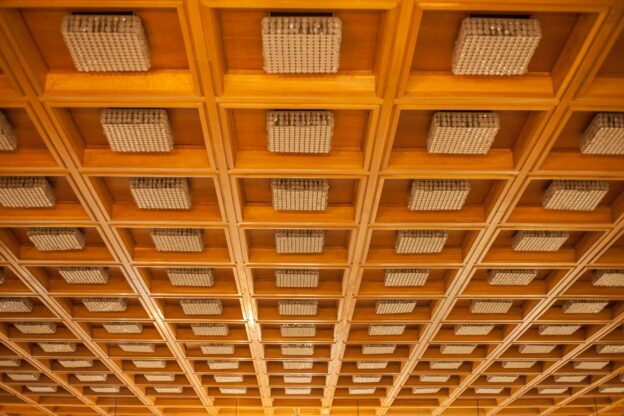
Kengo Kuma and Associates has unveiled Earth / Tree, an immersive installation at Copenhagen Contemporary that merges Japanese spatial philosophy with Danish material craft. The exhibition, which opened in late March and runs through February 2027, transforms one of the art centre’s old industrial halls into something elemental — a space that evokes what it feels like to stand beneath a tree canopy, feet grounded on earth.
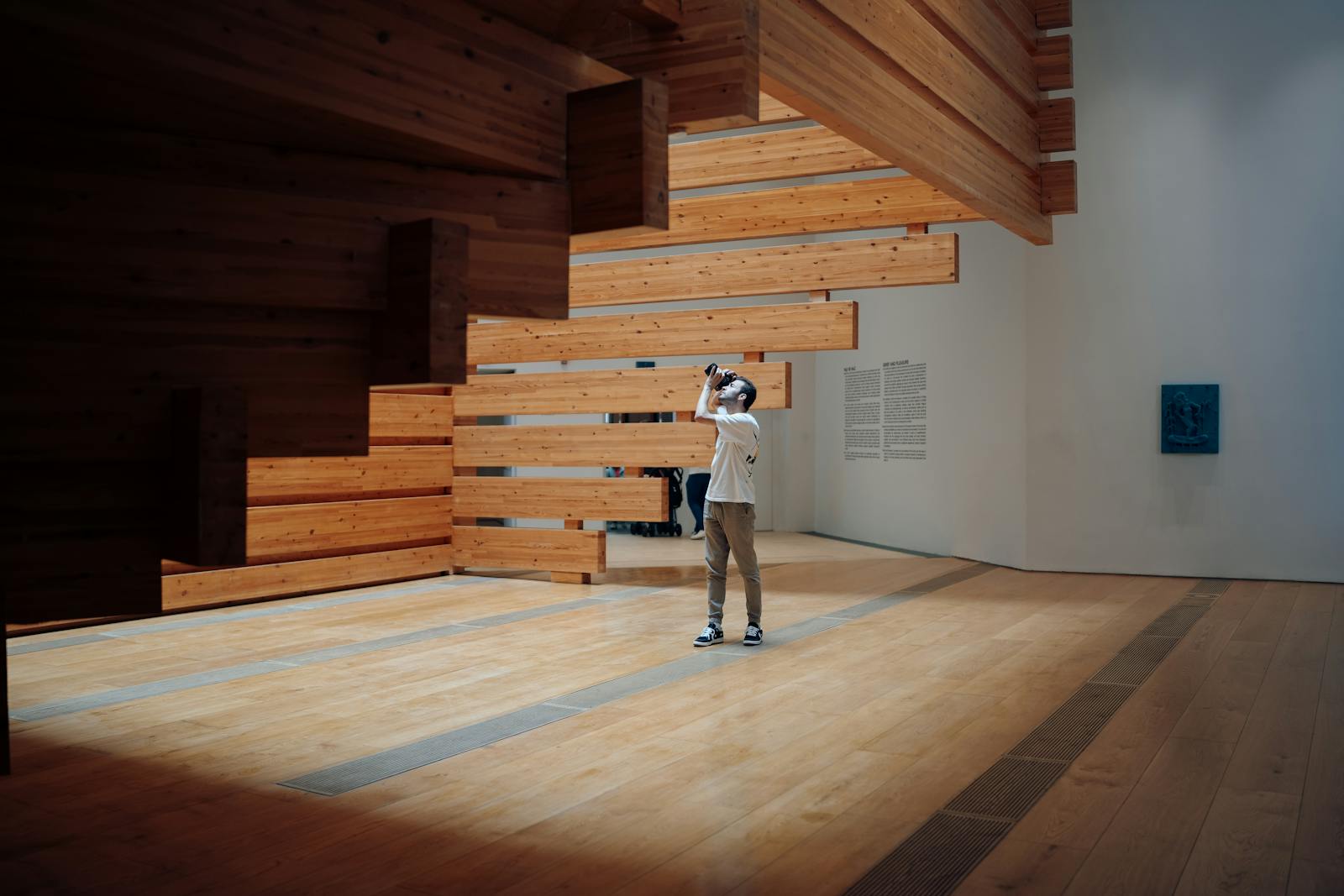
The project is anchored in the Japanese concept of komorebi, the interplay of shadow and light created when sunlight filters through leaves. It’s a word that doesn’t translate neatly into Danish or English, which is part of the point. The installation aims to create an architectural ‘komorebi,’ evoking sensorial moments beneath suspended wood above a brick foundation.
Timber Above, Brick Below
The installation’s structure is deceptively simple in concept: a suspended wooden ceiling hovers above a floor laid with brick. The ceiling mimics a canopy, filtering the hall’s industrial light into softer, dappled patterns. Below, the brick surface provides a tactile counterpoint — solid, grounding, and unmistakably Nordic in character.
The materials make the cultural exchange tangible. Wood was sourced from Dinesen, a Danish manufacturer known for its wide-plank flooring and long-standing collaborations with architects and artists. For Dinesen, working with artists is central to its identity — each collaboration brings unique stories to the material itself. Brick came from a Danish producer whose handmade bricks are a staple of Nordic architectural projects. Both are companies whose entire identity is built on the idea that materials carry meaning — that a plank of Douglas fir or a hand-fired brick isn’t just a building component, but a cultural object.
A Social Dimension Built Into the Making
One of the more quietly significant details of the project is that the wood used in the installation was processed in collaboration with a Danish educational institution as part of an initiative to empower students with special needs. This wasn’t an afterthought or a CSR footnote. The students’ involvement was integrated into the production phase itself, meaning the material visitors encounter in the gallery carries a social story alongside its physical one.
This kind of embedded social practice — where inclusion is woven into the making rather than added as a programme note — reflects a broader trend in Nordic cultural institutions toward participatory and socially engaged production processes. It also aligns with Kuma’s longstanding interest in architecture as a communal act rather than a purely aesthetic one. Taken together with the Dinesen timber and handmade brick, the installation becomes a portrait of a specifically Danish way of making: craft-driven, socially conscious, materially honest.
Where Japanese Philosophy Meets Nordic Craft
Cross-cultural design projects can easily tip into superficiality — a bit of wabi-sabi sprinkled onto Scandinavian minimalism for marketing purposes. Earth / Tree works differently because the overlap between Japanese and Danish approaches to materiality is genuine and specific. Both traditions place enormous weight on the integrity of natural materials. Both are suspicious of ornamentation for its own sake. And both have a deep, sometimes spiritual relationship with wood.
Kuma established his practice in 1990 and has built a career on what he describes as architecture that opens up new relationships between nature, technology, and human beings. The Tokyo-based firm has projects underway in numerous countries and has consistently returned to wood, stone, and other natural materials as a counterpoint to the steel-and-glass dominance of contemporary architecture. In the context of Earth / Tree, that career-long conviction meets a Danish material culture that shares its premises — which is what gives the installation its coherence rather than the feeling of a borrowed aesthetic.
The Interactive Workshop
Earth / Tree is not a look-but-don’t-touch installation. A dedicated workshop section invites visitors into creative play, featuring a sand pit and building blocks that allow people to construct their own miniature landscapes. The intent is to collapse the boundary between spectator and participant, giving visitors agency over their spatial experience.
For families and younger visitors, this is likely to be the draw. For anyone interested in architectural thinking, it’s an invitation to engage with the same fundamental questions the installation poses on a larger scale: how do materials shape space? How does a canopy change the way you move through a room? What happens when you build something with your hands instead of just looking at what someone else has built?
Why Copenhagen, Why Now
Copenhagen Contemporary, located in the Refshaleøen district, has carved out a reputation for large-scale, immersive exhibitions that use its former industrial spaces as canvases. The venue’s raw, high-ceilinged halls lend themselves to projects that play with volume and light — exactly the conditions Earth / Tree requires.
The installation arrives at a moment when Copenhagen’s cultural calendar is increasingly international in scope without losing its local grounding. For those keeping track of Denmark’s annual cultural events, Earth / Tree is worth marking: its nearly year-long run means there’s no rush, but the installation is the kind of experience that rewards an early visit, before familiarity dulls the initial sensory impact.
What makes this project worth paying attention to isn’t the prestige of the architect — though Kuma’s reputation certainly amplifies its visibility. It’s the specificity of the cultural exchange. Danish timber and brick, processed partly by students with special needs, shaped by a Japanese firm chasing the untranslatable quality of light through leaves. The result is an installation that doesn’t explain the connection between these two cultures so much as build it, literally, and let you walk through it.
Photo by Rainer Eck on Pexels