
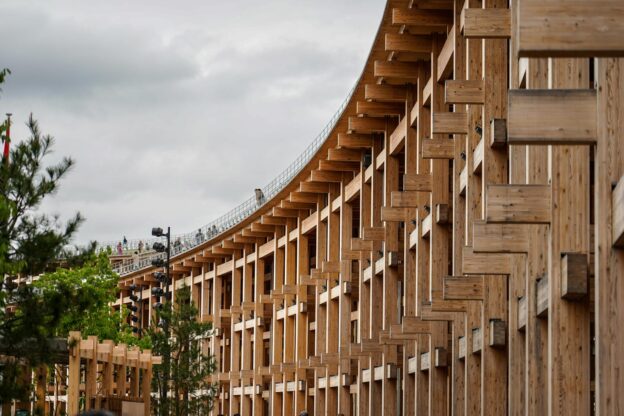
A Norwegian architecture firm just built a power plant on the Dunkirk waterfront — one that also happens to house offices, labs, and a startup incubator. Écosystème D, designed by Snøhetta in collaboration with French practice Santer Vanhoof, is a timber-framed positive energy building that generates more electricity than it consumes, feeding the surplus directly into the surrounding port. It’s the clearest case yet that Nordic architecture’s real export isn’t minimalism — it’s the ability to make buildings perform as energy infrastructure.

A Building That Gives Back to the Grid
The concept of a “positive energy building” sounds like marketing speak until you look at the numbers. Écosystème D’s faceted roof reportedly carries photovoltaic panels that produce more electricity than the building consumes. The surplus doesn’t just sit idle — it flows directly into the surrounding port development, which is being reimagined as an innovation hub focused on energy transition.
That makes this more than a well-insulated workspace with solar panels bolted on top. The building is, in effect, infrastructure — a piece of the port’s emerging energy network that happens to also house people and ideas. And the fact that a French industrial port turned to an Oslo-based firm to deliver it tells you something about where the real expertise in integrated energy design now sits.
The Nordic Advantage: Climate as a Design Driver
Anyone who has stood on the Dunkirk seafront in winter knows the wind is relentless. Rather than fight it, Snøhetta reportedly used it as a design driver — an instinct honed by decades of building in Norway’s equally punishing conditions. The building’s angular roof rises and falls in height, its geometry shaped by prevailing winds off the port. The varying roofline responds to the functional needs of different interior spaces — taller where the technology hall requires volume, lower where more intimate workspaces sit.
The roof’s faceted planes do double duty: they orient the photovoltaic panels for maximum solar capture while simultaneously deflecting wind loads. Form follows physics. This is the same logic behind Snøhetta’s Powerhouse series in Norway, where the firm proved that even in Nordic latitudes with limited winter sun, buildings could be engineered to achieve net-positive energy over their lifetimes. Écosystème D takes that proven methodology — optimising every surface for energy harvest, minimising every joint for thermal loss — and transplants it to a different coastline. The climate is milder, but the wind exposure and industrial context present their own constraints. What travels is the design philosophy: treat hostile weather as raw material, not as a problem to seal out.
Performance Over Aesthetics
The building envelope reportedly features triple-glazed windows, high-performance insulation, and joinery engineered for thermal efficiency — specifications that read like standard practice in Scandinavia but remain uncommon in French commercial construction. The timber structure keeps embodied carbon significantly lower than a steel or concrete equivalent. Norwegian firms have been building with engineered timber at scale for over a decade, from Mjøstårnet in Brumunddal to Treet in Bergen, developing supply chains and structural expertise that most other countries are only beginning to catch up with. In Dunkirk, that head start translates directly into a building that could be erected faster and with a fraction of the carbon footprint of the concrete structures surrounding it in the port.
At the building’s centre sits a planted courtyard, which serves both as a natural ventilation mechanism and a communal gathering point. The courtyard brings daylight deep into the floor plan and creates a sheltered microclimate within the angular exterior — a strategy familiar from Nordic institutional buildings, where maximising internal daylight is a non-negotiable design principle driven by long, dark winters. In Dunkirk, the same technique solves a different problem: reducing artificial lighting loads to keep the building’s energy balance firmly in the positive.
What Happens Inside
Écosystème D isn’t a showcase building meant to be admired from the outside. Its programme is deliberately functional: a technology hall for renewable energy research, an incubator for startups working on energy transition, a training centre, a showroom, and collaborative workspaces. The building exists to accelerate the development and deployment of clean energy technology in the Dunkirk port region.
The collaboration between Snøhetta and Santer Vanhoof is itself instructive. Nordic firms expanding abroad increasingly partner with local practices — not as a courtesy but out of necessity. Santer Vanhoof, with operations in the Hauts-de-France region, brings the knowledge that matters when you’re building on a working port: industrial regulations, municipal politics, regional supply chains. Snøhetta brings the energy modelling, the timber engineering expertise, and a track record of delivering buildings that actually hit their net-positive targets. It’s a division of labour that suggests how Nordic architectural influence will continue to scale: not through branch offices, but through partnerships where Scandinavian environmental performance methodology meets local execution.
Photography for the project was handled by Nicolas Fussler.
Exporting the Powerhouse Model
Positive energy buildings remain rare. The idea that a building should generate more power than it uses has been technically achievable for years, but economics, regulation, and inertia have kept most construction well behind what’s possible. Norway has been the primary testing ground for cracking these barriers. Snøhetta’s Powerhouse collaborations — with Entra, Skanska, and environmental consultancy Asplan Viak — produced net-positive buildings in Trondheim, Porsgrunn, and Telemark that proved the model could work commercially, not just as demonstration projects. The data from those Norwegian buildings is what makes Écosystème D credible: the energy modelling has been validated in harsher climates with less sun.
Écosystème D represents the next step: exporting that proven model to an industrial context outside Scandinavia, in a port city actively transitioning its economic identity. Dunkirk’s port is being reimagined as an innovation hub, and having a building that literally powers its neighbours changes the conversation about what sustainable development looks like in practice. If every new building in the port’s development plan followed this model, the district could approach energy self-sufficiency — a prospect that owes more to a decade of trial and error in Norwegian construction than to any single French policy initiative.
This is where Nordic architecture’s competitive advantage now clearly lies — less in minimalist beauty, more in the hard integration of energy systems, material intelligence, and climate-responsive form into a single coherent structure. When a French port authority needs a building that functions as both workspace and power source, it turns to Oslo. That pattern is repeating across Europe, from Snøhetta’s commissions to projects by Danish and Swedish firms winning work on the strength of their environmental engineering. Scandinavian design’s most consequential export in the 2020s isn’t furniture or lighting — it’s the ability to make buildings that give back more than they take.
The Bigger Picture
Écosystème D is a relatively small building by commercial standards. Its significance lies less in its scale than in its proposition: that new buildings in industrial zones should contribute energy to their surroundings rather than just consume it. If that idea takes hold — and if the Norwegian-developed positive energy model continues to prove replicable across borders and climates — the implications for port developments, logistics hubs, and industrial campuses across Europe are substantial.
For now, it sits on the Dunkirk waterfront, its angular roof catching the wind and the sun, quietly producing more than it takes. That’s a good building. It’s also a Nordic argument about what buildings should do — one that’s getting harder to ignore the further it travels from Scandinavia.
Photo by Ashar Mirza on Pexels