
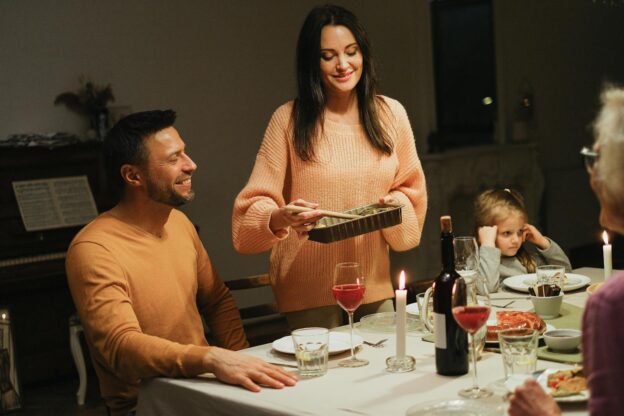
Most people assume that confidence is the thing that emerges from a good childhood. That the adults who grew up in stable, connected homes become the loudest, the most self-assured, the ones who walk into rooms already knowing they belong. But what I keep noticing, in Copenhagen and elsewhere, is something quieter. The people who sat down with their families every night for dinner don’t necessarily radiate confidence. What they radiate is calm. And it doesn’t become obvious until their thirties, when everyone else starts running out of whatever fuel they were using to fake it.
This article is about a specific mechanism: how the repetition of uneventful family meals builds emotional regulation skills that remain invisible until life demands them. Not the mythology of the family dinner. The actual thing it trains into your nervous system, and why it takes three decades to see the results.
What dinner was actually training
The specific research on family meals is less romantic than the cultural mythology suggests. A study published in the Journal of Aggression, Maltreatment & Trauma, led by Dr. Margie Skeer at Tufts University School of Medicine, analyzed survey data from over 2,000 adolescents and their parents. Higher quality family dinners were linked to a 22-34% lower prevalence of substance use among teens who had experienced no or low-to-moderate adverse childhood experiences.
The study didn’t measure calm. It measured something adjacent: whether kids were less likely to self-medicate. And the mechanism Dr. Skeer identified wasn’t the food or the table or the candles. It was routine communication. She pointed out that the meal can be as simple as a caregiver and child standing at a counter sharing a snack. The point is the regularity of showing up and talking.
National Geographic published a piece on communal dining and the loneliness epidemic that deepened this for me. The physical act of sharing food with people you know well appears to create a specific kind of social bonding that other shared activities don’t replicate as effectively. Part of the explanation is biological. Eating together slows you down. Your parasympathetic nervous system activates. You’re literally digesting, which requires your body to shift out of fight-or-flight. Doing this repeatedly in the company of the same people, at the same time, in the same place, builds an association between those people and a state of physiological rest.
So there are two layers. The Tufts research points to routine communication as a buffer against self-destructive coping. The communal dining research points to a physiological mechanism: repeated meals with safe people literally train your nervous system toward rest. Put them together and what you get isn’t a warm feeling about family togetherness. It’s a specific skill. The skill of being in a room with other people and not needing the interaction to escalate, resolve, or perform anything in order for your body to feel safe.
Kids who grow up with that association carry it into adulthood as a kind of baseline. Not happiness, exactly. Settledness. A body that knows what rest feels like because it practised rest in company for fifteen years before leaving home.
What this looks like in practice: the Danish structure
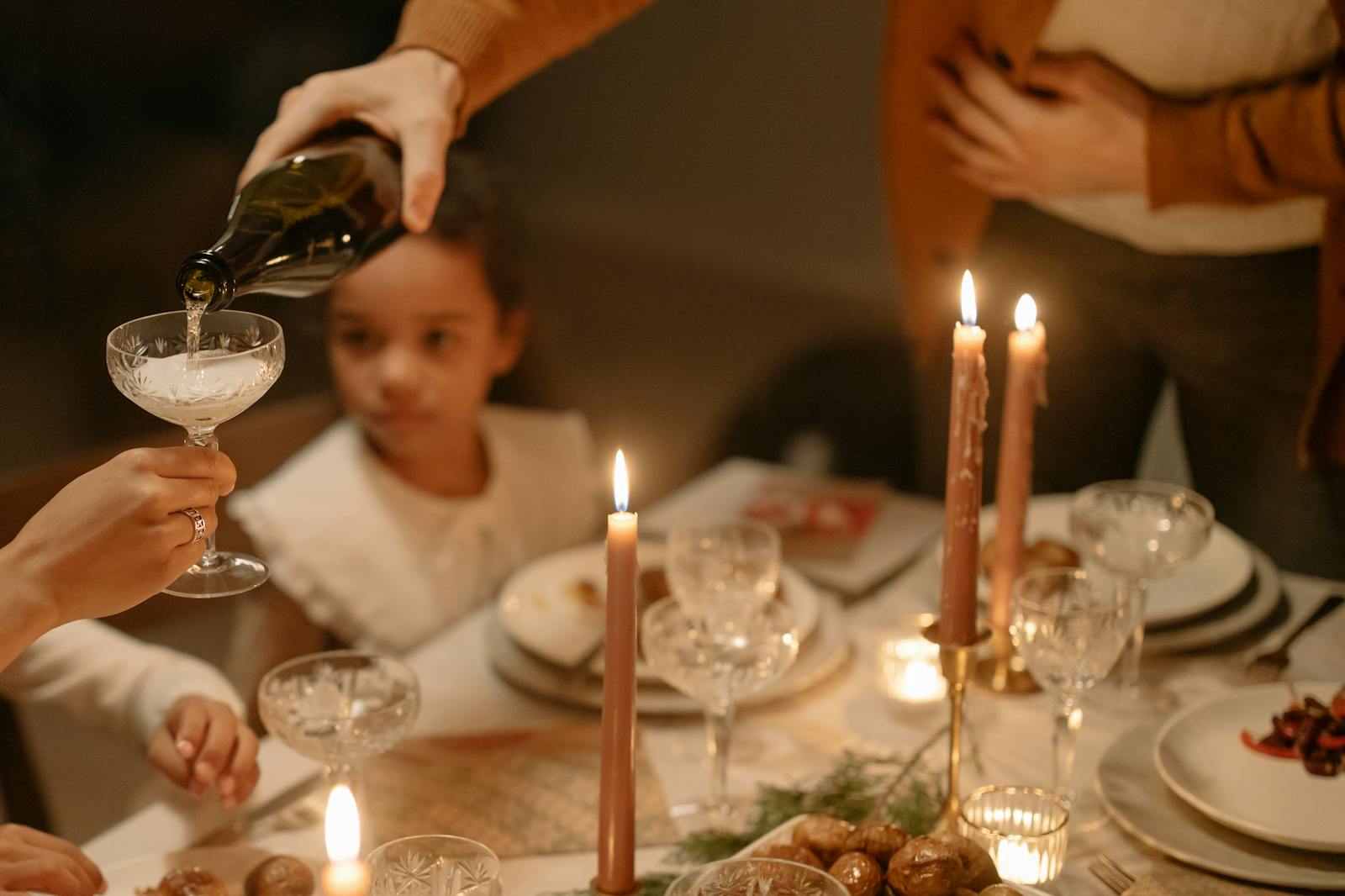
I’ve lived in Copenhagen for a decade now, and one of the things that took me longest to understand is that the evening meal here isn’t an event. It’s a structure. My partner’s mother taught me to cook traditional Danish food, and the thing that struck me wasn’t the recipes. It was the tempo. Everything is built around sitting down together at a specific time. The food is warm. The lighting is low. People eat slowly.
When I first arrived from Melbourne, I thought this was charming. A cultural quirk. A few Danish winters later, I understood it differently. A dinner with my partner’s family during the darkest weeks of January made me realise that the candles, the warm drinks, the gathering together: these aren’t aesthetic choices. They’re psychological infrastructure. They’re how Danes get through months of darkness without falling apart.
That reframing connected directly to the research. The regularity isn’t about tradition for tradition’s sake. It’s a rhythm that teaches your nervous system something about predictability and safety, long before you have the vocabulary to understand either concept. I wrote recently about how the people who thrive in Scandinavian winters treat darkness as furniture, not as something to defeat. The family-dinner calm operates on a similar principle. Silence at the table was never a problem to solve. It was just part of the meal.
I notice it at dinner parties in Copenhagen. Some people can sit through a lull in conversation without generating anxiety in everyone around them. They don’t rush to fill the gap. They don’t perform enthusiasm to keep the energy up. They just keep eating, and eventually someone says something, and the conversation resumes at its own pace. This is distinct from introversion. Plenty of extroverts have this quality. It’s not about how much energy you get from being around others. It’s about whether you need the interaction to be performing something in order to feel safe in it.
Why the thirties are when the skill becomes visible
Your twenties are mostly spent performing. Performing competence, performing independence, performing the version of adulthood you think other people expect. The fuel for that performance comes from many places: ambition, anxiety, caffeine, the adrenaline of being new at everything. In your twenties, everyone looks roughly the same level of functional because the context demands performance from everyone equally.
By your thirties, the performance budget runs low. You stop being new at your job. Your friendships settle into patterns. The relationships that survive are the ones where you can be boring together without panic. And this is where the family-dinner people become visible, because they already know how to be boring together. They learned it young. The coping strategies of the twenties start showing their seams. The people who powered through on charm start losing the thread. The people who avoided vulnerability start paying for it in their relationships. The people who used work as a substitute for identity hit the wall where the work stops being enough.
Meanwhile, the people with fifteen years of practiced emotional regulation at the dinner table don’t hit the same wall, because they weren’t performing in the first place. They were drawing on a different resource: a nervous system that had learned, through thousands of unremarkable evenings, that the absence of stimulation is not the same as the absence of safety.
There’s a well-known study by Justin Kruger and David Dunning, published in the Journal of Personality and Social Psychology in 1999, which found that people who scored in the bottom quartile on tests of humour, logic, and grammar dramatically overestimated their own abilities, while top performers slightly underestimated theirs. The part that interests me is the underestimation at the top. People who are actually good at something tend to assume that everyone else finds it equally easy. This maps onto the family-dinner calm in a specific way. People who grew up with stable, connected evenings don’t think of their emotional regulation as a skill. They think it’s normal. They assume everyone can sit quietly through a difficult moment without escalating. When they discover, usually in their thirties, that not everyone can do this, the reaction is confusion rather than pride.
That confusion is part of what makes the skill finally visible. By thirty-five, you’ve been in enough work meetings, enough relationships, enough low-stakes social situations to notice who can tolerate ambiguity and who needs immediate resolution. The family-dinner people tend to wait. They let things sit. They don’t mistake patience for passivity. And they have no idea they’re doing anything unusual.
When the mechanism breaks down
Dr. Skeer’s study at Tufts included an important caveat. The protective effects of family meals did not hold for adolescents who had experienced significant childhood adversity. Teens who had endured more serious stressors, including domestic violence and physical or sexual dating violence, did not show the same benefit from regular meals. They needed more intensive and trauma-informed approaches.
This is worth sitting with. The family dinner isn’t magic. It works when the family around the table is a source of safety. When the family itself is the source of harm, the meal becomes another context for vigilance rather than rest. The calm I’m describing isn’t produced by the table. It’s produced by what happens at the table, and that depends entirely on who is sitting there and what they bring with them.
I think about this when people romanticise the Scandinavian dinner tradition. The structure only works when the people inside the structure are trustworthy. The version of grief that doesn’t get discussed in Nordic culture is the one where everything looks objectively fine, and that includes the beautiful candlelit dinner where nobody is allowed to name what’s wrong. The mechanism is the same in both directions: repetition builds whatever emotional pattern is actually present at the table. If what’s present is warmth and safety, you get regulation. If what’s present is control and silence, you get a different kind of training entirely.
The skill can be built later — but it’s built differently
If you didn’t grow up eating dinner with your family, this article might feel like a door closing. Here’s another person explaining a benefit you can’t retroactively acquire. I don’t think that’s quite right, but I want to be honest about the difference.
Research on critical periods of brain development, published in Frontiers in Cellular Neuroscience, shows that while certain windows of heightened plasticity close after childhood, the brain retains sensitive periods where experience can still reshape patterns, though more slowly and with more effort. The architecture laid down in childhood is strong, but it’s not the only architecture the brain can build.
The calm I’m describing was built through two ingredients: repetition and safety. Those are available to adults, but they require deliberate construction rather than passive absorption. You can build your own version of the regular meal: same time, same people, same low-stakes presence. It won’t feel natural at first. It might feel aggressively boring. That’s actually diagnostic. If sitting in a quiet room with people you trust, eating simple food, feels unbearable, that discomfort is the exact edge where the skill starts to develop. The boredom is the training stimulus.
My partner’s family didn’t know they were giving him a therapeutic intervention. They were having dinner. That’s what makes it powerful and also what makes it frustrating to discuss. The most effective emotional training often doesn’t look like training at all. It looks like carrots and potatoes and someone asking how school was.
The unremarkable gift
I’ve written before about how people who leave Scandinavia and come back say it wasn’t the healthcare or the design they missed, but the silence nobody expected them to fill. The family dinner works on the same principle. The gift isn’t the conversation. It’s the fact that conversation was never required for belonging. You belonged because you showed up. And the food was warm. And someone else was there too.
Ask the people who have this calm what their childhood was like and they’ll say something vague. Fine. Normal. Nothing special happened. That’s the tell. Because the nothing-special was the thing. The regular, unremarkable, uninterrupted presence of family around a table, eating food that didn’t need to be remarkable either. Thousands of repetitions of a single lesson: you are safe here, and you don’t need to earn it.
That’s the whole technology. It takes about thirty years to realise you were lucky enough to have it. And if you weren’t, it takes about the same amount of time to build it on purpose — one boring, candlelit, stubbornly ordinary dinner at a time.
Photo by Anna Shvets on Pexels