
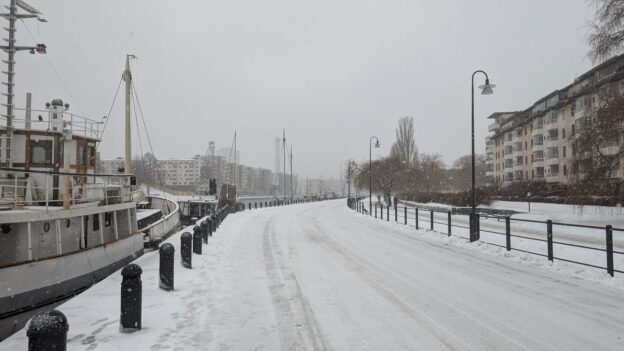
When Scandinavians compare hardship to weather, they’re not being poetic. They’re drawing on something literal. The Nordic countries sit at latitudes where the difference between a December day (roughly six hours of grey light in Copenhagen, less in Helsinki) and a June day (nearly eighteen hours of sun) is extreme. You cannot live at these latitudes without developing a felt understanding that conditions change. Darkness is real, but it is temporary. This isn’t optimism. Optimism says things will be fine. The weather metaphor says things will be different.
A Copenhagen kindergarten teacher I know through my children’s school lost a promotion she’d spent two years positioning herself for. She found out on a Thursday morning via a three-line email from her kommune. That evening she picked up her kids, made frikadeller, helped with homework, and went to bed at the usual time. She wasn’t performing stoicism. She wasn’t suppressing grief or anger. She genuinely seemed to treat the disappointment as atmospheric, something that had rolled in and would, with time, roll out. I’ve seen this posture so many times among Danes and Finns and Norwegians that I’ve stopped thinking of it as temperamental. It’s structural. It’s trained. And it has consequences, both good and complicated, that are worth taking seriously.
A metaphor that isn’t really a metaphor
The distinction between optimism and the weather frame matters. Optimism makes a promise about outcomes. The Nordic frame makes a promise only about change itself. Bad weather doesn’t mean the next season will be glorious. It means this particular configuration of cold and wind is not permanent. That’s a more modest claim, and perhaps for that reason, a more durable one.
Art historians have explored how Nordic painters depicted darkness not as an enemy to overcome but as a season to be occupied, and what struck me about these works was how the artists portrayed winter landscapes. The paintings aren’t cheerful. They aren’t grim either. They’re patient. That patience, I think, is what Mette was channelling. Not a belief that things would be fine, but a discipline of staying present in a bad stretch without assuming it defines everything that follows.
The difference between endurance and numbness
There’s a version of this that tips into something less healthy. The specific calm that Scandinavian people carry can look like peace from the outside but is really a practiced discipline of not making your problems everyone else’s problem. The line between that discipline and emotional suppression is thinner than we sometimes admit.
Research in psychology has examined what some scholars call normative male alexithymia: a difficulty in identifying and expressing emotions that results not from pathology but from decades of socialization telling people that vulnerable feelings are a problem to be solved, not experienced. The term alexithymia refers to having difficulty with emotional awareness. Studies have suggested this pattern is trained through socialization, not inherent. Evidence indicates that boys begin life more emotionally expressive than girls, but by school age, socialization has often reversed the pattern.
Nordic cultures of the mid-twentieth century delivered a particularly concentrated version of this training. The Scandinavian welfare state was built by a generation that had survived occupation, poverty, and the psychological strain of wartime neutrality (or in Finland’s case, two brutal wars with the Soviet Union). Their children, the generation that built the golden age of the Nordic model from the 1960s through the 1980s, inherited a deep suspicion of emotional display. You didn’t burden others. You managed. You were, as the Danes say, “rolig.” Calm. Steady. Sorted.
This is the emotional architecture I grew up inside in Aarhus. My parents’ generation didn’t talk about feelings as a matter of principle. The cultural instruction was clear: handle it privately, don’t escalate, move forward. And much of the time, this actually worked. Danes of that generation are remarkably capable people. But research suggests that this kind of emotional restriction can be negatively correlated with relationship satisfaction and positively correlated with fear of intimacy. The capacity to endure is real. The cost is also real.
Variations on endurance: sisu and the Nordic spectrum
My wife is Finnish, an academic, and we’ve spent years comparing notes on how our two countries process difficulty. The Finns have a word that sharpens the distinction I’ve been drawing: sisu. It roughly translates as gritty determination, a willingness to persist through conditions that seem impossible. Scholars have examined why sisu matters as a concept for getting through tough times, and the Finnish relationship with this quality is complex.
Sisu is celebrated in Finland as a national virtue. But my wife has pointed out, with characteristic Finnish directness, that sisu also makes it difficult for Finns to ask for help. If your cultural identity is built around enduring, then needing support feels like a failure of character. The weather metaphor as practiced in Denmark and Norway is healthier than sisu in one specific way: weather passes on its own. You don’t have to be heroic. You just have to wait. Sisu asks you to push through. The Danish and Norwegian version, closer to what Mette expressed, asks you to simply be present while the storm runs its course.
The gap between those two postures looks small. In practice, it’s significant. Pushing through implies agency, effort, will. Waiting implies acceptance. These are variations on the same Nordic inheritance — the conviction that difficulty is normal and survivable — but they place very different demands on the person inside the storm. The Finnish model risks exhaustion and isolation; the Danish and Norwegian model risks passivity and denial. Both emerged from the same postwar emotional culture, the same suspicion of complaint, the same generations shaped by war and scarcity. But the Finnish version added an element of heroic endurance that the western Scandinavian version mostly did without. The Nordic approach to disappointment, at its best, is closer to acceptance than to effort. But acceptance is harder than it sounds, because it requires you to sit with discomfort without doing anything about it.
How the welfare state shapes emotional weather patterns
Part of what makes this weather-oriented mindset possible in Scandinavia is that the consequences of bad outcomes are genuinely cushioned. Losing a job in Denmark is painful, but the Danish flexicurity system provides substantial unemployment benefits for lower earners, combined with active labour market programmes designed to get people back into work quickly. Losing a partner doesn’t mean losing healthcare. A failed business doesn’t mean personal bankruptcy in the American sense.
This matters for how people relate to disappointment. When the floor under you is solid, you can afford to treat setbacks as weather. When there’s no floor, every setback feels existential. The Nordic model doesn’t eliminate suffering, but it reduces the catastrophic tail risks that make disappointment spiral into despair. I wrote recently about financial habits among Scandinavian men in their forties that look boring but build real freedom, and the same logic applies here. When you’ve constructed a stable base, financial or institutional, the volatility of life feels less threatening.
This is the part that outsiders often miss. They see Nordic calm and attribute it to cultural character, to something deep in the Viking DNA or the Lutheran temperament. But a lot of it is policy. It’s easier to be philosophical about a job loss when you know your children’s daycare is still covered. It’s easier to treat disappointment as temporary when the structures around you are designed to prevent temporary problems from becoming permanent ones.
The generational shift beneath the surface
Something is changing, though, and I see it in my own household. My children (eight and eleven) are growing up in a Denmark that talks about emotions far more openly than the one I grew up in. Their school has structured sessions on social-emotional learning. They know words like frustration and anxiety as part of their everyday vocabulary. They have language for what they feel in a way that my parents’ generation absolutely did not.
The Swedish approach to raising resilient children, as parenting expert Linda Åkeson McGurk has described it, includes a concept called friluftsliv (open-air living), which encourages kids to spend time outdoors in all conditions. The lesson embedded in that practice is exactly the weather metaphor made physical: you go outside when it’s cold, when it rains, when conditions aren’t ideal. You don’t wait for perfect weather. You develop the clothing and the habits that let you function regardless. McGurk has argued this builds a kind of emotional resilience alongside the physical kind.
The tension I notice in the current generation is between this inherited weather posture and a newer, more expressive emotional culture imported partly from American therapeutic language. Young Danes talk about boundaries. They talk about mental health. They use the word toxic with a fluency that would have baffled my parents. Some of this is genuinely healthy. Some of it, I think, tips into a kind of emotional inflation where every inconvenience becomes a crisis.
The older Nordic approach risked numbness. The newer one risks fragility. The question is whether there’s a middle ground that keeps the weather metaphor’s wisdom (this will pass, you don’t need to catastrophize) while adding the emotional vocabulary that the older model lacked (and you’re allowed to feel bad while it’s raining).
Resilience as a cultural inheritance, not just a personality trait
Research on the intergenerational transmission of trauma and resilience suggests that both vulnerability and coping patterns pass between generations, through behaviour, through family culture, and possibly through epigenetic mechanisms. Researcher Rachel Yehuda at the Icahn School of Medicine at Mount Sinai has studied how trauma leaves biological traces that can affect offspring, work originally conducted with children of Holocaust survivors but since extended to other populations.
The Nordic countries carry their own intergenerational legacies. Finland’s Winter War and Continuation War. Denmark’s occupation. Norway’s resistance. Sweden’s policy of neutrality and the moral complexity that accompanied it. These experiences shaped the emotional cultures of the postwar period, and those cultures shaped the children, and those children built the societies we see now.
The weather metaphor, in this light, isn’t just a coping mechanism. It’s an inheritance. It’s what a population develops when it has learned, over generations, that darkness comes and goes, that hardship is frequent but not usually fatal, and that the best response to a bad stretch is to keep the house warm, keep showing up, and wait.
Researchers like George Bonanno at Columbia University have found that the most common human response to adversity is not prolonged dysfunction but a pattern he calls resilience, a relatively stable trajectory of healthy functioning after a disruptive event. Most people, in other words, recover. The Nordic cultural contribution to this finding is the idea that recovery isn’t something you have to work at heroically. It’s something that happens if you don’t interfere with it too much.
What the weather metaphor actually asks of you
I’ve been thinking about this since writing my piece on the kind of ambition that doesn’t announce itself, which was really about the Scandinavian preference for steady, quiet accumulation over dramatic gestures. The approach to disappointment works the same way. No grand narratives of triumph over adversity. No motivational speeches. Just a daily practice of continuing to function while something painful processes in the background.
What does this ask of you, specifically? A few things.
First, it asks you not to narrate the disappointment into something bigger than it is. The Danish instinct when something goes wrong is to resist the urge to construct a story about what it means. Job loss doesn’t mean you’re a failure. A broken relationship doesn’t mean you’re unlovable. These are events, not identities. Weather, not climate.
Second, it asks for patience. Real patience, not the performative kind. The willingness to feel bad for a while without treating the feeling as an emergency. A meta-analysis of interventions for improving subjective well-being published in Frontiers in Psychology found that mindfulness-based approaches were among the most effective methods for increasing well-being, and what mindfulness essentially teaches is the ability to observe an experience without immediately reacting to it. The Nordic weather posture is a folk version of that same skill.
Third, it asks you to maintain routine. This is the part that looks cold to outsiders but is actually the mechanism by which the approach works. You keep making dinner. You keep picking up the kids. You keep going to work. These routines are not denial. They’re the structure that holds you while the emotional weather moves through.
The limits of the metaphor
I should be honest about where this breaks down. The weather metaphor works for the ordinary disappointments that make up most of a life: missed promotions, failed plans, relationships that didn’t work out, financial setbacks that sting but don’t destroy. For these, the Nordic approach is genuinely effective. Don’t dramatize. Don’t catastrophize. Keep moving. It will pass.
But some things are not weather. The death of a child is not weather. Serious mental illness is not weather. Systemic injustice is not weather. And the Nordic tendency to treat all difficulty as temporary and manageable can, in its worst form, prevent people from seeking help when they genuinely need it. Scandinavia has some of the highest antidepressant prescription rates in Europe, which tells you that beneath the calm surface, there’s significant pain that this weather-based approach isn’t reaching.
The Janteloven, that famous Danish social code which discourages standing out, applies to suffering too. You’re not supposed to have worse problems than anyone else. You’re not supposed to need more help than average. This creates a subtle pressure to downplay genuine distress, to treat a hurricane as a light rain and carry on.
There’s a Finnish phrase that captures this mindset: hiljaa hyvä tulee (good things come quietly), which reflects a cultural belief in quiet endurance. My wife loves this about Finnish culture and also recognizes it as the reason Finland has one of the highest suicide rates in Western Europe, a rate that has improved significantly over the past three decades but remains a stark counterargument to the idea that treating pain as weather is always sufficient.
Where this leaves us
The Nordic approach to disappointment is, like most Nordic things, genuinely admirable and genuinely incomplete. It works most of the time because most of the time, bad outcomes really are temporary. The promotion goes to someone else. The project fails. The relationship ends. And a year later, the landscape looks different, just as it always does when the seasons change.
The practice is simple to describe and hard to execute: when something bad happens, resist the urge to build a permanent identity around it. Let it be weather. Let it be uncomfortable, cold, dark, inconvenient. But don’t mistake the February sky for the only sky there is.
The weather metaphor’s real strength is that it holds space for both the traditional Nordic emotional discipline and the newer therapeutic vocabulary without fully surrendering to either. My parents’ generation had the discipline but not the language. My children’s generation has the language but is still learning the discipline. The synthesis, if it comes, will look something like this: you name the feeling (the therapeutic contribution), and then you let it pass (the Nordic contribution). You don’t pretend the storm isn’t happening. You also don’t build your house in it.
The sophistication of this posture, when it’s working, is that it combines emotional acknowledgment with temporal perspective. You’re allowed to feel bad. You’re just not required to believe the feeling is forever. That’s not optimism and not stoicism. It’s something quieter than both, shaped by long winters and stable institutions and a cultural memory of darkness that always, eventually, lifts.
Mette, the kindergarten teacher, got a different position four months later. Better hours, closer to home. When I asked if she was happy about it, she responded with the kind of practical, understated acknowledgment common in Danish culture — recognizing the change without excessive celebration. The weather had shifted. She’d noticed. She carried on.
Photo by groundhelio on Pexels