
Most parents around the world would agree that raising a successful child means producing someone who stands out. A child who wins prizes, gets into the best schools, earns more than their peers, and is publicly recognized for exceptional ability. The Scandinavian parenting model is built on a premise that quietly contradicts all of this. The child worth raising is not the one who distinguishes themselves from the group, but the one who can function within it, contribute to it, and still maintain a sturdy sense of who they are when nobody is watching.
This difference is not subtle, and it produces adults who look very different from what parents in the United States, East Asia, or South Asia tend to aim for. The gap is not about love or effort. It is about what constitutes adequate outcomes when a child has grown up.
What Scandinavian Parents Are Actually Optimizing For
If you spend time in Danish, Swedish, or Norwegian classrooms, the thing that strikes you is what’s missing. There are no honor rolls. No public rankings. No “student of the month” photos on the wall. Children are not sorted into gifted and non-gifted tracks at age seven. The absence of these things is not an oversight. It is design.
The Nordic pedagogical model prioritizes play-based learning, emotional development, and social competence over early academic performance. Children in Scandinavian countries typically don’t begin formal literacy instruction until age six or seven. Before that, they spend years in outdoor kindergartens learning to cooperate, resolve disputes, and tolerate frustration.
My two kids, ages eight and eleven, attend schools in Copenhagen that reflect this approach. The older one recently explained to a visiting cousin from Helsinki that you don’t get grades until you’re older, reflecting the system’s emphasis on learning processes over competitive outcomes. She said it without any sense that this was unusual. That’s the system working as intended.
The target outcome is a person who is self-regulating, collaborative, and intrinsically motivated. Not a person who is top of the class. Those two things sometimes overlap, but the system is calibrated for the first, not the second.
Research on what psychologists call “parental meta-emotion philosophy” helps explain why this calibration works. Studies show that parents who practice “emotion coaching” support their children’s emotional regulation, behaviour, and social skills. When a Danish child has a meltdown in a supermarket, the standard parental response is not to punish the behaviour or distract from it, but to kneel down and help the child name what’s happening. This is not softness. It is a very specific skill-building exercise disguised as patience. Parents who dismiss uncomfortable emotions tend to produce children who struggle to regulate themselves. Parents who treat emotions as legitimate information — as Scandinavian culture encourages by default — tend to produce children who can.

Janteloven: The Invisible Curriculum
You cannot understand Scandinavian child-rearing without understanding Janteloven, the “Law of Jante,” a set of cultural norms codified satirically by Danish-Norwegian author Aksel Sandemose in 1933 but rooted in much older social patterns. The core message: you are not better than anyone else. Don’t think you are special. Don’t think you can teach us anything.
Outsiders often read Janteloven as oppressive conformism. From inside, it functions differently. It creates a baseline of social equality that children absorb before they can articulate it. My kids are growing up bilingual in Danish and Finnish, and in both cultures, the child who brags about test scores at dinner is not admired. They are gently corrected. The child who helps a struggling classmate without being asked is the one who gets the approving nod.
As Scandinavia Standard has explored, the confidence that emerges from this system looks like modesty but is actually a kind of strategy. The child raised under Janteloven learns to build social capital through reliability and contribution rather than through display. That’s a different skill set. It produces a different kind of adult. But the pressure is real: children who are genuinely exceptional at something learn to downplay it, and some internalize the message that wanting to be great is the same as wanting to be better than others. I wrote recently about the generation of Scandinavians now entering their forties who grew up with enormous freedom and are now quietly wondering what all that freedom was for. Part of what they’re working through is the tension between the egalitarian ideal and the human need to feel that your particular life has particular meaning.
What This Looks Like in Practice: Risk, Trust, and Outdoor Play
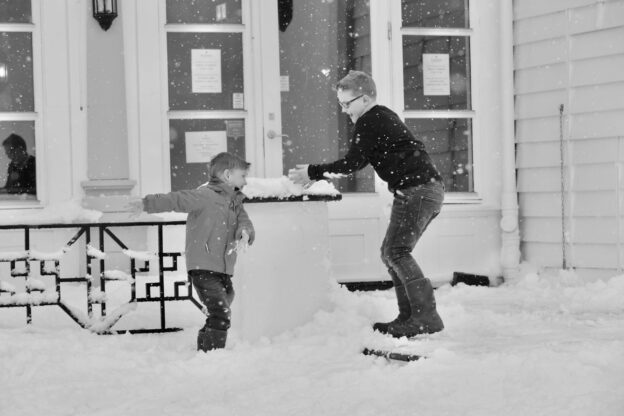
The Atlantic’s 2014 feature on Swedish parenting remains one of the best descriptions of the Scandinavian approach visible to outsiders. Writer Linda Perlstein observed that Swedish parents leave children alone in ways that would cause panic in an American suburb. Babies nap outside in strollers in sub-zero temperatures. Toddlers climb structures that would be fenced off in other countries. Six-year-olds walk to school alone.
This is not neglect or recklessness. It is a calibrated expression of the belief that competence develops through experience, including the experience of minor failure and manageable risk. The parent’s job is not to prevent all discomfort but to create conditions in which discomfort teaches something useful.
The same philosophy extends indoors. Scandinavian parents tend to give children real responsibilities early: setting the table, helping cook, managing small amounts of money. The child is treated as a member of the household with genuine duties, not as a guest being served. This produces a very specific kind of self-reliance, the kind that doesn’t need an audience.
A cross-cultural study published in Frontiers in Psychology compared Danish and American parents’ growth mindsets and home-learning activities and found telling differences in framing even when the activities looked similar. Danish parents might emphasize prediction and imagination in reading activities. American parents might focus on phonetic decoding skills. Both are valid. But they optimize for different things: one for imagination and agency, the other for decoding and accuracy. The academic pressure arrives later in Denmark, and when it does, it arrives within a framework that has already established emotional security and self-direction as the foundation. The house is built before the furniture goes in.
As Scandinavia Standard has written, there is a version of ambition that doesn’t announce itself. It wakes up early, does the work, goes home on time, and builds something real over twenty years. That adult was a child who learned to set the table without being told.
The Shared Parenting Infrastructure
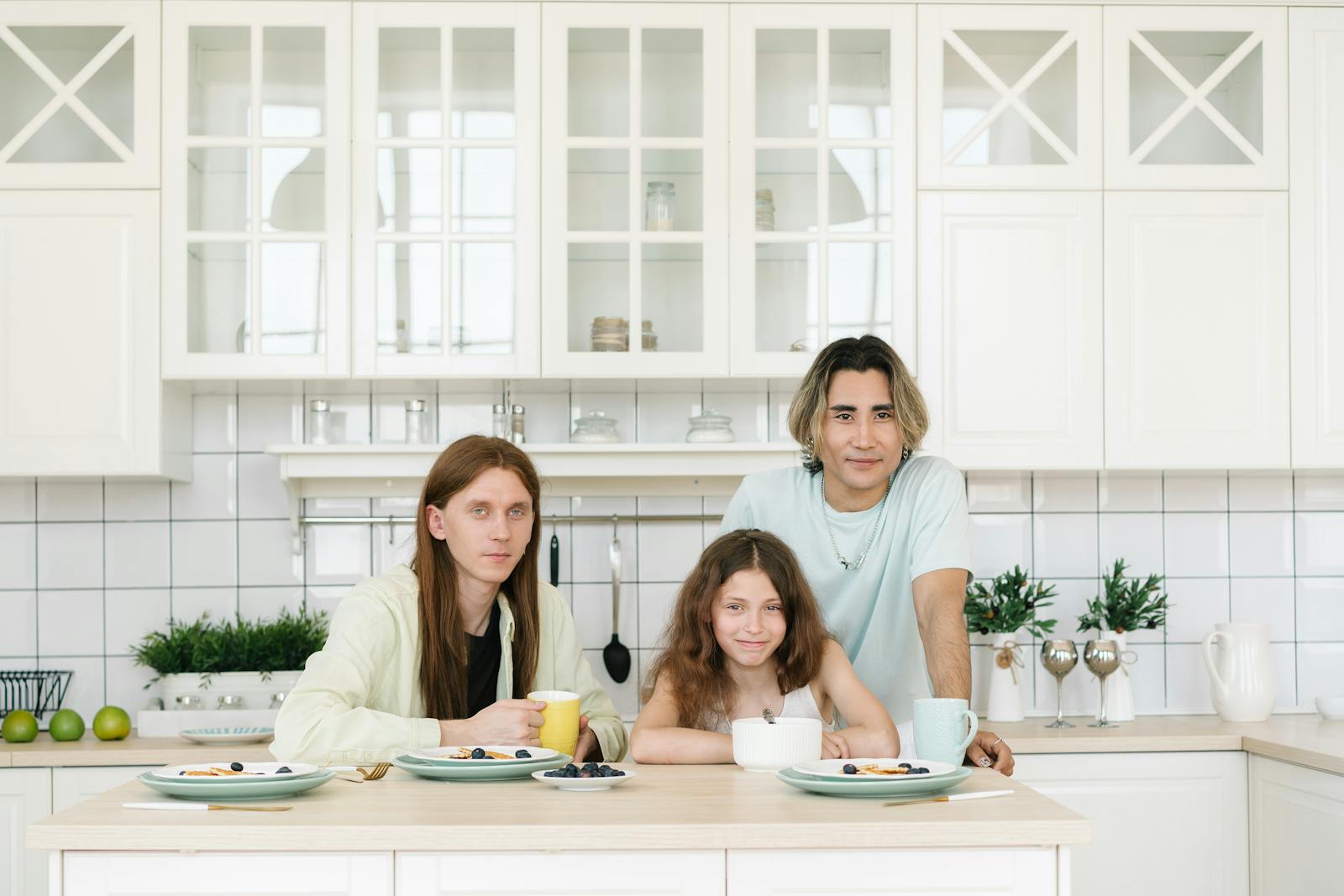
Scandinavian parenting philosophy does not exist in a vacuum. It is supported by policy infrastructure that makes its ideals practically achievable. Denmark, Sweden, and Norway all offer generous parental leave, subsidized childcare, and a cultural expectation that both parents participate actively in child-rearing.
A 2024 study published in Frontiers in Global Women’s Health examined shared parenting and father involvement after divorce in Denmark and found that Danish fathers maintain significant involvement with their children even after separation. Joint physical custody arrangements are common, and the cultural expectation that fathers are equally competent caregivers is reflected in policy and practice.
This matters for child development because it means the parenting model is not resting on the shoulders of one person. When both parents are expected to be emotionally present, to coach feelings, to allow appropriate risk, the child receives a more consistent message about how the world works. The system, the policy, the culture, and the individual family all point in the same direction.
My wife, who is a Finnish academic, and I have discussed this often: the way Danish and Finnish systems support shared caregiving makes the parenting philosophy sustainable in a way it wouldn’t be if one parent were carrying the entire load while the other worked sixty-hour weeks. The philosophy requires time. The policy provides it.
Where the Model Strains
No system produces flawless results, and the Scandinavian parenting model has genuine weaknesses that are worth examining honestly.
The emphasis on group cohesion and emotional regulation can produce adults who are conflict-averse to a fault. I’ve covered Danish domestic politics for years, and one thing that strikes me about Danish public discourse is how rarely people raise their voices, even when they probably should. The same cultural instinct that makes Scandinavian children cooperative can make Scandinavian adults passive when situations demand confrontation.
There is also the question of what happens to children who don’t fit the mold. The system works well for children who are socially intuitive and temperamentally even. For children who are intense, highly competitive, or simply different, the constant message that you should not stand out can be genuinely painful. Some of the most creative and driven Scandinavians I know describe their childhoods as a process of learning to hide the parts of themselves that didn’t match the collective expectation.
The late start on formal academics, too, has critics. While Finnish students famously excel on international assessments despite starting school later, Danish students perform more modestly. The approach works in countries with strong institutional support, but it relies on that support. Export the philosophy without the infrastructure and you get children who are neither academically pushed nor emotionally coached.
A Different Definition of Success
The most honest way to describe the Scandinavian parenting model is this: it is optimizing for a different outcome than most of the world’s parents are aiming for. The successful Scandinavian child grows into an adult who can regulate their emotions, contribute to a group without needing to dominate it, tolerate uncertainty, and find meaning in ordinary work done well.
That adult is unlikely to be the CEO of a multinational corporation. They are unlikely to have a personal brand or a TED talk. They are likely to have a stable job they find reasonably meaningful, a partnership built on equality, a circle of friends they’ve kept for decades, and a fundamental sense that their life is their own.
Whether that counts as success depends entirely on what you think a life is for.
My son is eight. He came home from school last week and told me that his friend had cried during a game because he lost, and my son had sat with him until he felt better. He didn’t tell me this to get praise. He told me because it was interesting to him that someone could feel so bad about losing. I asked him if he ever felt that way. He thought about it and said, “A little bit, but then it goes away.”
That response is not wisdom. It’s an eight-year-old processing the world with tools his culture gave him. But those tools are specific. They were chosen. And they produce a very particular kind of person — one who sits with a crying friend before anyone asks him to, who can name a feeling and let it pass, who does not need to win in order to feel that the game was worth playing. Most parenting cultures would see that boy and want to add something: more drive, more ambition, more edge. The Scandinavian bet is that what he already has is enough, and that enough, built on a solid foundation, is more durable than exceptional.
It is a quiet bet. It does not announce itself. But the societies that have made it consistently rank among the happiest, most trusting, and most equal on earth. That is not a coincidence. It is a return on an investment that most of the world doesn’t recognize as one.
Photo by Chen Te on Pexels