

A cathedral takes decades to build, and most of the work happens underground. The foundation, the drainage, the invisible structural logic that keeps the stone from cracking under its own weight. Nobody photographs the foundation. Nobody writes about the years spent leveling bedrock. But without that work, the spire is just a fantasy sketched on parchment. There is a version of ambition that operates like cathedral-building: patient, unglamorous, and oriented toward a structure that will outlast the builder.
That version of ambition is systematically undervalued. Not because it doesn’t work — the evidence suggests it works better than most alternatives — but because it doesn’t perform well. It doesn’t photograph well. It doesn’t compress into a narrative arc that fits a keynote talk or a LinkedIn post. And so the people practicing it, often the most effective builders in any field, are rendered invisible by a culture that mistakes volume for velocity.
I’ve been thinking about this since I wrote about people in Sweden who simply wanted enough. That piece touched something. The responses I received weren’t from people who lacked ambition. They were from people who had plenty of it but felt that the dominant culture of ambition, the loud kind, the kind that announces itself in LinkedIn posts and career pivots, didn’t describe what they were doing with their lives. They were building something. They just weren’t performing it.

The Quiet Version
The ambition I’m talking about is the kind that wakes up at 6:15 and sits down at a desk before anyone else is awake. It doesn’t hustle. It doesn’t grind. It shows up, does focused work, picks the kids up from school at 15:30, and does it again the next day. Over five years, this looks like nothing. Over twenty, it looks like a career, a body of knowledge, or a business that actually works.
This version of ambition is hard to see because our culture has trained us to look for the dramatic arc. The breakthrough. The pivot. The moment someone decides to quit everything and bet on themselves. Those stories are exciting because they compress years of cause into a single visible effect. But most lasting achievement doesn’t work like that.
Most of it is boring. Productively, usefully boring.
The Counterargument Worth Taking Seriously
There’s a serious case against what I’m describing. As discussed in Psychology Today, some argue that intensity may be better suited for making gains, while consistency helps maintain progress. This framework suggests that most people live in perpetual maintenance mode, doing enough to avoid losing ground but never enough to cross the threshold where real transformation happens. The metaphor is vivid: just as a single lightning strike can alter a landscape while many small sparks dissipate, some believe breakthroughs require concentrated effort rather than distributed effort.
That’s a powerful image. And it’s partly true. Breakthroughs often require concentrated effort.
But here’s what I notice about these examples: the sprints that work are almost always embedded in years of prior steady work. The foundation was already there. The sprint just made it visible. The Psychology Today piece itself acknowledges this: steady habits maintain the new identity, but occasional sprints create it. The sprint matters. But the sprint is only possible because the foundation is there.
A runner who tries to sprint without a base of steady training gets injured. A career built on pure intensity without consistency burns out. The quiet ambition I’m describing isn’t the absence of intensity. It’s the infrastructure that makes intensity possible when it counts.
The Nordic Template
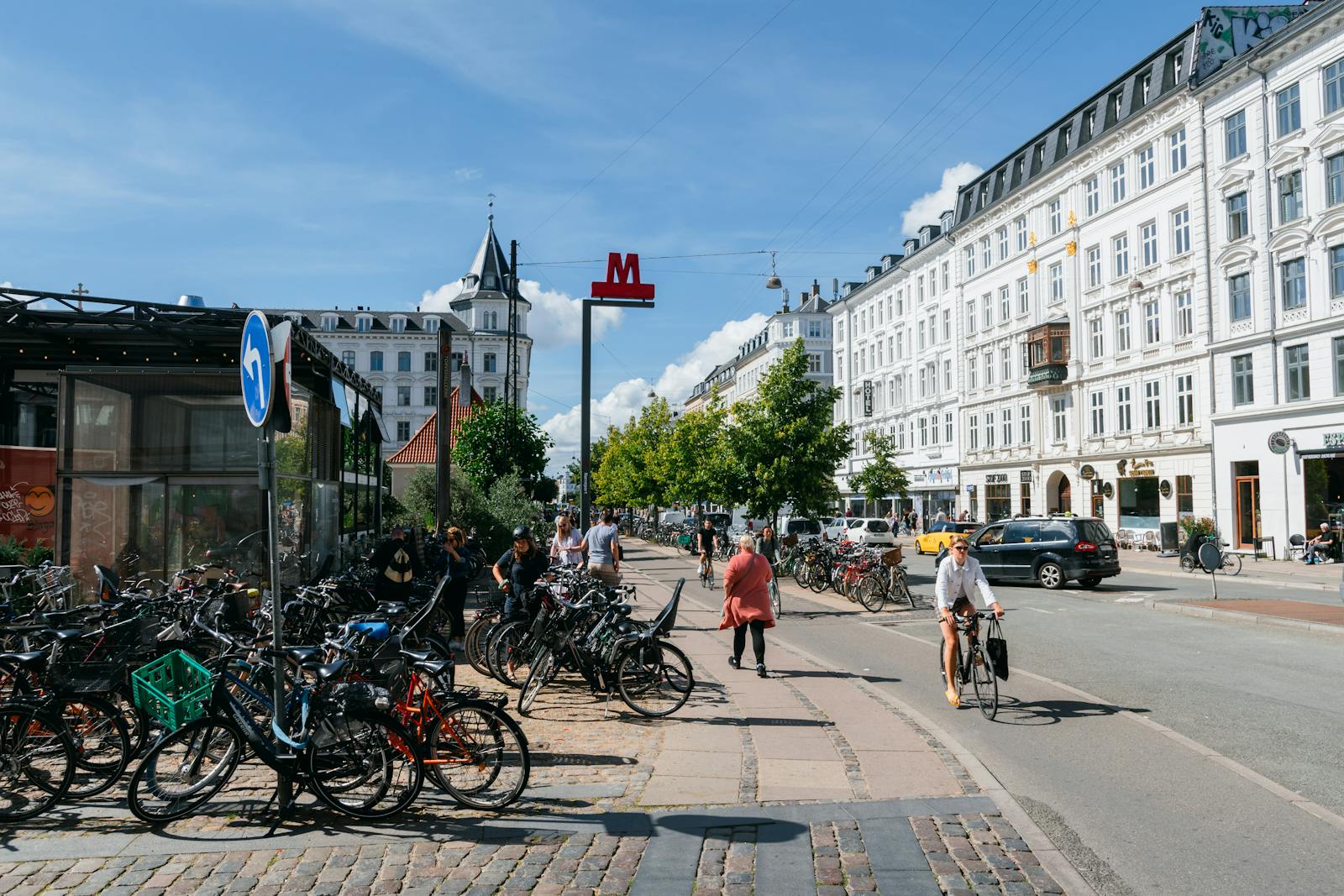
Scandinavian societies are structured around a specific assumption about ambition: that it should be compatible with a full life. Research suggests the Danish working week averages around 33 hours. Parents leave work at reasonable hours. The cultural expectation isn’t that you sacrifice everything for your career. The expectation is that you do your work well and then go home.
This gets misread from the outside as a lack of ambition. It isn’t. Studies indicate Denmark consistently ranks among the most productive countries per hour worked in the OECD. The Danes I grew up around in Aarhus weren’t lazy. They were efficient in a specific way: they front-loaded their focus, protected their energy, and played a long game.
There’s a particular confidence that comes from growing up in a country where showing off is quietly punished. It shapes how people think about achievement. You don’t announce your goals. You don’t perform your work ethic. You just do the work, year after year, and eventually the results speak. Or they don’t, and you adjust.
The cultural machinery behind this, including concepts like Janteloven, the generous parental leave, and the flat hierarchies in workplaces, creates conditions where quiet ambition isn’t just tolerated. It’s the default mode. And the outcomes are measurable.
The Structure That Makes It Possible
Quiet ambition doesn’t just require individual discipline. It requires structural support. This is where the Nordic model has something to teach the rest of the world, and where it occasionally falls short.
When a society provides universal childcare, affordable healthcare, and strong unemployment insurance, it lowers the stakes of patient career-building. You can take risks precisely because the floor is solid. You can work at a moderate pace because you’re not racing to avoid catastrophe. The Danish flexicurity model is designed, whether intentionally or not, to enable exactly this kind of long-term ambition.
But the system has blind spots. Flat hierarchies can become stifling. The cultural pressure not to stand out can suppress the very intensity that some argue is necessary for breakthroughs. And the generous safety net can, in some cases, become a comfortable plateau that people never leave.
The leadership research on long-term transformation that Paola Cecchi-Dimeglio outlines in Forbes emphasizes that lasting change requires clarity, structured planning, and empowerment at every level. The same applies to personal ambition. You need a clear purpose, you need to break the work into manageable phases, and you need an environment that trusts you to execute without constant surveillance. That last point is where Nordic workplaces genuinely excel.
Twenty Years Looks Different Than You Think
I left daily journalism at 39. I’d spent eight years at Berlingske covering Danish domestic policy and EU affairs. I was good at it. The problem was the rhythm. The daily treadmill, the constant reaction, the inability to stay with any question long enough to actually understand it. I was producing noise, not understanding.
When I shifted to long-form writing, the first two years felt like nothing was happening. I was reading, thinking, drafting pieces that took months instead of hours. My output, measured by published words, dropped by probably 90 percent. Measured by the depth of what I was producing, it increased. But that wasn’t visible to anyone, including me, for a long time.
That’s the hard part of this kind of ambition. The feedback loop is long. You don’t get the dopamine hit of publication, or the social proof of a viral post. You get the slow, uncertain feeling of investing in something that might pay off in five years or might not.
I’ve learned to trust that taking time to think produces better work than rushing to publish. But that trust took years to build, and it still wavers on the days when the work feels invisible.
The Compound Effect Is Real, but Misunderstood
There’s a popular idea in productivity culture that small daily improvements compound exponentially. The math is appealing. The psychology is not.
Human progress is lumpy. We plateau. We regress. We have bad weeks. Research published in Frontiers in Sociology on consistency in learning found that consistency of experience matters enormously for long-term development, but that it’s not the same as uniformity. What matters is the repeated engagement, not the steady perfection. You can have inconsistent days and still build consistent habits.
This maps onto professional life in ways that productivity advice rarely acknowledges. The meetings that go nowhere. The draft that gets thrown out. The project that stalls for three months. These aren’t failures of ambition. They’re the texture of long-term work. Most days of a twenty-year project feel grey. That’s not the signal that something is wrong. That’s the signal that you’re doing it right.
The loud version of ambition tells you that grey days are wasted days. The quiet version knows better.
What It Costs
I don’t want to romanticize this. Quiet ambition has costs.
The obvious one is visibility. People who do steady, excellent work for twenty years are often less recognized than people who make one splashy move. Promotion systems in most organizations reward legibility: the person who presents well, who takes on visible projects, who makes sure the right people know about their contributions. The person who just does good work and goes home can be invisible.
There’s a social cost too. When ambition is your identity, it gives you something to talk about. When your ambition is quiet, you sometimes don’t have a ready answer for “what are you working on?” The work is too slow-moving, too incremental, too embedded in context to explain at a dinner party.
And there’s the internal cost of patience itself. As Indian Television Dot Com reported in a column on what endurance sports teach about business growth, the discipline of maintaining effort through long, unrewarding stretches requires a specific psychological skill: the ability to tolerate discomfort without interpreting it as failure.
That’s harder than it sounds.
Going Home on Time
The most radical act in the title of this piece might be the simplest one: going home on time. In cultures where overwork is a status signal, leaving the office at five o’clock looks like a lack of commitment. In Scandinavia, it looks like good judgment.
Going home on time means you’ve structured your day to do your best work within working hours. It means you’ve prioritized. It means you have something worth going home to. And, over twenty years, it means you’ve protected the energy and relationships that make sustained work possible in the first place.
I used to feel guilty about this. During my years at Berlingske, the newsroom rewarded presence. Being there late signaled dedication. When I left for long-form work, I had to retrain myself to believe that finishing at a reasonable hour was not the same as giving up.
It took time. It took trusting that the work would still be there tomorrow, and that tomorrow’s version of me, rested and clear, would do better work than tonight’s version, tired and forcing it.
What It Produces
When I look at what quiet ambition actually produces, the evidence is surprisingly clear. Stable marriages. Deep expertise. Businesses that survive recessions. Children who see their parents present and engaged. Research that accumulates over decades into something that actually shifts understanding.
None of these things make for good social media content. They don’t compress into a before-and-after narrative. They’re hard to photograph.
But they’re real. And they last.
My wife, a Finnish academic, has been working in her field for over fifteen years. The depth of her knowledge, the quality of her thinking, the network of collaborators she’s built: none of that came from a breakthrough moment. It came from showing up. In Aarhus, I know a furniture maker who has run the same workshop for twenty-two years. His pieces are in museums now. He never had a viral moment. He had twenty-two years of mornings at his bench. I know a former colleague from Berlingske who left newspapers to build a small consultancy focused on public sector communications. She’s never been featured in a business magazine. But her client retention rate is extraordinary, and she leaves work at four o’clock every day to be home when her children arrive.
These people don’t usually get profiles written about them. They don’t get invited to give keynote talks about their journey. Their ambition doesn’t look like ambition to anyone watching from the outside.
The Quiet Part
There is a version of ambition that doesn’t announce itself. It doesn’t have a personal brand or a morning routine optimized for peak performance. It doesn’t track its habits in an app or post its wins. It just works.
It wakes up early because the early hours are quiet and the thinking is better. It does the work because the work is the point. It goes home on time because a good life requires more than output. And it builds something real over twenty years because that’s how long real things take.
The world is full of people doing exactly this. You probably know some of them. They’re the colleague who’s been there twelve years and knows everything. The parent who coaches the same youth football team season after season. The teacher who has quietly refined her methods for two decades and whose former students keep coming back to say thank you.
The culture of loud ambition will keep rewarding the people who perform their striving. That’s fine. But the culture of quiet ambition doesn’t need that reward. It has something else: a body of work that accumulates, year after year, into something that no sprint could replicate. A foundation so deep that when the spire finally rises, it holds.
Stand back far enough, and the cathedral is unmistakable.
Photo by Thái Trường Giang on Pexels