
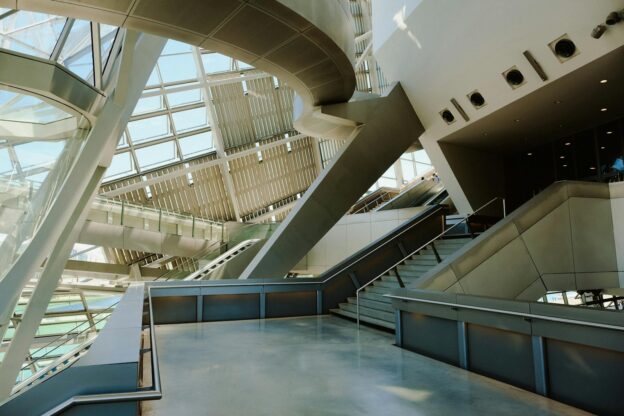
What happens when a major museum decides its new building should feel less like a cathedral to culture and more like the neighbourhood it sits in? The V&A East Museum, designed by Irish architects O’Donnell + Tuomey, recently opened on London’s Queen Elizabeth Olympic Park — and the answer it proposes is worth studying closely, because it draws on an approach to civic architecture that Scandinavian institutions have been refining for decades.
The building is the second piece of the V&A’s east London expansion, following the V&A East Storehouse, which opened recently. Together, they represent a significant institutional bet: that one of the world’s most established design museums can meaningfully transplant itself into a part of the city shaped by DIY culture, immigration, and grassroots creativity — and that the architecture itself should reflect those values rather than impose a glass-and-steel monument from above.
A Building Designed to Keep You Moving
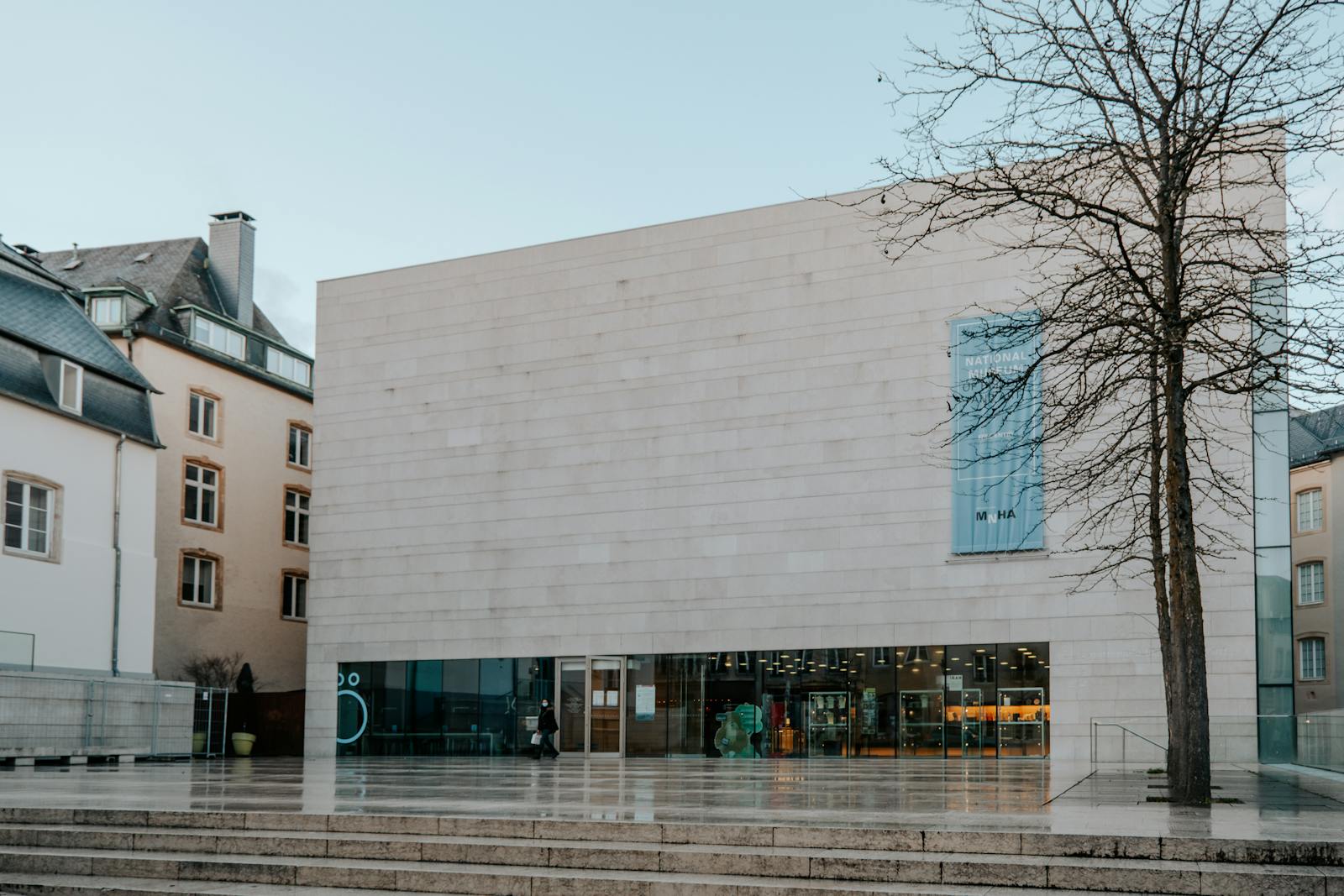
The museum’s most immediately striking feature is its angular, concrete-clad exterior — a faceted form that gives the building a geological quality, as if something crystalline had been deposited in the park. The design creates a crust around the edge that gives it its identity externally, while also integrating movement and circulation spaces. The continuous flow encourages visitors to keep exploring as they turn each corner.
That continuous circulation is literal. A single stair connects multiple floors, encouraging visitors to move through the building without the dead-end corridors and wayfinding fatigue that plague so many large institutions. The building opens onto a newly created public square, positioning the museum as a threshold between park and neighbourhood rather than a destination sealed off from its surroundings.
Anyone who has visited Louisiana Museum of Modern Art north of Copenhagen will recognise the underlying philosophy — the way Jørgen Bo and Vilhelm Wohlert’s 1958 building uses a continuous sequence of corridors and rooms to pull visitors through the collection along a landscaped path, so that inside and outside blur and the act of moving becomes part of the experience. Artipelag, outside Stockholm, works a similar principle in reverse: the building is embedded in its rocky shoreline so that the landscape enters the galleries. The V&A East isn’t perched on a Scandinavian coastline — it sits in the Stratford area, surrounded by the legacy infrastructure of the 2012 Olympics — but the conviction that circulation and threshold matter as much as gallery walls comes from the same lineage. What’s different is how O’Donnell + Tuomey have adapted that thinking to a dense urban site where the “landscape” is a neighbourhood of high streets, housing blocks, and leftover Olympic infrastructure.
Gallery Spaces That Echo the Street
Inside, the gallery design was handled by JA Projects, while Studio Mutt designed the museum’s shop spaces, featuring mobile timber display units that can be reconfigured.
The museum is shaped by east London — its high streets, its parks, and the ways communities already gather, make and represent themselves. The galleries are intended to evoke the familiarity of local shops and streetscapes — spaces people already know how to navigate — rather than the white-cube formality that can make design museums feel like places where you need permission to be.
This is a deliberate curatorial choice. The museum aims to re-empower young people to think about creativity, creating a space that you can participate in rather than one that requires expensive credentials to access. Here, too, there’s a Nordic precedent worth naming. Denmark’s DOKK1 library in Aarhus, designed by Schmidt Hammer Lassen, was conceived not as a repository of books but as a civic living room — a place where the programme is shaped by who shows up. The Swedish Nationalmuseum’s 2018 reopening in Stockholm similarly reorganised its galleries to flatten hierarchies between “high” design and everyday objects, making the museum legible to visitors who had never set foot in one before. The V&A East pushes that thinking further by encoding it in the architecture itself: the street-like gallery layouts aren’t just a curatorial gesture but a spatial one, designed to make the building navigable on instinct rather than instruction.
What’s Inside: Objects and a Story About Black British Music
The permanent exhibition brings together design, fashion, art, and architecture objects. The roster of featured designers spans contemporary and established names across disciplines. It’s a deliberately wide net — the exhibition’s premise is that creativity is a shared human impulse rather than a professional credential.
The museum’s inaugural temporary exhibition explores the impact of Black British music through a collection of objects. In a city where music culture has long been one of the most vital forms of creative expression — and one of the least represented in traditional museum settings — the choice of opening show signals where the V&A East wants to position itself in the cultural conversation.
The Bigger Question: Can Institutions Decentralise?
The V&A East Museum arrives at an interesting moment for major cultural institutions across Europe. The question of whether flagship museums can successfully establish satellite locations — and whether those satellites can develop genuine local identity rather than functioning as branded outposts — has been tested with mixed results from Abu Dhabi to Helsinki.
Scandinavian institutions offer some instructive contrasts. When the Munch Museum moved to its new waterfront building in Oslo’s Bjørvika district in 2021, it faced criticism that the architecture — a monumental tower by Estudio Herreros — prioritised skyline spectacle over the neighbourhood-level integration it promised. The building is striking; whether it belongs to its community in the way the old Tøyen location did remains an open question. Finland’s Amos Rex, by contrast, succeeded partly because JKMM Architects buried much of the building beneath Helsinki’s Lasipalatsi Square, letting the public space on top remain genuinely public. The V&A East seems to have studied these tensions carefully. Its architects and curators appear more interested in the Amos Rex model — architecture that creates civic space rather than consuming it.
What’s notable about the V&A’s approach is the degree to which the architecture and curation have been shaped by local practitioners. JA Projects and Studio Mutt are London-based studios with deep ties to the communities surrounding the site. O’Donnell + Tuomey, while based in Dublin, brought an approach to public architecture that prioritises civic generosity over spectacle. The building wants to be used, not just photographed.
Whether that ambition translates into genuine community ownership — rather than the institutional gentrification that cultural projects in redevelopment zones often accelerate — will take years to assess. The architecture and the curatorial framework are promising. The harder work is what happens after opening day, when the public square fills (or doesn’t) with the people the museum says it was built for.
What This Means for Museum Design Now
The V&A East Museum matters because it represents a convergence. The principles that shaped Scandinavia’s best civic buildings over the past half-century — dissolving thresholds between institution and public space, designing circulation as experience, flattening the hierarchy between visitor and collection — have now been absorbed, adapted, and redeployed in a radically different context. The faceted concrete, the references to east London’s commercial streetscape, the deliberate roughness of the material palette — none of this looks remotely Nordic. But the underlying convictions about what a public building owes its public are unmistakable.
What the V&A East adds to that conversation is specificity. A museum shaped by Stratford’s high streets rather than Copenhagen’s harbourfront. Galleries curated to reflect Black British music culture rather than canonical Nordic design. Architecture that takes its cues from the energy of a neighbourhood that was making things long before any institution arrived to document it. If the building succeeds — and that will only become clear over years, not weeks — it will be because those borrowed principles found genuine local roots. That’s the test facing every ambitious civic building right now, in London or anywhere else: not whether the architecture is good, but whether the place it creates actually belongs to the people around it.
Photo by Mathias Reding on Pexels