
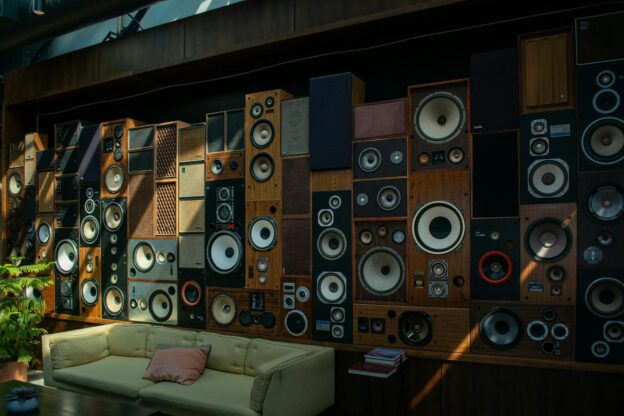
Spotify has opened a purpose-built listening lounge at its London headquarters, and the Swedish streaming giant is making an argument that doubles as a confession: its own product, as most people experience it, isn’t good enough. In a room where acoustically optimized architecture, bespoke British-designed speakers, and lossless audio streaming converge, Spotify is tacitly acknowledging what audiophiles and musicians have argued for years — that algorithmic convenience hollowed out the experience of listening to music, and that the company most responsible for that transformation now feels compelled to build a physical monument to everything its platform sacrificed. This isn’t a brand activation. It’s an identity crisis made architectural.
A Room Designed as an Instrument
The Spotify Listening Lounge sits inside the company’s central London offices, accessible to select fans through year-round programming. It launched with an event featuring UK artists, with guests listening to full tracks — not snippets, not algorithmically truncated previews — in a space built to make every detail audible. The format itself is a quiet rebuke of how Spotify’s own platform trains people to listen: skip-forward culture replaced, at least in this room, by enforced attention.
The space was designed in collaboration with architecture and audio design partners who treated the room itself as an instrument. The interior features warm lighting, slate floors, steel details, and a palette of rich browns and tactile materials drawn from mid-century Italian design — all deliberately receding into the background so the sound remains the focal point. Every surface pattern and material choice, from calibrated wall textures that disperse frequencies evenly to acoustic panels from premium Nordic textile manufacturers, was made to eliminate interference and complement the precision of the custom speakers. Readers familiar with the principles underpinning Scandinavian design will recognize the philosophy: form entirely subordinated to function, beauty emerging from functional integrity rather than decoration for its own sake. The room functions less like a venue and more like a precision instrument that happens to have seating.
British Audio Heritage Meets Swedish Streaming
At the heart of the lounge is a custom audio system built by a British loudspeaker design studio. The speaker system features Alnico magnet drivers, components associated with respected studio systems in British audio history, including those used in mastering at Abbey Road. The system also includes custom-made cabinets and a frosted glass waveguide horn.
The project designer framed the work as an extension of a distinctly British audio lineage, citing a background in and around recording studios as inspiration. The designer argued that British sound system culture — from DIY builds to Carnival stacks — shares the same ambitions as high-end audio, and the new space attempts to bridge these traditions.
There’s something worth noting in the cross-pollination here: a Swedish-founded company drawing on British craft traditions and acoustic expertise, all channeled through a design language that owes something to Scandinavian material sensibility. It’s a collaboration that only makes sense if you understand Spotify is no longer trying to be just a software company. It’s trying to become something closer to a cultural institution — and cultural institutions need rooms.
Why a Streaming Company Is Building Physical Spaces
The more revealing question is what Spotify is admitting by investing in a physical, architecturally precise listening environment at a moment when the streaming industry is otherwise racing toward ubiquity and algorithmic personalization. The company began redesigning its offices in 2021 to improve acoustics and introduce softer, more intentional spaces. The Listening Lounge is the most ambitious expression of that shift — and the closest thing to an admission that the product Spotify delivers to 600 million users through phone speakers and Bluetooth earbuds represents a fundamentally compromised version of the music it hosts.
According to Spotify’s UK and Ireland marketing leadership, the Listening Lounge represents an alignment of technology, craftsmanship, and culture, designed to demonstrate streaming’s full potential through lossless audio in a premium environment.
The lossless audio component is key to understanding the commercial logic. Spotify launched its lossless tier in 2025, entering a market where Apple Music and Amazon Music had already offered CD-quality and hi-res streams for several years. Lossless audio — compressed audio that retains all the information of the original recording — demands better playback equipment to deliver its full benefit. Most people streaming through Bluetooth headphones won’t hear the difference. A purpose-built room with a bespoke speaker system, however, makes the case viscerally obvious. The Listening Lounge exists, in part, to sell you on the idea that you should pay more for something you’ve been getting in degraded form all along.
The Experiential Bet
What Spotify is really doing with the Listening Lounge is creating a physical proof-of-concept for its premium tier. Access is limited to select fans and Spotify Premium users, making it both an exclusive experience and a marketing tool that ties the brand to quality, craft, and community rather than convenience alone. Year-round programming will bring artists and listeners together in a format that privileges full, intentional listening over the passive consumption that defines most streaming behavior.
This mirrors a broader trend across Nordic-origin companies investing in physical experience as a counterweight to digital saturation. Spotify’s approach shares a logic with brands that have realized the limitations of purely digital relationships with their audiences. The Listening Lounge doesn’t scale in the way a playlist does, and that’s precisely the point. Scarcity and sensory richness become the value proposition.
But here is what makes the Listening Lounge more than a clever marketing play: it reveals a structural tension at the heart of Spotify’s business that the company has never fully resolved. The platform was built on the premise that music should be frictionless — infinitely available, algorithmically sorted, portable to any device. That premise won. Spotify has more users than any music platform in history. And now, having won, the company is building a room that embodies the opposite of everything that made it dominant: friction, scarcity, physical specificity, communal presence, and the radical idea that a song deserves your full attention. The company that dismantled the album-listening ritual is now spending real money to reconstruct it in a London office building. That’s not a brand extension. That’s a company reckoning with the consequences of its own success — and discovering that the thing it disrupted might have been valuable after all.
Photo by Dee Hunna on Pexels