

In the mid-1960s, Sweden’s Social Democratic government began proposing significant restructuring of childcare that would, over the following decades, make universal public daycare increasingly available for children. The policy didn’t emerge from a single moment of legislative brilliance. It grew out of a recognition that if women were going to enter the workforce in large numbers (and they were), and if families were going to hold together under the pressures of industrial modernity (and they needed to), then the state had to treat childcare as infrastructure, not charity. That decision, replicated with variations across Denmark, Norway, and Finland, is the reason that Scandinavian cities look the way they do at 5 p.m. on a Tuesday. Streets full of parents with children. Playgrounds in use. Grocery stores crowded with families buying dinner together. The scene is so ordinary here that most Scandinavians don’t register it as unusual. But it is.
What you’re seeing when you walk through Copenhagen or Oslo or Stockholm at five in the afternoon is the visible output of an entire system designed around a single premise: that time with your family after work is not a luxury to be negotiated. It’s a structural expectation. And the most remarkable thing about that expectation is not the policy papers behind it or the tax revenues that fund it. It’s what it looks like from the sidewalk. Ordinary. Unremarkable. Just parents walking home with their kids. That ordinariness is the achievement.

The Hours That Shape Everything
The standard working day in Denmark ends, for most office workers, somewhere between 4 and 5 p.m. This isn’t a cultural quirk or a matter of individual employer generosity. It’s embedded in collective agreements, workplace norms, and a tax-funded childcare system where daycare closes at a specific hour and parents are expected to pick up their children on time. The BBC has reported on this distinctly Danish approach, where leaving the office at 4 p.m. carries no stigma, and where the assumption that long hours signal dedication has simply never taken hold the way it has in Anglo-American work culture.
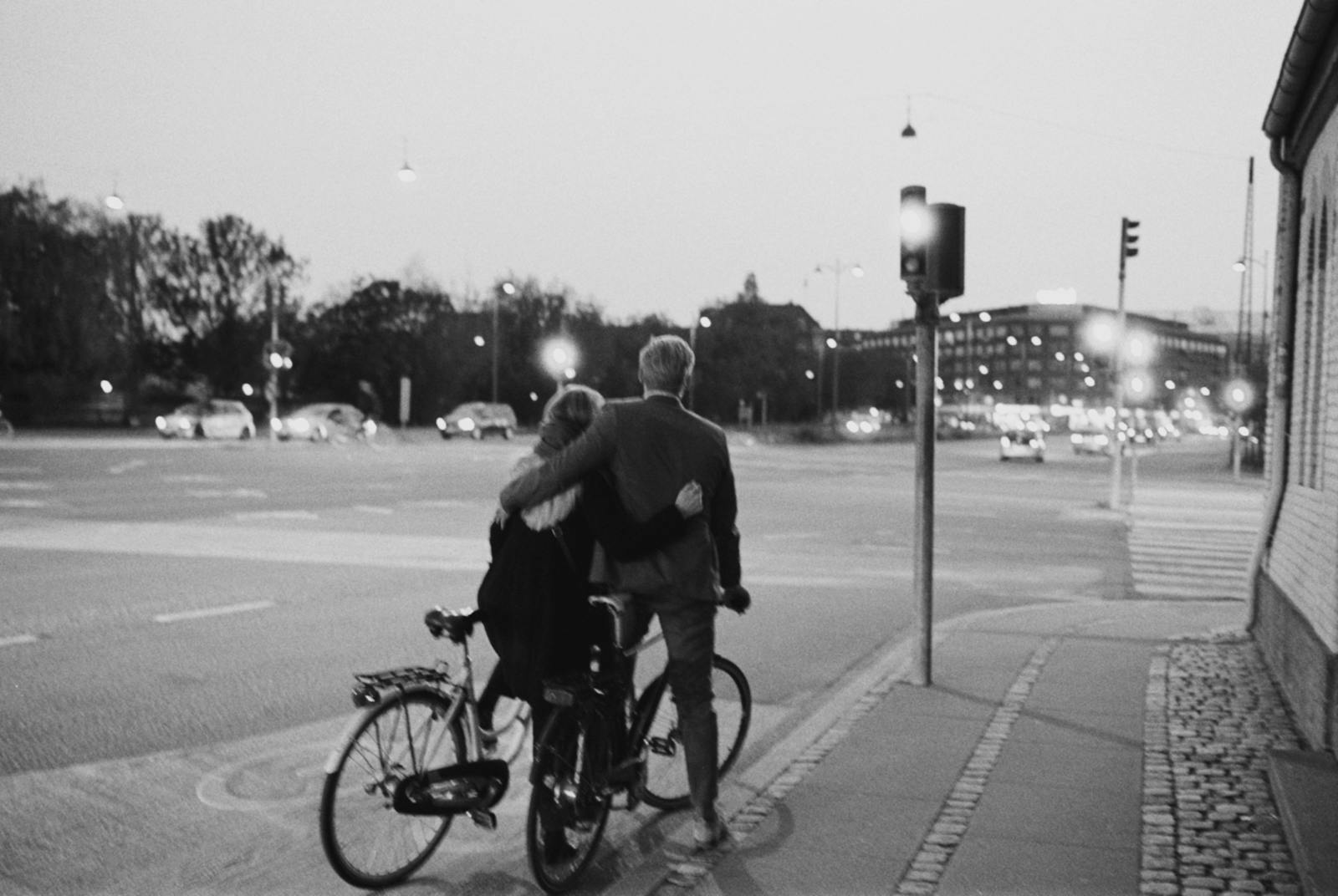
The result is visible every single day. By 4:30, the bike lanes in Copenhagen fill with parents heading toward daycare centers. By 5, the playgrounds start filling. By 5:30, you can stand on almost any residential street in Frederiksberg, where I live, and watch the neighborhood transform from quiet to full. Kids on scooters. Strollers on sidewalks. Fathers carrying grocery bags in one hand and holding a small hand with the other. The rhythm is so consistent you could set your watch by it.
Compare this to the United States, where American employees work significantly more hours per year than employees in comparable economies like Australia, Canada, and France. That’s more than an extra hour every workday. The difference compounds. Over a child’s school years, it adds up to thousands of hours that a parent either spends at home or doesn’t. And those hours are not abstract. They are the difference between a city whose streets fill with families at 5 p.m. and one whose streets remain empty until 7 or 8, when exhausted parents finally make it home.
Research indicates the US ranks relatively low on the OECD’s work-life balance index. The US Surgeon General has labeled parental stress a significant public health issue, driven in large part by long working hours and the absence of a national paid parental leave policy. When I read statistics like these, I think about the inverse: what does it look like when a society scores near the top of that index? It looks like the streets of Frederiksberg at 5:15 on a Wednesday, where the sidewalks are full of people heading home to make dinner. The data is real, but so is the scene it produces.
What Builds the 5 P.M. Streets
That early-evening street life doesn’t happen by accident. It requires an architecture of care so extensive that most Scandinavians never think about its individual parts. But every piece matters, because remove any one of them and the 5 p.m. streets start to thin out.
Start with childcare. Walk through a Danish residential neighborhood and you’ll notice how many daycare centers there are. They’re everywhere, tucked into ground-floor spaces, occupying converted villas, attached to schools. This density is intentional. Denmark guarantees every child a daycare spot from early infancy, and municipalities are legally required to provide it. The cost is subsidized so heavily that most families pay a fraction of what private childcare costs in the UK or the US. This means a parent doesn’t spend months on a waiting list or half a salary on a nanny. They drop their child at a center around the corner and go to work, knowing they’ll be back by late afternoon.
Then there’s parental leave. Scandinavian countries offer some of the most generous parental leave systems in the world. Denmark provides approximately a year of combined parental leave. Norway offers nearly a year of paid leave with options for full or reduced pay. Sweden offers extensive paid leave per child, and some of those days are reserved specifically for each parent, making it structurally awkward for one parent to take all the leave while the other works through.
The reserved leave for fathers (or the non-birthing parent) is particularly important for what the streets look like later. Norway pioneered the “daddy quota” in the early 1990s, setting aside weeks that could only be used by the father or they would be lost. The effect was immediate and lasting: fathers started taking leave because the system made it the default rather than the exception. Jacobin has explored how Norway’s paternity leave policy has functioned as a counter-pressure against the resurgence of traditional gender roles, creating a generation of fathers who spent months as primary caregivers before their children could walk. When those children grow older, those fathers don’t suddenly stop showing up. The 5 p.m. streets aren’t just full of mothers. They’re full of fathers too, and that’s a direct legacy of policies enacted decades ago.
Sweden took the idea further in 2024, when it became the first country in the world to let grandparents take paid parental leave. Under the new law, parents can transfer some of their parental leave days to grandparents, who receive the same government compensation. The logic is straightforward: families are complex, and the state’s job is to support the actual shape of care, not just the theoretical nuclear model. And so the streets at 5 p.m. sometimes include grandparents too, picking up children, walking them home, folding seamlessly into the rhythm of the early evening.
The physical infrastructure matters as much as the policy infrastructure. Scandinavian cities are designed at a scale that makes the 5 p.m. transition from work to home efficient. Short commutes, cycling infrastructure, reliable public transit. A parent in Copenhagen can leave the office, cycle ten minutes to a daycare, pick up a child, and be home by 4:45. That’s not possible in cities designed around freeways and sprawl. The street life you see at 5 p.m. depends on the streets themselves being built for it.
As we’ve explored at Scandinavia Standard, the trust visible in Scandinavian public life, from strollers left outside cafes to bikes unlocked on the street, extends to a broader social contract: parents trust that employers won’t punish them for prioritizing their families. That trust is what turns policy into a living, breathing pattern you can see from any park bench.
What the Rankings Actually Measure
Denmark has been named the best European country for work-life balance in 2025, according to Time Out. These rankings make for good headlines, but they also reflect something measurable: the number of hours employees work per week, the availability and generosity of paid leave, the proportion of GDP spent on family support, the percentage of children in publicly funded childcare. What the rankings cannot capture is what all those inputs look like as an output. They can’t measure the feeling of a playground at 5:30 p.m. on a Thursday, full of parents who arrived without rush, without guilt, without their phones buzzing with messages from a boss who expected them to stay later.
International work-life balance assessments typically evaluate factors including the percentage of employees working very long hours and the amount of time devoted to leisure and personal care. On both measures, Denmark, Norway, and Sweden consistently outperform most other wealthy countries. The difference is structural, not attitudinal. Danes aren’t inherently lazier or less ambitious. They work in a system that distributes time differently, and that distribution shows up, physically, on the streets every evening.
My wife, who is Finnish, sometimes points out that Finland’s approach is slightly different again. Finnish parental leave was significantly reformed in the early 2020s to give each parent an equal, non-transferable quota. The reform was explicitly designed to push toward gender equality in caregiving. Our kids, growing up bilingual and bicultural, absorb these differences instinctively. My 11-year-old once asked why his Finnish cousins’ father took so much leave when a new baby arrived. The answer, he understood once I explained it, was simple: because the law told him to, and because his employer expected him to. That expectation, multiplied across millions of families, is what creates the street-level reality.
Why It Feels Radical
The Forbes piece on working parents in America, written by Lieke ten Brummelhuis, offers practical advice for individuals trying to optimize their own happiness within a system that doesn’t structurally support family time. The tips are sound: prioritize your roles, distribute your psychological needs across different life domains, lower your self-expectations, stop comparing yourself to seemingly perfect parents on social media. But the framing itself reveals the gap. American parents are being coached to individually manage a problem that Scandinavian countries addressed collectively decades ago.
Psychologists Richard Ryan and Edward Deci, both Professors Emeriti at the University of Rochester, identified three basic psychological needs: competence, connection, and autonomy. As Forbes notes, working parents who are spread thin can try to distribute these needs strategically across their different roles. But when I read that advice from Copenhagen, I notice something: in a system where you reliably get home by 5, where childcare is guaranteed and affordable, and where both parents are expected to be present, you don’t need a psychological framework to make it work. The system does most of the heavy lifting. The connection happens on the walk home from daycare. The autonomy comes from knowing you can leave the office without consequence. The competence is just showing up, reliably, every evening, because nothing in the system is preventing you from doing so.
That’s the quietly radical part. Scandinavian countries made a series of policy decisions that removed the need for individual heroism in family life. You don’t have to be exceptionally organized, wealthy, or lucky to eat dinner with your children on a weekday. You just have to live in a society that decided this was a priority and then put its money, its laws, and its workplace culture behind that decision.
Scandinavia Standard has written about how Scandinavians’ relationship with work shapes their experience of retirement, and the same pattern applies here. The boundaries around work are established early. They’re cultural before they’re personal. By the time you reach your 40s, the habit of leaving the office at a reasonable hour isn’t a daily negotiation. It’s just how things are done. And what it looks like, from the outside, is a city that fills with families every evening as if by magic.
The Signal in the Ordinary
I walk through my neighborhood most evenings. The playgrounds in Frederiksberg are always full at 5:30. Fathers push swings. Mothers sit on benches talking. Kids run between climbing frames. Sometimes I see families I recognize from my children’s school. The light in Scandinavia at that hour, especially in the long summer evenings, gives everything a particular quality. Unhurried. Warm. The kind of scene you might photograph if you were a tourist, but which residents experience as simply the way the day ends.
There is nothing dramatic about any of this. That is precisely the point.
The radical act is in the absence of drama. No one had to fight their boss to be there. No one is checking work email while pretending to watch their child on the monkey bars (well, some are, but it’s not required). No one is anxious about whether leaving the office at 4:30 will cost them a promotion. The system made this the default outcome, not the exceptional one.
Other countries admire the result without wanting to adopt the mechanism. They see the happy families but not the tax rates, the collective bargaining agreements, the mandatory paternity leave quotas, the publicly funded daycare infrastructure, the political consensus that took half a century to build. They want the 5 p.m. streets without paying for the 5 p.m. streets.
The families walking home in the late afternoon light don’t think of themselves as making a political statement. They’re just going home. But the fact that they can, reliably, predictably, across income levels and family structures, is the product of choices that most societies have not made. And every time I see it, even after years of living inside this system, I notice it. Not as something to celebrate. As something to understand. The streets at 5 p.m. are a kind of evidence. They are what it looks like when a society decides that evenings belong to families and then, over decades, builds every piece of infrastructure necessary to make that decision hold.
For those planning a family visit to Scandinavia, this is one of the things that often surprises grandparents from abroad most: the rhythm of the day, the way cities empty out of commuters and fill up with families by early evening. It looks effortless. It isn’t. It’s the most expensive, most carefully engineered effortlessness in the world.
Photo by Alexis B on Pexels