
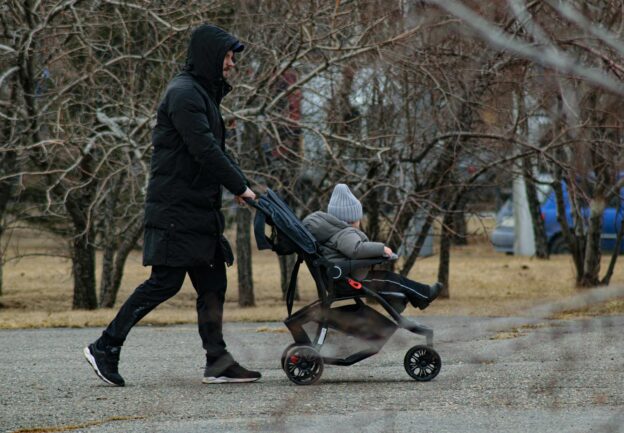
When my son was small enough to fit in a stroller, I remember the Tuesday afternoons most clearly. Not the weekends, when the parks in Frederiksberg filled with both parents and the whole performance of family togetherness. The Tuesdays. The quiet ones, where I’d push the stroller past the bakery on Gammel Kongevej and the only people out were other fathers, a few grandparents, and the retired man who always sat on the same bench near the church. Nobody looked at me twice. Nobody said anything encouraging. That absence of commentary was, I think, the whole point.
There is a kind of pride in that. But it isn’t the kind you’d recognize if you grew up in a culture where fathers taking leave is treated as heroic or remarkable. Scandinavian men pushing strollers on a Tuesday don’t look proud. They look ordinary. And that ordinariness is the pride.
The infrastructure that made Tuesday fatherhood normal
The scene I’m describing didn’t happen by accident. It was built, policy decision by policy decision, over decades. Denmark, Norway, Sweden, Finland, and Iceland all have parental leave systems that reserve a portion of paid leave specifically for fathers, a quota that vanishes if unused. In Norway, the father’s quota is now 15 weeks. In Sweden, it’s 90 days per parent. The mechanism is simple: use it or lose it.
This design choice matters more than people realize. When parental leave is a single shared pool, the economic logic of most households pushes toward the mother taking it all, because in most families she earns slightly less and the cost of her absence from the labour market is calculated (often unconsciously) as lower. The earmarked father’s quota broke that calculation. It said: this leave belongs to you, specifically. Take it or it disappears.
The contrast with the United States is stark. Only about a quarter of private sector workers in the U.S. have access to any amount of paid parental leave, according to the Bureau of Labor Statistics. There is no national paid parental leave law. The best American companies offer what the Nordics consider a baseline, and most offer less.
Hillary Cookler, a PhD candidate and researcher at UCLA Anderson School of Management, has tracked paid parental leave policies at the 500 largest U.S. publicly traded companies. Her 2025 data found that the average amount of paid leave for primary parents was 11.8 weeks, up from 11.1 weeks the year prior. That figure applies only to the largest companies. For most American workers, the number is zero.

What the quota did to masculinity
Norway introduced the first earmarked paternity quota in 1993. Four weeks, reserved exclusively for fathers. The uptake was immediate and overwhelming. Before the quota, roughly 3% of Norwegian fathers took parental leave. After it, the number jumped to nearly 70% within a few years.
That shift didn’t just change who was home with the baby. It changed what fatherhood meant. A generation of Norwegian men experienced something their own fathers mostly hadn’t: the slow, unglamorous rhythm of caring for an infant alone. The 3 a.m. feedings. The walks to nowhere. The realization that a baby doesn’t care about your professional reputation.
As Jacobin recently documented, Norway’s pappaperm (father’s leave) has become a cultural institution, not just a policy. The leave isn’t seen as a favour from an employer. It’s a right attached to fatherhood itself. And the social expectation has shifted accordingly: a Norwegian man who doesn’t take his leave raises more eyebrows than one who does.
This is the quiet revolution in Scandinavian masculinity. It didn’t arrive through manifestos or consciousness-raising groups. It arrived through payroll systems and employment law. The policy created the behaviour, and the behaviour, repeated across millions of families over three decades, created a new norm.
Pride without performance
Here’s what I think outsiders misunderstand. When international media covers Scandinavian fatherhood, the framing tends to be celebratory: look at these enlightened men, so involved, so progressive. The tone suggests that these men are performing something admirable. But the fathers I know, the ones on those Tuesday afternoon walks, are not performing anything. They are simply present.
The pride I’m describing isn’t the pride of doing something unusual. It’s the pride of competence. Of knowing how to get a toddler into a snowsuit in under five minutes. Of having a favourite bench at the playground that gets afternoon sun. Of being the parent who knows the child’s paediatrician’s name without checking.
This connects to something I wrote about recently: the version of themselves that Scandinavian parents raise their children to become is fundamentally different from what many cultures consider a successful child. The same applies to what Scandinavian culture considers a successful father. Success isn’t measured by provision. It’s measured by presence and by the small daily evidence that you actually know your child.
My wife, who is Finnish, has pointed out that the Finnish and Danish versions of this norm differ in tone but not in substance. In Finland, a man on parental leave is perhaps even less likely to mention it voluntarily. In Denmark, there’s slightly more social conversation around it, but the underlying expectation is the same: you take your leave, you do the work, you don’t expect applause. The Janteloven current runs through fatherhood too. You are not special for doing what you should.
The economics underneath the emotion
There is a hard economic argument underneath this cultural story, and ignoring it would be dishonest. Scandinavian parental leave is publicly funded, income-replaced at high rates, and guaranteed by law. Danish parents receive roughly 52 weeks of total leave between them, with portions earmarked for each parent. The state pays. The employer is obligated to hold the job.
This means the decision to take leave isn’t really a decision at all. It’s a default. The economic penalty for taking leave is minimal compared to countries where leave is unpaid or poorly compensated. When Cookler found that almost half of U.S. employees who have access to paid leave report taking less time than they are offered, citing a 2023 Pew Research report, it underscored something the Nordics solved decades ago: access alone isn’t enough. You also need a culture and an economic structure where using the leave carries no penalty.
The Scandinavian model removes the negotiation. A father doesn’t have to ask his boss for permission, read the room, or calculate the career cost. The leave exists. It is his. The structural certainty is what allows the emotional experience to happen without self-consciousness.
And that’s what makes the Tuesday afternoon stroller walk possible. The father isn’t wondering whether taking this time will cost him a promotion. He isn’t performing fatherhood for social media or for his partner’s approval. He’s doing something profoundly normal, in a society that spent decades making it normal.
When the model gets complicated
The honest version of this story includes the complications. Scandinavian parental leave policies are generous, but they haven’t solved everything.
Birth rates across the Nordic countries have been falling for years, despite the world’s most supportive family policies. Norway’s fertility rate has dropped to levels that alarm demographers. Finland’s is even lower. The Guardian reported on Norway’s government grappling with this paradox, which forces a harder question: if generous leave and subsidised childcare don’t reliably produce higher birth rates, what are the policies actually for?
The answer, I think, is that they’re for the children who are born. And for the parents who raise them. The policies don’t create families. They shape the experience of families that exist.
There’s also the question of whether the cultural norm creates its own pressures. Some Scandinavian men report feeling judged if they don’t take the full allotted leave, or if they seem too eager to return to work. The social expectation that once liberated fathers from an older model of distant breadwinning can, in certain lights, become its own form of conformity. You must be this kind of father. You must feel a specific way about it.
I’ve felt this pressure myself, on those years coaching my son’s football team while trying to meet deadlines. The expectation of equal participation is real and mostly good, but it doesn’t eliminate the practical tensions of two-career households. It just distributes those tensions more evenly.

What the research says about presence
A study covered by DW found that parents report greater meaning in life than non-parents, but often lower day-to-day life satisfaction. This tracks with what every honest parent knows. The meaning is real. So is the exhaustion. The Tuesday afternoon walk is both: meaningful and monotonous, full of purpose and also just a long walk with a stroller.
The Scandinavian model doesn’t pretend parenthood is bliss. It acknowledges that caring for small children is work, real work, and structures its systems accordingly. Leave is compensated because it is labour. Fathers take it because the society has decided that this labour should not fall to one parent alone.
And the fathers themselves? They rarely talk about it in these terms. The vocabulary of policy and gender equity belongs to the people who designed the system, not to the people living inside it. A Danish father on leave doesn’t think of himself as a participant in a social experiment. He thinks of himself as a guy who knows where the good playground is.
The gap between the ideal and everyone else
One thing that’s easy to overlook from outside the Nordics: the stroller-pushing father on a Tuesday afternoon is, in almost every media depiction, white, middle-class, and employed in a salaried job with clear parental leave entitlements. The model works differently for self-employed fathers, for immigrants whose employment situations are precarious, for men in industries where the culture still discourages leave-taking despite the legal right.
This gap is not unique to parental leave. It runs through much of the Scandinavian social model. The confidence that comes from growing old in a country where your worth was never tied to your productivity is more available to some than others. The same applies to the confidence of young fatherhood. The system is good. It is not yet universal in practice.
And internationally, the Scandinavian approach remains an outlier. South Korea has recently seen significant increases in paternal leave uptake, with fathers on parental leave approaching 40 percent of total recipients, suggesting that policy design can shift behaviour even in cultures with very different gender norms. The mechanism is consistent: when you earmark leave for fathers and compensate it properly, fathers take it.
Tuesday afternoon, continued
My children are 8 and 11 now, well past the stroller years. The Tuesdays look different. School runs, homework supervision, the logistics of two working parents coordinating schedules across Danish and Finnish school calendars. The infrastructure of involved fatherhood extends long after the parental leave ends, though it becomes less visible and less celebrated.
But I still notice the fathers with strollers. In Frederiksberg, on a Tuesday, you’ll see them at the café on Smallegade, the one with the wide space between tables. They’re not making a statement. They’re having coffee while the baby sleeps.
The pride is quiet because the culture has made it quiet. It isn’t pride in being different. It’s pride in being ordinary. In being the kind of father who simply shows up, not because it will be noticed, but because showing up is what fathers do here. Not all fathers. Not without complication. But enough of them, enough of the time, that a man alone with a baby on a weekday is just a man alone with a baby.
That’s what policy can do when it’s given enough time. Not change hearts by decree, but create conditions where a new kind of normal becomes, eventually, just normal. The father pushing the stroller doesn’t think about the 1993 Norwegian quota or the earmarked weeks in the Danish barselsloven. He thinks about whether the baby needs a new nappy and whether there’s milk at home.
The system did its work. Now the father is doing his.
Photo by Radik 2707 on Pexels