
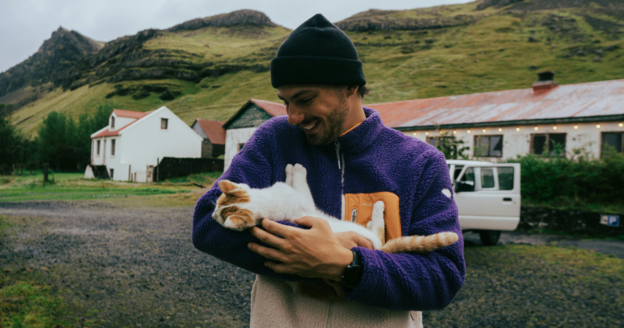
I spent three months in Iceland during what should have been the darkest period of my life — post-divorce, between careers, carrying the kind of quiet grief that has no diagnosis code. What struck me wasn’t the midnight sun or the volcanic landscapes.
It was how content everyone seemed despite living through their own financial collapse just years before, navigating winters with four hours of daylight, and existing on an isolated island where the weather changes every ten minutes. The numbers back this up: Icelanders consistently rank among the world’s happiest people, with 73% reporting contentment compared to just 33% of North Americans, according to The Guardian.
After twelve years as a clinical psychologist, I thought I understood happiness. I’d read all the attachment literature, could recite the DSM criteria for adjustment disorders, knew the clinical frameworks for well-being. But Iceland taught me something my training never did: happiness isn’t about fixing what’s broken or optimizing what works. It’s about a series of quiet habits so embedded in daily life that most Icelanders don’t even recognize them as practices.
1) They share meals without making it an event
We make such production out of dinner parties here in Portland — the planning, the cleaning, the performance of it all. In Iceland, I watched neighbors drift in and out of each other’s kitchens with the casualness of checking mail. No invitations, no formal arrangements. Just people eating together because humans have always eaten together, and making it complicated serves no one.
The research validates what I observed: Iceland is the only European or North American country in the global top ten for shared meals, and this simple act correlates strongly with their life satisfaction scores. During my time there, I ate more meals with strangers-who-became-friends than I had in the previous decade.
There’s something about breaking bread together that bypasses all our careful psychological defenses — you can’t maintain professional distance over fish stew in someone’s kitchen while the wind rattles the windows.
2) They embrace what they call “þetta reddast”
This phrase roughly translates to “it will all work out,” but that misses the nuance entirely. It’s not toxic positivity or denial. It’s more like a collective agreement that worrying changes nothing, so why dedicate energy to it? When your country sits on active volcanoes and your economy can collapse overnight, you develop a different relationship with uncertainty.
I watched this play out in real time when a snowstorm canceled flights for three days. No one panicked. No one demanded to speak to managers. People simply adjusted, found places to stay, shared resources. As someone who spent years treating anxiety disorders, I recognized this as a culture-wide practice of what we clinically call distress tolerance — the ability to withstand difficult emotions without immediately trying to escape them.
3) They spend time outdoors regardless of weather
Portland rain doesn’t bother me — never has — but Icelandic weather exists on another scale entirely. Horizontal rain, winds that literally knock you over, darkness at 3 PM. Yet everyone goes outside anyway. Not for exercise or vitamin D or any wellness goal. They go outside because staying inside all day makes you strange to yourself.
My morning walks here in Northeast Portland started after watching Icelanders navigate their brutal winters with such matter-of-factness. We pathologize everything in clinical practice — seasonal affective disorder, weather-related mood changes. But maybe some discomfort is just discomfort, and moving through it daily makes it smaller, more manageable, less likely to metastasize into something requiring intervention.
4) They read books like their sanity depends on it
Iceland publishes more books per capita than almost any country, and everyone reads. Not self-help, not optimization guides, but fiction, poetry, sagas. Stories that connect them to something larger than their individual psychology. During the dark months, reading isn’t entertainment — it’s survival.
I’ve maintained my evening reading since returning, though I resist it imperfectly. The pull of the screen is strong, and I understand doomscrolling as the self-harm it is. But there’s something about holding a physical book that reminds me of those Icelandic evenings, when stories felt like the only reasonable response to darkness.
5) They maintain community pools as social spaces
Every neighborhood has its heated outdoor pool, open year-round. These aren’t fitness centers or wellness spaces. They’re where people go to sit in hot water and talk about nothing in particular. The democracy of it struck me — everyone strips down to bathing suits, eliminating most class markers, and soaks together in the same water.
The clinical term would be “social integration,” but that makes it sound intentional, programmatic. This is simpler: humans in warm water, talking or not talking, present with each other in the most basic way. No one’s performing wellness. They’re just being bodies in water together, which might be the most honest form of community we have.
6) They practice brutal honesty without cruelty
Icelanders will tell you exactly what they think, but without the American tendency to either soften everything into meaninglessness or weaponize truth as cruelty. It’s honesty as respect — assuming you’re sturdy enough to hear reality and adjust accordingly.
After years of watching clients dance around their actual feelings, terrified of conflict or abandonment, this directness felt revolutionary. We spend so much therapeutic energy teaching people to identify and express their needs, but in Iceland, this comes standard. Not because they’re emotionally superior, but because on an isolated island with 300,000 people, you can’t afford the luxury of unspoken resentments.
7) They create during the darkness
Winter darkness isn’t fought or fixed or therapized away. It’s used. Everyone seems to have some creative practice — knitting, writing, music, woodworking. Not as self-expression or healing, but as something to do with your hands while the world is dark.
This aligns with everything we know about behavioral activation in treating depression, but stripped of its clinical framework. Make something because making something is what humans do. The darkness is going to come anyway. You might as well have something to show for it.
8) They don’t pursue happiness directly
This might be the quietest habit of all: Icelanders don’t seem particularly concerned with being happy. They’re concerned with being useful, connected, engaged with their landscape and community. Happiness appears to be a byproduct, not a goal.
We’ve turned happiness into another optimization project, another thing to achieve or fail at. But watching Icelanders navigate their objectively difficult conditions with such equanimity taught me what my clinical training never quite could: contentment might have less to do with fixing what’s wrong and more to do with accepting what is while staying connected to what matters.
Conclusion
The research tells us Icelanders report life satisfaction levels that should be impossible given their circumstances — the isolation, the weather, the economic vulnerabilities. But maybe we’re measuring the wrong things. Maybe happiness isn’t about optimal conditions or resolved traumas or achieved goals.
Since returning to Portland, I’ve tried to maintain some of these quieter practices. Not as a program or intervention, but as a different way of moving through ordinary life. I share more meals without occasion. I walk in the rain without narrating my discomfort. I read in the evenings, imperfectly but persistently.
We keep looking for happiness in all the diagnostic categories, the optimization strategies, the clinical interventions. But perhaps the Icelanders have it right: happiness might be nothing more than a series of quiet habits that acknowledge difficulty without being defeated by it, that prioritize connection over improvement, that accept darkness as part of the rhythm rather than something to be cured.
These aren’t lessons that fit neatly into treatment plans or self-help frameworks. They’re simpler and more complex than that — just ways of being human together on a difficult planet, making the best of what we have.