
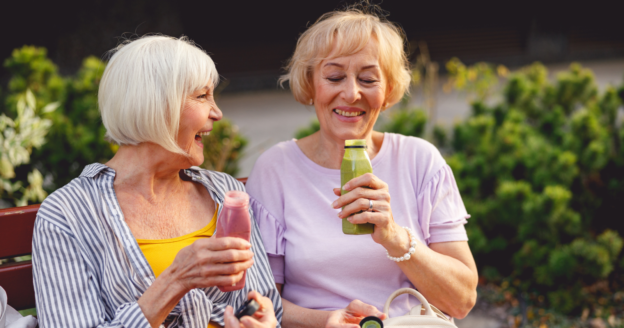
When researchers studied centenarians in Denmark, they discovered something unexpected: those who lived past 100 weren’t just maintaining old friendships — they were actively making new ones well into their 80s and 90s.
In fact, Danish seniors who formed new friendships after 70 had a 22% lower risk of mortality compared to those who stuck only with existing social circles.
This finding turned conventional wisdom on its head. Most of us assume that by our 70s, our friend group is pretty much set. We’ve got our people, and that’s that. But the Danes approach friendship differently as they age, and it might be one reason why Denmark consistently ranks among the countries with the highest life satisfaction scores for seniors.
The Danish concept of “venskab” goes deeper than friendship
In Danish culture, there’s a word — venskab — that translates to friendship, but carries more weight than our English version. It implies an active, ongoing commitment to building connections, regardless of age. While researching this topic, I came across the work of Danish psychologist Marie Helweg-Larsen, who explains that Danes view friendship as a skill you continue developing throughout life, not something you master in your 20s and then coast on.
This resonates with me. As a retired teacher who’s maintained friendships from college, young motherhood, and my teaching years, I’ve always valued depth over breadth in relationships. I’d rather have five close friends than fifty acquaintances. But what struck me about the Danish approach is how intentional they are about expanding their inner circle, even when most people are content to let it shrink.
Danish seniors join clubs not just to pursue hobbies, but explicitly to meet people. They attend community dinners designed for making connections. They participate in something called “friendship benches” — designated park benches where anyone can sit when they’re open to conversation with a stranger.
Why new friendships matter more as we age
Here’s something I’ve noticed since retiring: old friends are wonderful, but they can’t always meet all your needs in this new life stage. My teacher friends are scattered across different retirement timelines. Some are still working, others have moved to be near grandchildren. The friends from my young motherhood days? We’re all navigating different health challenges, caregiving responsibilities, and energy levels.
New friendships bring fresh perspectives and shared current experiences. When you meet someone at 67, you’re both dealing with similar life transitions — retirement adjustments, health concerns, maybe loss of a spouse. There’s an immediacy to these connections that friendships from decades ago might lack.
Research from the University of Copenhagen found that seniors who form new friendships report feeling “younger” psychologically. These new relationships often involve shared activities — hiking groups, book clubs, volunteer work — that keep both the mind and body engaged. It’s not just about having someone to talk to; it’s about having someone to do things with.
The Danes have figured out something important: community matters more as you age, and you need to invest in connections before you desperately need them. They don’t wait until they’re isolated to seek friendship. They build their social infrastructure early and keep reinforcing it.
The biology behind late-life friendships
There’s hard science behind why new friendships boost longevity. When we form new social bonds, our brains release oxytocin and dopamine — the same chemicals triggered by falling in love or achieving a goal. This neurochemical cocktail reduces inflammation, lowers blood pressure, and strengthens immune function.
Dr. Robert Waldinger, who directs the Harvard Study of Adult Development, found that the quality of relationships at age 50 is a better predictor of health at 80 than cholesterol levels. But here’s what’s fascinating about the Danish research: it’s not just quality that matters in later life — it’s novelty. New friendships stimulate different neural pathways than familiar relationships. They require us to be more present, more engaged, more ourselves.
Think about it. With old friends, we fall into patterns. We tell the same stories, have the same conversations. With new friends, we have to explain ourselves fresh. We share different memories, discover unexpected commonalities. This cognitive stimulation might be part of why new friendships correlate so strongly with longevity.
Breaking through the barriers to senior friendships
Let’s be honest about why making friends gets harder as we age. There’s vulnerability in putting yourself out there at 70 or 80. You might worry about rejection, feel rusty at small talk, or simply lack the energy for the effort friendship requires.
The Danes address these barriers systematically. Many communities offer “friendship training” workshops for seniors — not because they’ve forgotten how to be friends, but because the dynamics change with age. You might need to be more direct about your needs, more flexible about meeting formats, more patient with health limitations.
I’ve experienced this myself. My walks with Biscuit have become my primary social activity, and through them, I know every dog and owner in the neighborhood. These brief daily interactions have blossomed into real friendships — but only because I pushed past my initial hesitation to suggest coffee after our walks.
The Danish model also acknowledges practical barriers. Transportation challenges? They organize neighborhood walking groups. Mobility issues? They bring social activities to senior housing. Economic constraints? Most friendship initiatives are free or low-cost.
Creating your own friendship renaissance
You don’t need to move to Denmark to benefit from their approach. Start small. Join one new group this month — whether it’s a gardening club, a grief support group, or a pickle ball league. The activity matters less than the intention behind it: you’re there to connect, not just participate.
Consider what I call “friendship dating.” Just as Danish seniors are intentional about meeting new people, you can be too. Strike up conversations at the grocery store. Attend community events solo so you’re more approachable. Accept invitations even when you’d rather stay home with Netflix.
My network of retired educators has taught me something valuable: shared professional background creates instant connection, but it’s the new experiences we pursue together that deepen our bonds. We’re not just reminiscing about classroom days; we’re trying new restaurants, taking art classes, planning trips.
The compound effect of connection
The Danish research shows that the benefits of new friendships compound over time. Each new connection increases your likelihood of making another. Your social confidence grows. Your calendar fills with meaningful activities. Your sense of purpose strengthens.
This matters because isolation is arguably the biggest health threat facing seniors today. The U.S. Surgeon General has declared loneliness a public health epidemic, comparing its health impact to smoking 15 cigarettes a day. But here’s what gives me hope: unlike many health interventions, friendship is accessible to almost everyone.
Looking forward
The Danish approach to senior friendship challenges us to rethink aging. Instead of accepting social shrinkage as inevitable, what if we saw our 70s and 80s as prime time for expanding our social circles? What if we approached friendship with the same intentionality we bring to diet and exercise?
I’ve written before about how retirement can feel like losing your identity. New friendships offer a powerful antidote — they let you be who you’re becoming, not just who you’ve been.
The Danes have given us a blueprint, backed by compelling longevity data. The question is: will we use it? Will you join that club you’ve been considering, reach out to that interesting person from your exercise class, or simply sit on a park bench with an openness to conversation?
Your future self — and your longevity statistics — might thank you for it.