
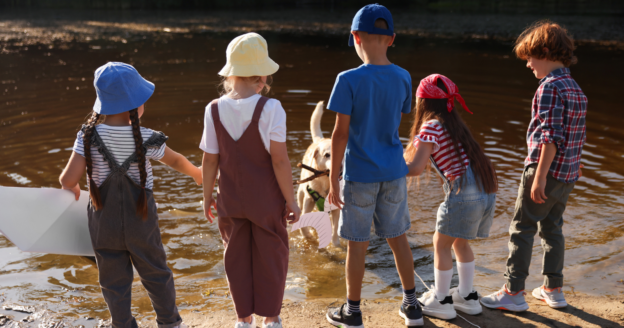
When I first visited Copenhagen to see a friend who’d moved there years ago, I couldn’t believe what I was witnessing. Seven-year-olds were biking to school alone through city traffic. Preschoolers were using real saws and hammers at their outdoor kindergarten. And my friend’s nine-year-old was taking the train by herself to gymnastics practice twice a week.
Back home, parents were getting visits from child protective services for letting their kids walk to the park unsupervised. Yet here in Denmark — and across Scandinavia — this kind of childhood independence wasn’t just accepted. It was expected.
After three decades teaching high school and raising my own sons, I thought I understood child development pretty well. But watching Scandinavian children navigate their world with such confidence made me reconsider everything I’d learned about raising capable, self-assured adults.
The philosophy runs deeper than you might think
Scandinavian parenting isn’t just about letting kids roam free. It’s rooted in a fundamental belief that children are competent beings who deserve respect and trust from an early age. This shows up in ways that would shock many American parents.
In Norway, it’s common to see babies napping in their strollers outside cafes in winter — yes, in below-freezing temperatures. Swedish preschools let three-year-olds help prepare meals with real knives. Finnish children don’t start formal academics until age seven, spending their early years in unstructured outdoor play instead.
This approach has a name: “friluftsliv,” which roughly translates to “open-air life.” But it’s more than just being outdoors. It’s about believing children can handle real experiences, real tools, and real responsibilities.
I remember being stunned when my friend explained their school system. Children call teachers by their first names. They help decide classroom rules. And starting around age six, they’re expected to get themselves to school — whether that means walking, biking, or taking public transportation.
Compare that to the pickup lines I witnessed every afternoon at the high school where I taught, with parents idling for twenty minutes to drive their teenagers three blocks home.
What the research tells us about confidence
You might wonder if all this independence actually translates to more confident adults, or if it’s just a cultural quirk. The research is pretty clear on this one.
Studies consistently show that Scandinavian adults report higher levels of self-efficacy and life satisfaction compared to their peers in more protective parenting cultures. They’re more likely to take calculated risks in their careers, more comfortable with uncertainty, and less prone to anxiety disorders.
Davia Sills, a psychologist who studies parenting styles, notes that “Research shows supporting kids’ autonomy promotes mental health and good grades.” This isn’t just about academic success — it’s about developing an internal compass that guides decision-making throughout life.
The World Health Organization regularly ranks Scandinavian countries at the top for adolescent well-being. Danish teens, despite having more freedom than almost any other teenagers in the world, have lower rates of risky behavior than American teens. They drink less, have fewer teen pregnancies, and report feeling more connected to their families.
How does more freedom lead to better choices? When children learn to assess risk for themselves from an early age, they develop better judgment. They understand consequences not because someone told them, but because they’ve experienced them in small, manageable doses.
The outdoor kindergarten changed my perspective
During another visit to Scandinavia, I spent a morning observing a Danish “forest kindergarten” where children spend most of their day outside, regardless of weather. Watching those four and five-year-olds, I understood something profound about confidence building.
One little girl was determined to climb a particularly challenging tree. The teacher stood nearby but didn’t help or hover. The child tried different approaches, failed several times, and eventually made it up. The look on her face wasn’t just pride — it was ownership. She’d done it entirely herself.
This reminded me of my own granddaughter Emma, who at eight still asks for help with tasks she could easily handle. We’ve taught our children to look to adults for validation and assistance at every turn. Scandinavian children learn to look inward first.
The forest kindergarten had another rule that fascinated me: children could venture as far as they could still hear the teacher’s voice. This created a natural boundary that expanded as children grew more confident and aware. Some stayed close. Others pushed the limits. But each child was learning to gauge their own comfort with independence.
Why this matters more than ever
In our current era of helicopter parenting and smartphone tracking, the Scandinavian approach feels almost radical. Yet their young adults are thriving in ways ours are struggling.
American colleges report unprecedented levels of anxiety and inability to cope with basic life challenges among students. Young adults are moving back home in record numbers, not just for economic reasons but because they lack confidence in their ability to manage adult life.
Meanwhile, Scandinavian young adults are traveling the world on gap years, starting innovative companies, and reporting high levels of life satisfaction. They’re not inherently different from our kids — they’ve just been given more practice at being human.
I think about my years in the classroom, watching teenagers who couldn’t make simple decisions without texting their parents first. These were smart, capable kids who’d been so carefully managed that they’d never developed their own internal guidance system.
The irony is that by trying to protect our children from all discomfort and failure, we’re actually undermining their future confidence. Scandinavian parents understand that small struggles in childhood prevent bigger struggles in adulthood.
Bringing Nordic wisdom home
You don’t have to move to Stockholm to incorporate these principles. Start small. Let your child walk to a friend’s house. Have them order their own food at restaurants. Give them real responsibilities, not just chores.
I’ve been trying this with my grandchildren during their visits. Lucas, my six-year-old grandson, now makes his own breakfast and packs his own backpack for our outings. Yes, he once forgot his water bottle on a hot day. But guess what he remembers now without any reminding?
The key is resisting the urge to jump in when things aren’t done perfectly or quickly. Scandinavian parents have mastered the art of patient observation. They watch, they wait, and they let children work through challenges.
This doesn’t mean being neglectful or uninvolved. Scandinavian parents are deeply engaged with their children — they just engage differently. They ask questions instead of giving directions. They problem-solve together instead of fixing everything. They treat children as capable people who are still learning, not incompetent beings who need constant management.
The confidence that comes from trust
What strikes me most about Scandinavian child-rearing is the deep trust it demonstrates. Trust that children can handle more than we think. Trust that the world, while not perfectly safe, is generally good. Trust that mistakes are teachers, not disasters.
This trust creates a powerful cycle. Children who are trusted become trustworthy. They develop internal motivation because they’ve been given real autonomy. They become confident because they’ve proven to themselves — not just been told — that they’re capable.
After decades in education, I’ve seen how we’ve progressively removed opportunities for children to develop genuine confidence. We’ve replaced real achievement with participation trophies, real risk with sanitized experiences, and real independence with constant supervision.
The Scandinavian model offers a different path — one where confidence isn’t given but earned through real experience.
Final thoughts
Watching Scandinavian children navigate their world with such ease and confidence has made me question many of our assumptions about childhood and parenting. Maybe children don’t need as much protection as we think. Maybe they need more trust, more real experiences, and more opportunities to prove themselves capable.
The research is clear: children raised with Scandinavian-style independence grow into more confident, capable, and satisfied adults. They’re not fearless — they’ve just had more practice managing fear. They’re not perfect — they’ve just learned that imperfection isn’t catastrophic.
As I watch my own grandchildren grow, I find myself channeling my inner Scandinavian grandparent more often. Stepping back when I want to step in. Asking “What do you think you should do?” instead of giving instructions. Trusting them with real responsibilities and real consequences.
What small step could you take today to give a child in your life a little more independence? Sometimes the greatest gift we can give the next generation is simply the space to discover their own capabilities.