
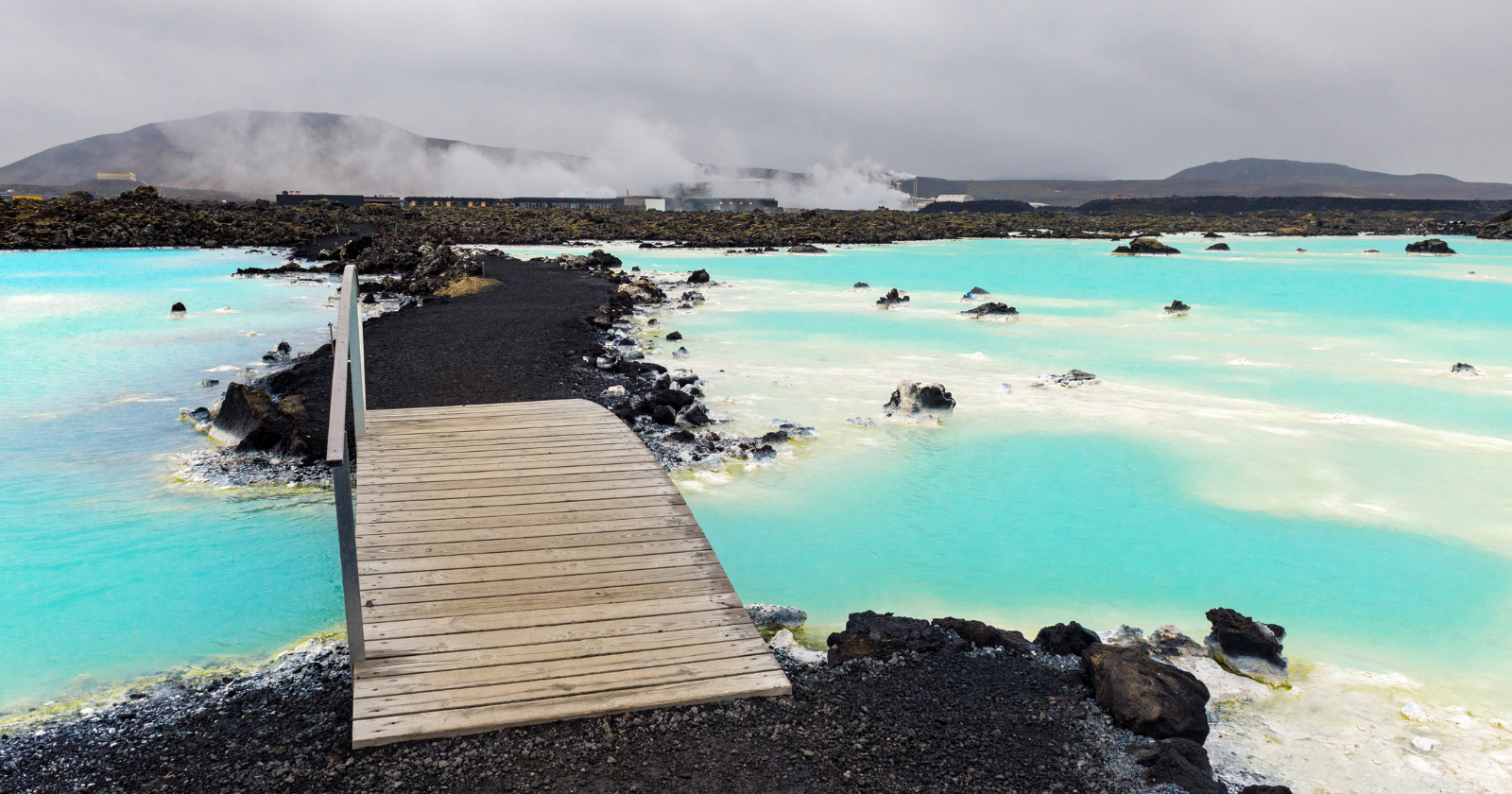
Nobody designed the Blue Lagoon. That is the detail the spa’s serene marketing photographs, all steam and milky turquoise against black rock, politely decline to mention. Iceland’s most famous attraction, a place that sells silence and silica face masks to well over a million visitors a year, began life as an industrial disposal problem that refused to dispose of itself.
The plant came first
In 1976, on the Reykjanes Peninsula’s raw lava fields southwest of Reykjavík, the Svartsengi geothermal power plant began operations. The plant drills roughly two kilometers down into rock heated by the Mid-Atlantic Ridge, where seawater has seeped through the porous lava and mixed with groundwater into a scalding, mineral-saturated brine at around 240 degrees Celsius. That brine is too corrosive and too salty to pipe into anyone’s radiators, so Svartsengi uses its heat to warm clean freshwater for the towns nearby and to spin turbines, and then it is left holding the used fluid, still hot, by the ton, every hour of every day.
The disposal plan was the lava field itself. The plant’s surroundings are a wilderness of rock from an eruption in 1226, and young lava is riddled with cracks and voids, so porous that Iceland’s rain vanishes into it without forming streams. Engineers released the spent brine onto the rocks with the reasonable expectation that it would percolate down and disappear, the way water always had.
The water disobeys
For a while it did. But the brine was not water; it was a solution carrying an enormous load of dissolved silica, leached from the deep rock and held in solution by heat. As the discharged fluid spread and cooled on the lava, the silica came out of solution, precipitating into microscopic particles that settled as a soft, white mud into every crack, pore and void the rock offered.
The lava field, in other words, was being grouted. Each day’s discharge lined the basin a little more thoroughly with silica sludge, plugging the drainage the engineers were counting on, and the pond that was never supposed to exist crept outward across the black rock, opaque and impossibly blue-white, the color itself a product of the suspended silica scattering sunlight. Svartsengi had built, entirely by accident, a self-sealing pool: the same mineral that made the wastewater striking made the ground beneath it watertight, and the more brine the plant discharged, the better caulked its pond became.
Locals regarded the spreading blue water as what it officially was, power plant effluent, and mostly kept out of it. The lagoon’s second accident was a man named Valur Margeirsson, a plant employee with psoriasis, who in 1981 asked permission to bathe in the warm runoff, reasoning that the mineral water might soothe skin that Iceland’s public pools made him self-conscious about. It helped, visibly, and word moved through Iceland’s psoriasis community with the speed of any good cure rumor. Within a few years people were picking their way across the lava to soak beside an operating power station, and in 1987 the first modest changing facilities went up. The lagoon acquired its name, then a company, then clinical studies confirming the silica and algae genuinely benefited psoriasis, then a dedicated treatment clinic, a research arm, a skincare line built on the white mud that had sealed the basin, and eventually a purpose-built luxury lagoon, hotels and a Michelin-starred restaurant.
The plumbing never changed
What did not change is the fundamental arrangement, which remains, to this day, gloriously industrial. The Blue Lagoon is still downstream of Svartsengi, still filled by the plant’s mineral-rich discharge, its nine million liters renewing completely every couple of days as fresh brine flows through at a bath-perfect 37 to 40 degrees. Bathers float in engineered runoff, between a power station and a lava field, and pay premium rates for it. The white silica mud that guests scoop from underwater buckets and smear on their faces is the same precipitate that plugged the rock, the caulk of the basin doubling as the product line.
Recent years have added a reminder of what the whole arrangement is built on. The volcanic system beneath the Reykjanes Peninsula reawakened in 2021 after eight centuries of quiet, and repeated eruptions near Grindavík have sent the lagoon into periodic evacuations while new lava flowed within sight of the water, stopped short of the plant by hastily raised barriers. The 1226 lava the brine seals is no longer the peninsula’s newest.
There is a tidy irony available here about wellness tourism and wastewater, but the better lesson is geological. The engineers of 1976 made only one mistake: they treated their discharge as water. Water drains through young lava; a silica solution entombs itself. The plant assumed the ground would swallow its problem, and instead the problem paved the ground, sealed its own pool, painted it blue, and became worth more than the electricity. Iceland’s most visited attraction is a chemistry error with a gift shop, and the error renews itself, nine million liters at a time, straight from the turbines.