

Run a quick 3 a.m. inventory of every relationship in your life. The spouse, the parents, the siblings, the friends — all beloved, and every single one carrying some balance: the thing said at Christmas, the call you owe, the low-grade negotiation that never fully closes.
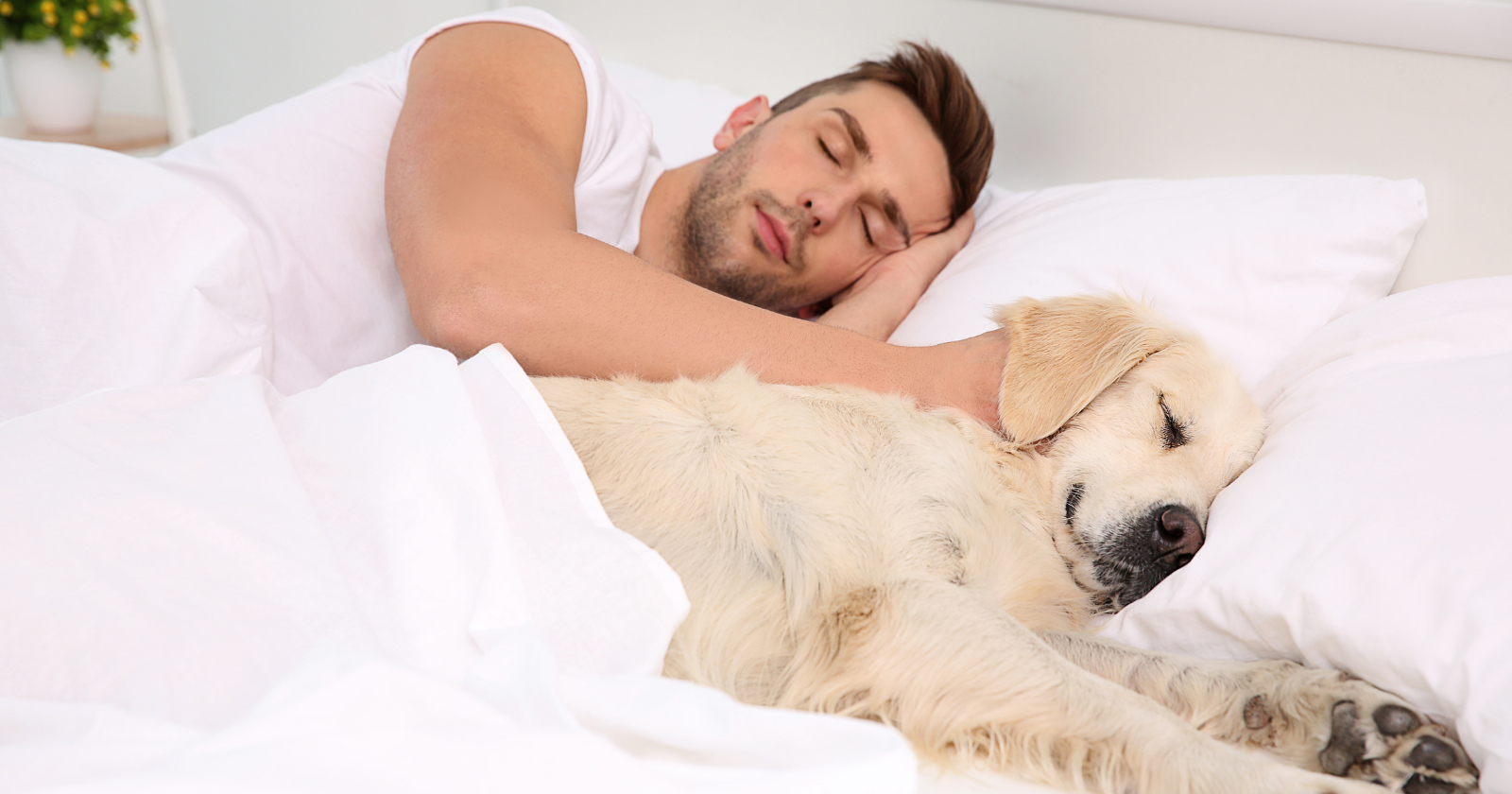
Now check the foot of the bed. Seventy pounds of fur, breathing slowly, holding — as it has for its entire life — a balance of exactly zero. No grievances on file. Nothing pending. The one connection in your entire portfolio with no unresolved tension anywhere in it.
It sounds like a joke about dog people. It isn’t. Researchers have put this exact comparison through laboratory stress tests, and the results were unflattering enough to the humans that the findings are still being cited thirty years later.
The experiment where the friend made everything worse
In a classic study, psychologist Karen Allen had women perform stressful mental arithmetic while researchers tracked their cardiovascular responses under three conditions: alone, with a close friend present, or with their dog present.
The dog condition won — calmer physiology than any other setup. But the twist was the friend condition: with a supportive human friend watching, women showed higher physiological reactivity and worse performance than with the dog or even alone. The friend — loving, encouraging, entirely on their side — made the stress worse. Allen’s follow-up work, wonderfully titled “The Truth About Cats and Dogs,” extended the comparison to spouses and found the same pattern: for comfort under pressure, the pet outperformed the spouse and the friend.
Why would the people who love us most raise our blood pressure? Because their eyes come with something the dog’s eyes structurally cannot carry: evaluation. Even the kindest human witness is a witness — someone forming an impression, someone whose opinion of us can move. The body knows it, and performs accordingly. The dog is the only audience on Earth in front of whom there is nothing to perform, because the dog is not grading. It never was. There’s no rubric in there.
That’s the physiology under the title’s claim, measured in heartbeats: the most stable presence in the house is the one that isn’t keeping any kind of book.
And no — it’s not a lesser bond standing in for a real one
Before anyone files this under “sad substitute,” the attachment science should be entered into the record, because it’s unambiguous: the dog bond is the genuine article, running on the original human machinery.
Psychologist Lawrence Kurdek tested whether pet dogs meet the formal criteria of attachment figures — the safe-haven and secure-base functions we normally reserve for parents and partners — and found that they do: people genuinely turn to their dogs in distress, not merely near them. And in a famous Science paper, Takefumi Kikusui’s team found that when dogs and owners gaze at each other, oxytocin rises in both — a positive feedback loop borrowed directly from mother-infant bonding. Hand-raised wolves, tellingly, don’t do it. Somewhere across ten thousand years of domestication, dogs plugged themselves into the exact neurochemical circuit humans use to bond with babies — which is why the thing in your bed doesn’t feel like an animal you own. Chemically speaking, it’s family.
So the bond is real, the machinery is real, the comfort is measurable. What makes it unlike every human attachment isn’t depth. It’s what’s missing.
The three gears the dog doesn’t have
Look closely at the title’s three clauses, because together they describe the machinery of every human relationship — even the good ones.
Humans keep score. Not out of pettiness (mostly), but because human love is a shared enterprise: contributions tracked, imbalances felt, ledgers quietly maintained because the enterprise fails if one party carries everything. Humans go cold strategically — the shortened answers, the withdrawn warmth — because in human relationships, affection is also a signal, and turning it down is how displeasure gets communicated without a fight. And humans require re-entry to be earned — the apology, the repair, the probation period — because trust, once dinged, is rationally rebuilt rather than restored on demand.
None of these are flaws, exactly. They’re the gears of accountability, and a human bond without any of them would be a strange, boundaryless thing. But live inside that machinery with every person you love, for decades, and it exacts a permanent low-grade toll: some part of you is always tracking the balance, reading the temperature, calculating standing.
The dog has none of the gears. It cannot run tit-for-tat; it holds no file. It cannot go cold to make a point; it has no points to make. And it cannot demand you earn your way back, because it never registered your departure as a debt — scold it at breakfast and be received at lunch like a returning war hero. The greeting after your worst day, your biggest failure, your ugliest week is identical to the greeting after your best: full wag, zero adjustment, nothing pending. The stability isn’t the absence of complexity in the dog.
It’s the absence of strategy. There is no move being made, ever. Just the same verdict, re-issued daily, unconditionally: you’re back, and that’s the whole story.
What the dog can’t do — and what it quietly teaches
Now the honest half of the title’s own caveat, because the dog’s superpower and its limit are the same feature.
The dog never keeps score — and never knows your story. It can’t betray you, and it also can’t forgive you, because forgiveness requires the ledger it never kept. It offers total acceptance of a person it cannot actually comprehend, which is precisely why the acceptance never wavers and precisely why it can’t replace the human kind — being fully known and still accepted is a prize only the scorekeeping species can award, and it costs what it costs. The dog isn’t a deeper love. It’s a different service: the one nonevaluative base in a thoroughly evaluated life — the place the performance stops.
And maybe that’s the quiet lesson worth stealing from the foot of the bed, the one Allen’s blood-pressure monitors were pointing at all along: the people we love are healthiest around us in the moments we manage what the dog does effortlessly — presence with the grading suspended. The unimpressed, unstrategic, no-file welcome home.
You’ll never fully pull it off. You have the gears; they turn on their own.
But the dog will be there again tonight anyway, holding its balance of zero — the only relationship you have that is, and has always been, entirely off the record.
Which, once a day at least, is exactly the record you need.