
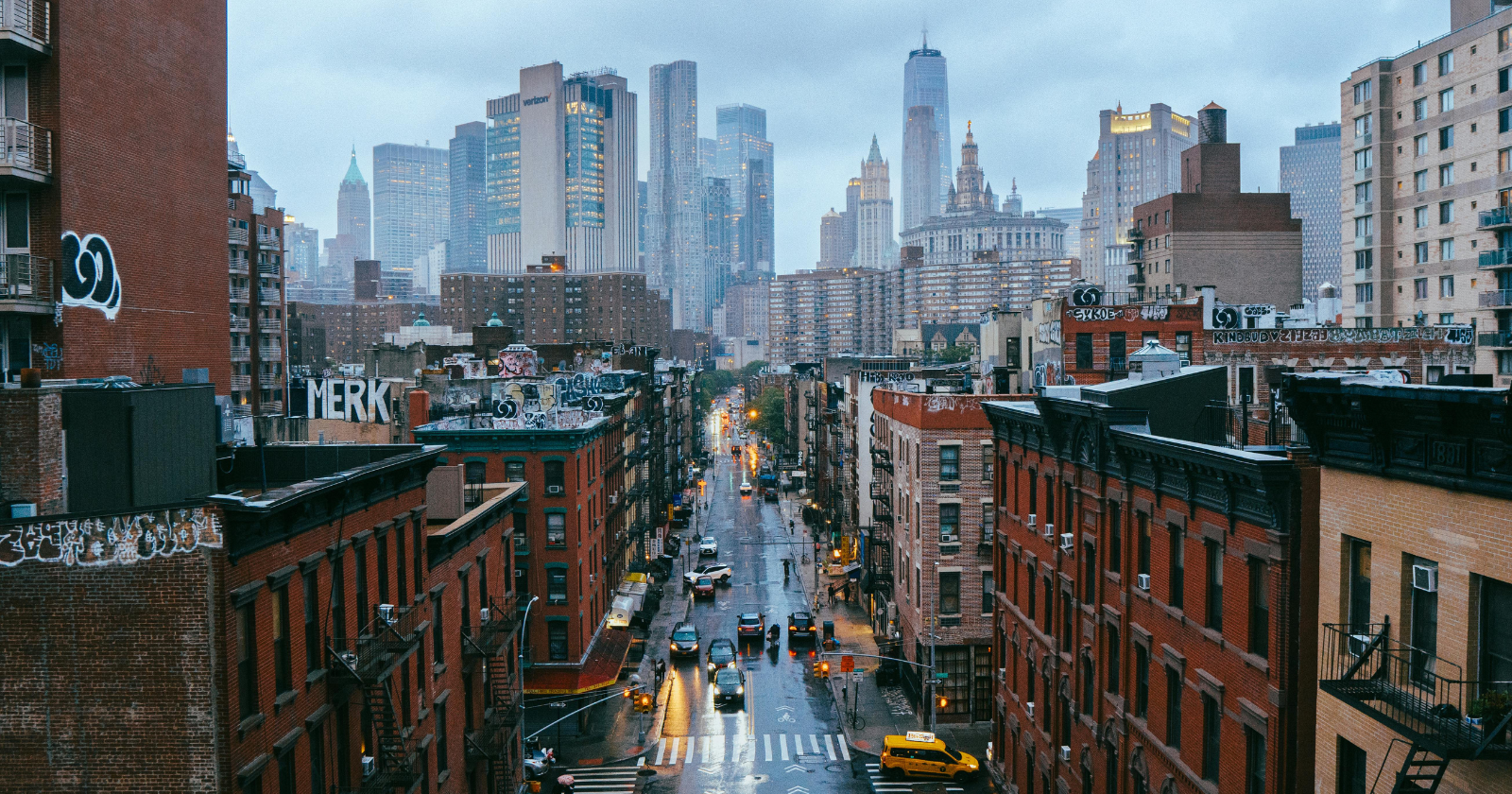

A man went down hard on the stairs at the Nassau Avenue G stop. February. Black ice tracked in on four hundred pairs of boots, and his feet just left him. Groceries everywhere. An orange rolled to the platform edge and dropped onto the tracks like it had somewhere better to be. A can of Spam may have been involved.
Here is the part I still think about. Not one person on those stairs had looked at him on the way down. Not at him, not at each other. Fifteen commuters, same thousand yard stare, all minding their own business with the discipline of monks.
Then three of them were on their knees picking up his shopping.
Nobody said “oh my gosh, are you okay?” Nobody performed concern. A guy in a Sanitation jacket handed him his hat, said “you’re good,” and was gone before the man could finish thanking him. Four seconds, start to finish. Every item recovered except the orange, which nobody was going to die for.
I had been in the city about five weeks and I was still keeping a mental tally of how rude everyone was. That morning the tally stopped making sense.
I’d taken a place in Greenpoint for a year, mostly to do a writing course, partly because I had just handed over a business and did not know what to do with my hands. I wanted the New York from the films. Wisecracking neighbours, dollar slices, stoop conversations, a diner where they know your order. What I got was a city that would not smile at me and would absolutely help me.
It took the full twelve months to work out that those two things are not a contradiction. They are separate skills, and most of us only ever train one.
Nice is a performance. Kind is a bill you pay.
Nice is a surface. Tone of voice, eye contact, the little upward lilt at the end of a sentence. It costs nothing and it can be produced on demand by absolutely anyone, including people who would sell your kidney.
Kind is different. Kind costs something. Time, money, dignity, being late, getting involved in a mess that is not yours.
The organisational psychologist Adam Grant went looking for a link between the two and could not find one. He assumed pleasant people would turn out to be generous people. When he ran the numbers, the correlation between how agreeable someone seems and whether they actually give was basically nil. Agreeableness, he decided, is your outer veneer. Giving and taking are your inner motives.
Which leaves you four kinds of people instead of two. Warm and generous, easy to spot. Gruff and selfish, also easy. Then the two nobody watches for. Disagreeable givers, prickly on the outside, would drive you to the airport at four in the morning. And agreeable takers, who Grant calls fakers, lovely right up until the moment you need something.
New York runs an unusually high concentration of the third type. Bangkok, where I live now, runs a lot of the first. Telling the four apart is one of the more useful adult skills nobody bothers teaching you.
The subway has a word for the silence
Why does nobody smile at you down there? I assumed hostility for months. Turns out sociologists named the behaviour sixty years ago and it sits closer to a courtesy than an insult.
Erving Goffman called it civil inattention. You glance at a stranger, you register that they are a person, then you look away. In plain English you are saying: I see you, I am not a threat, and I am not going to make you perform a conversation you did not ask for.
Goffman’s point was that the alternatives are worse. Staring turns people into objects. Not noticing them at all turns them into nobodies. The quick look and the glance away is the polite option, not the cold one.
Do the maths on a New York morning and it makes even more sense. Millions of bodies moving through tunnels on a schedule. If everyone did Manila small talk, or the boarding school thing where you acknowledge every single person you pass, the city would seize up by nine.
So the flat face is not coldness. It is a shared agreement to hand each other some privacy in public. And it switches off the second something actually happens. That is exactly what I watched on those stairs. Fifteen people minding their business, then the situation changed, and the agreement was over.
My hardware guy never once said good morning
Three blocks from my building there was a hardware shop, the kind with forty years of stock and no discernible system. The man who ran it did not do good mornings. Not out of malice. Greeting me simply was not part of the transaction.
I would describe a problem. He would look at me the way you look at a dog that has brought you a stick you did not throw. Then he would walk into the back and return with the correct object.
In March my radiator started doing an impression of a man being murdered in a bathtub. I described the noise badly. He listened, put a valve key on the counter, said a number, and went back to whatever he had been doing.
The key did not fix it. I came back the next day to complain and got precisely no sympathy for my trouble. Instead he shut the shop. He walked the three blocks through slush in a coat that was not up to it, came into my building, bled the radiator himself, recited my landlord’s number from memory, and left before I could pay him for anything.
He was not nice. On the available evidence he was one of the kindest people I met that year.
There is a whole category of person like this in that city, and if you screen for warmth you will miss every single one of them.
What the Bronx taught me about labels
I went up to the Bronx maybe a dozen times, mostly for food, once for a reading, once purely because people kept telling me not to.
Worth sitting with, that. The people warning me were, without exception, people who had never been. They were working from a mental picture assembled out of films made before I was born.
One evening I came out of the wrong exit near Fordham with no idea where my stop was. I asked a woman waiting at a shelter with two enormous shopping bags whether the Bx12 went from there. She told me I wanted a different bus entirely, in a tone suggesting I had personally offended her by being wrong. Then she argued with me about it. Then her own bus came and she did not get on it. She walked me two blocks, put me at the correct stop, waited until she could see mine coming, and left.
Warmth had nothing to do with it. Getting me onto the right bus, evidently, was non-negotiable.
The research on this is oddly cheering. A team led by Richard Philpot went through security camera footage of 219 real arguments and assaults in Amsterdam, Cape Town and Lancaster. In more than nine out of ten, at least one bystander stepped in. Not a lone hero either. The average was closer to four people.
Here is the bit that landed for me. Intervention rates came out the same across all three cities, including the one outsiders consider least safe. What predicted whether someone got help was not how dangerous the neighbourhood was reputed to be. It was simply whether the moment read as a situation that needed handling.
And the famous story that says otherwise, the one about the thirty eight New Yorkers who supposedly watched Kitty Genovese die in Queens in 1964 and did nothing, has been quietly taken apart. Researchers went back through the trial transcripts and archive material and found no evidence for thirty eight witnesses, no evidence they watched the murder, and no evidence they stayed passive. One of them shouted and drove the attacker off the first time.
We built an entire folk theory about the coldness of cities on top of a story that was reported wrong. Then we taught it in textbooks for fifty years, and a lot of people learned to expect less of the person next to them than they would actually give.
None of which makes the Bronx, or anywhere else, uniformly lovely. It just means the label was doing work that the evidence never asked it to do.
The only test I bother with now
One question, and it works on strangers, in parties, on job interviews, and slightly uncomfortably on yourself.
Did it cost them anything?
Nice is free. A compliment is free. “We should definitely catch up” is free. Remembering your dog’s name is nearly free. None of that is fake, it just does not prove anything.
Kind arrives with a price tag attached, and the price is usually inconvenience. The friend who says nothing sympathetic but is at the airport. The colleague who tells you your idea is weak in the meeting instead of nodding along and rolling their eyes about it afterwards.
Three ways I run that question in practice. First: when this person was inconvenienced by me, what happened? That is close to the whole game. Anybody can be pleasant to you while you are easy to be around.
Second: do they say the uncomfortable thing? Grant’s argument about undervalued people was exactly this. The ones who hand you feedback you did not want are usually the ones on your side.
Third: are they kind with no audience? No live stream on Instagram? Nice loves a witness. Kind does not particularly care either way.
The reverse is worth running too, because niceness is not the enemy here. Plenty of people are warm and generous at the same time, and I would take one of those over a prickly saint most days. The trap is not warmth. The trap is treating warmth as evidence.
What I actually changed when I got home
Two things.
The first thing is that I stopped auditioning. Fifteen years in hospitality had sharpened a habit of being extremely pleasant to everyone in the room, and it took me a while to notice that this is a professional reflex rather than a virtue. Restaurant nice is a service you are selling. I had been running it on friends, which meant I was warm with people constantly and useful to them rarely. I wrote a while back about how walking away from a business felt less like freedom than like losing my calendar, and the same adjustment was overdue here. Without a floor to work, I had to find out what I did for people.
So now I aim to be a bit more boring and a lot more available. Fewer “so good to see you”s. More turning up.
The second thing is that I got much slower to write people off. The gruff waiter, the neighbour who does not do hellos, the colleague with no small talk. I used to read all of it as a verdict on me. These days I assume I am looking at a clunky interface and I wait to see the operating system underneath.
I still get it wrong regularly. Some people are rude, warmth is not worthless, and a city where nobody meets your eye carries real costs I would rather not pretend away. Loneliness in New York is a specific and famous flavour of loneliness for a reason.
But what I brought home from that year was not “New Yorkers are secretly lovely.” It is smaller and more useful than that.
Nice and kind, or politeness and decency if you want the fancier words, are separate muscles. Some cultures train the first one very hard. Some train the second. Almost nobody trains both, and hardly anyone notices which one they are actually good at.
I know which one I would want the next time I stumble down the stairs.