
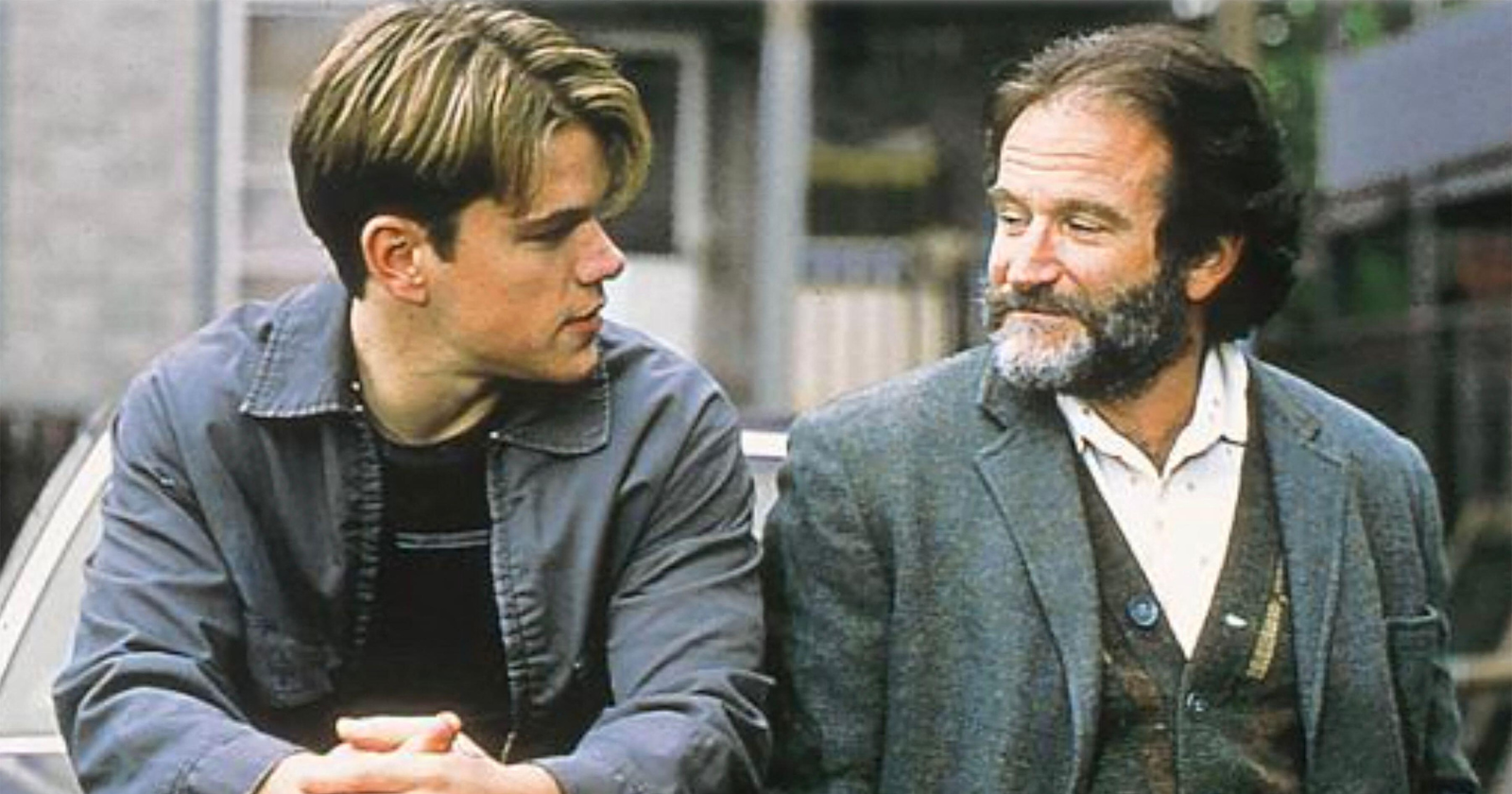

The first Robin Williams I knew was the loud one. Aladdin’s Genie on a worn-out VHS, rewound so many times the tape started to warble. Then Mrs Doubtfire. I was a kid, and as far as I was concerned the man was a machine for producing noise.
Years later I was twenty-something and jet-lagged in a rented room in London, watching Good Will Hunting on a laptop balanced on the radiator, the only warm surface in the place. Then the bench scene, the one where Sean tells a clever, arrogant kid that reading a book about war does not mean he knows anything about holding a friend while he dies.
Williams barely moves in it. No voices. No accents. No riffing. Just a man sitting very still, speaking softly, letting the silences run long enough to get uncomfortable.
I remember thinking, with the particular confidence of someone that age, that I had finally caught him doing the hard version.
I had it backwards.
The performance everyone remembers is the easy one
Ask anyone about Robin Williams and you get the hurricane. The talk show appearances where he ran on fuel the rest of us do not have access to. That is the version we all bought tickets for, and it is also, apparently, the version that took the least out of him.
People who worked with him kept describing somebody else. Lisa Jakub, who played his daughter in Mrs Doubtfire, has said the assumption that he was exhausting to be around was simply not true. As an introvert, she found it reassuring how often he was quiet and just listening. His manager of thirty-five years said as much at a Sundance screening of the documentary about him, calling Williams a very, very shy person who went inward whenever he was not performing or among close friends.
Two people sharing one life
Steve Martin, in that same documentary, said his friend was more comfortable on stage than off it. Read that twice, because it undoes the whole public image in one line. The most exposed place in the room was the restful one.
Which brings me to the film of his I would actually defend to strangers: One Hour Photo. Nobody’s comfort watch. He plays a man who develops other families’ holiday snaps and quietly decides he belongs in them. Williams does almost nothing in it. Flat voice, bad haircut, small careful movements, a face doing its best to look like a face.
It is the most unsettling thing he ever put on screen, and I think that is because the quiet was not a trick he had to learn. He already had it. He just usually kept a hurricane parked in front of it.
Most of us are two people as well. We work at a smaller scale, so nobody makes a film about it.
The tidy story is the wrong one
Here I have to slow down, because there is a lazy narrative available and I do not want to hand it to you.
The sad clown thing is neat, quotable, and mostly inaccurate in his case. After his death in 2014, his widow Susan Schneider Williams wrote an extraordinary piece in the journal Neurology describing his final year. He had been diagnosed with Parkinson’s a few months earlier. The autopsy found something else: diffuse Lewy body disease, in nearly every region of his brain and brain stem, which doctors told her was among the worst cases they had seen. She has since been clear that depression was one symptom among dozens and not the predominant one.
So the melancholy his friends noticed was real, and it was also, at the end, tangled up with a disease nobody had named yet. Both true. Neither explains the other. We do this with people we know all the time: notice a quietness, write a story to explain it, and the story is always simpler than the person.
Holding a face in place is expensive
The sociologist Arlie Hochschild had a name for the work of manufacturing an expression you are not actually feeling. She called it emotional labour, and split it in two.
Surface acting is faking it. You are flat, you produce a smile, and the gap between inside and outside stays open all day. Deep acting is talking yourself into feeling something closer to what you are showing.
The research is unglamorous but consistent: surface acting is the one that wrecks people. It is linked to emotional exhaustion and to feeling detached from your own work, and it does not politely stay at the office. It follows you home as insomnia, as having nothing left for the people who live with you.
Nobody surface acts more than a professionally delightful person.
Who has met the quiet version of you
Right. Practical.
Name three people who have seen you at low wattage. Not crying, not in crisis. Just flat. Uninteresting. Making no effort to be good company, and not apologising for it afterwards.
Three is decent. If you got to one and it was a family member who does not really have a choice, pay attention to that. If the honest answer is nobody, every relationship you have runs on you being switched on, which makes all of them a job.
That is the actual risk, and it isn’t being private. Everybody has an inner life that looks different from the outer one. What matters is whether the private version ever gets introduced to anyone, because, left unintroduced long enough, it starts to feel unintroducible.
Small ways to close the gap
Stop treating your good mood as the cover charge for company. If you only see friends when you are on form, you have quietly agreed the flat version of you is unwelcome, and they have no idea they signed anything.
Walk with people instead of sitting opposite them. Side by side, no eye contact, no obligation to perform. It is remarkable what gets said when everyone is looking at a road.
Learn to answer honestly at low resolution. Not a confession. Just “bit rough this week, nothing dramatic” instead of the reflexive “yeah, great.” Small door, but a door.
I have a friend who has been the funniest man in any room he walked into for as long as I have known him. Reliably. All night, every time, without visible effort. Then he went quiet for about four months, and I told myself he was busy. Easier than ringing him.
He was not busy. He had been having the worst year of his life and had stopped turning up anywhere he would be expected to be entertaining, which by then was everywhere. He is fine now. I still think about how long I let a theory do the work of a phone call.
So when someone quiet goes quiet on you, do not build a theory. Ring them.
Back to the bench
That scene lands, I think, because it is the one moment where the character stops performing. Sean spends the whole film deflecting with jokes. Then he sits down, says the plainest possible thing in the plainest possible voice, and a kid who has never lost an argument in his life has nothing to say back.
By every account of the people who actually knew him, the loudest man in the room was the quietest one. That is not a tragedy in itself. Lots of us are like that.
It only becomes one when nobody ever gets to meet him.
If any of this is landing close to home, talk to someone. A GP, a therapist, or a friend who will not need you to be entertaining about it.