
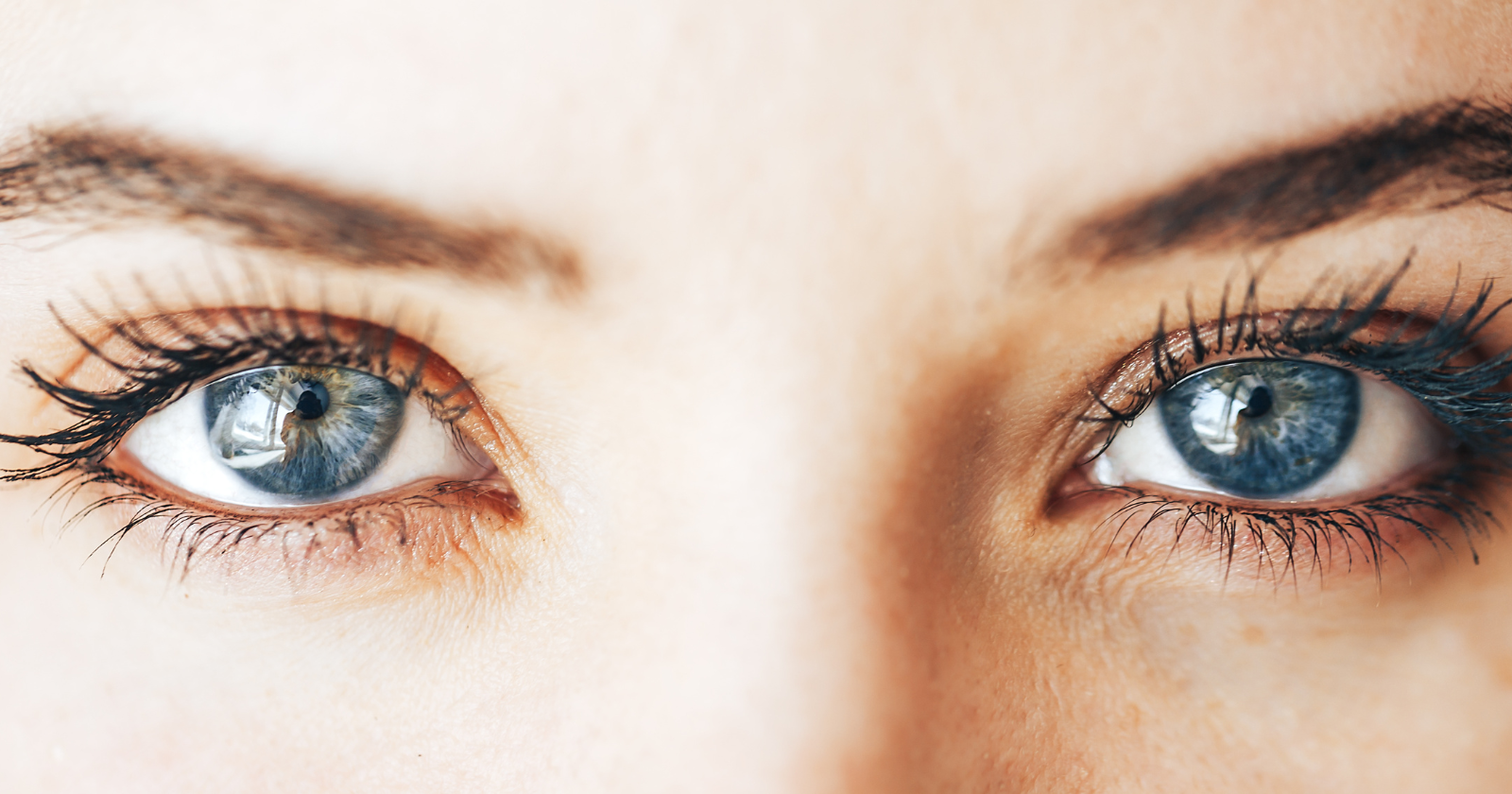
Portrait retouchers worked this out long before the psychologists did: brighten the whites of the eyes and the whole face seems to lift.
It happens in the same pass as softening skin and darkening lashes, and it takes about four seconds. Nobody looking at the finished picture can say what changed. They just quietly decide the person looks well.
The only blank canvas on the face
Humans are the odd primate here. Most monkeys and apes carry heavy pigment in the sclera, so their eye whites read as brown or near black, while ours are pale, glossy and unusually large when seen head on. That makes them a display surface for whatever is going on underneath: blood vessels dilating in the transparent membrane over the top, fat settling into collagen, pigment, bilirubin.
A team led by Slawomir Wacewicz tested how much that display matters. Writing in Scientific Reports, the researchers built 20 realistic hominin faces and gave each one a bright, humanlike sclera and a dark, apelike sclera, then asked several hundred people to rate them. The bright-eyed versions came back younger, healthier, more attractive, more trustworthy and less aggressive. Almost nobody noticed the eyes had been edited at all.
What the ratings studies found
Robert Provine and colleagues at the University of Maryland, Baltimore County got there first with real faces. In a paper published in Human Nature, they took photographs of eyes and digitally tinted the whites red, yellow, or whiter than life. Red and yellow eyes were rated less healthy, less attractive and older. The bleached “super-white” version tested younger and stopped there: no healthier, no more attractive than the untouched control.
So the effect has a ceiling, which is bad news for anyone hoping to slide the whitening dial to eleven.
Richard Russell and co-authors then looked at what happens naturally over a lifetime. Their study in Psychology and Aging measured sclera colour across a large sample of adult women and found the older faces had whites that were darker, redder and yellower. Nudging those values up or down on the same face moved every judgement with them: age, health, beauty. Whiteness measured on ordinary unretouched portraits tracks attractiveness ratings too, per a study by Martin Gründl’s group in Aesthetic Plastic Surgery.
All of these are photo-rating experiments with modest samples, mostly on white European faces, which is a real limit. What they have going for them is agreement. Separate labs, separate methods, same direction of travel.
Why eyes stop being white
Ageing does it chemically. Lipids accumulate between the collagen fibres of the sclera, and decades of ultraviolet light alter the elastic fibres in the tissue over it. A lifetime of small inflammations adds to that, leaving the vessels sitting slightly more open than they once did. Sex plays a part as well: Sarah Kramer and Russell reported in Archives of Sexual Behavior that male sclerae carry noticeably more red and yellow pigment than female ones, a difference most people cannot name but apparently still register.
Boring explanations, mostly
Red whites usually mean a short night, dry air, hay fever season, or eight hours of staring at a screen without blinking properly. Tina Sundelin’s team at Karolinska Institutet photographed people after normal sleep and again after 31 hours awake, and observers rated the sleep-deprived faces as having redder eyes, heavier lids, more swelling, darker circles and a sadder expression. As documented in Sleep, the eyes did most of the telling.
Yellowing is a different animal. A yellow cast across the white is scleral icterus, the classic visible sign of raised bilirubin, and it points at the liver or the bile ducts rather than at last night. That one earns a doctor’s appointment, not a filter.
The people who tried to force it
Because a cue this quiet still gets noticed, somebody inevitably tried to buy it outright. Cosmetic wide conjunctivectomy, a procedure that strips away reddened conjunctival tissue and applies the chemotherapy agent mitomycin C to stop it growing back, became popular in South Korea and was marketed in the United States as I-BRITE.
The results were spectacular in the wrong direction. A cohort study of 1,713 patients in Seoul, published in the American Journal of Ophthalmology, put the overall complication rate at 82.9 percent, with 55.6 percent of those graded severe: fibrovascular overgrowth, calcified scleral plaques, raised eye pressure, double vision. Majid Moshirfar and colleagues rounded up that finding along with the rest of the case reports in a review for Clinical Ophthalmology. Necrotising scleritis, in which the white of the eye dies back, turned up repeatedly. South Korea’s Ministry of Health and Welfare eventually banned the operation outright, as documented by the ophthalmology reference EyeWiki, which notes there is still no equivalent ban in the United States.
Vasoconstrictor drops can shrink the vessels for a few hours, though used often enough they tend to bring the redness back worse than before, and a phone camera will do the job for free.
Neither touches the thing being signalled. A clear sclera is legible precisely because it is cheap to lose and awkward to fake, a strip of tissue with no makeup, no muscle and nowhere to hide, reporting on sleep and liver function and the state of the smallest plumbing in the body. Which makes it less a beauty feature than a gauge, mounted on the front of the face, angled outward, readable by strangers from a metre and a half away.