
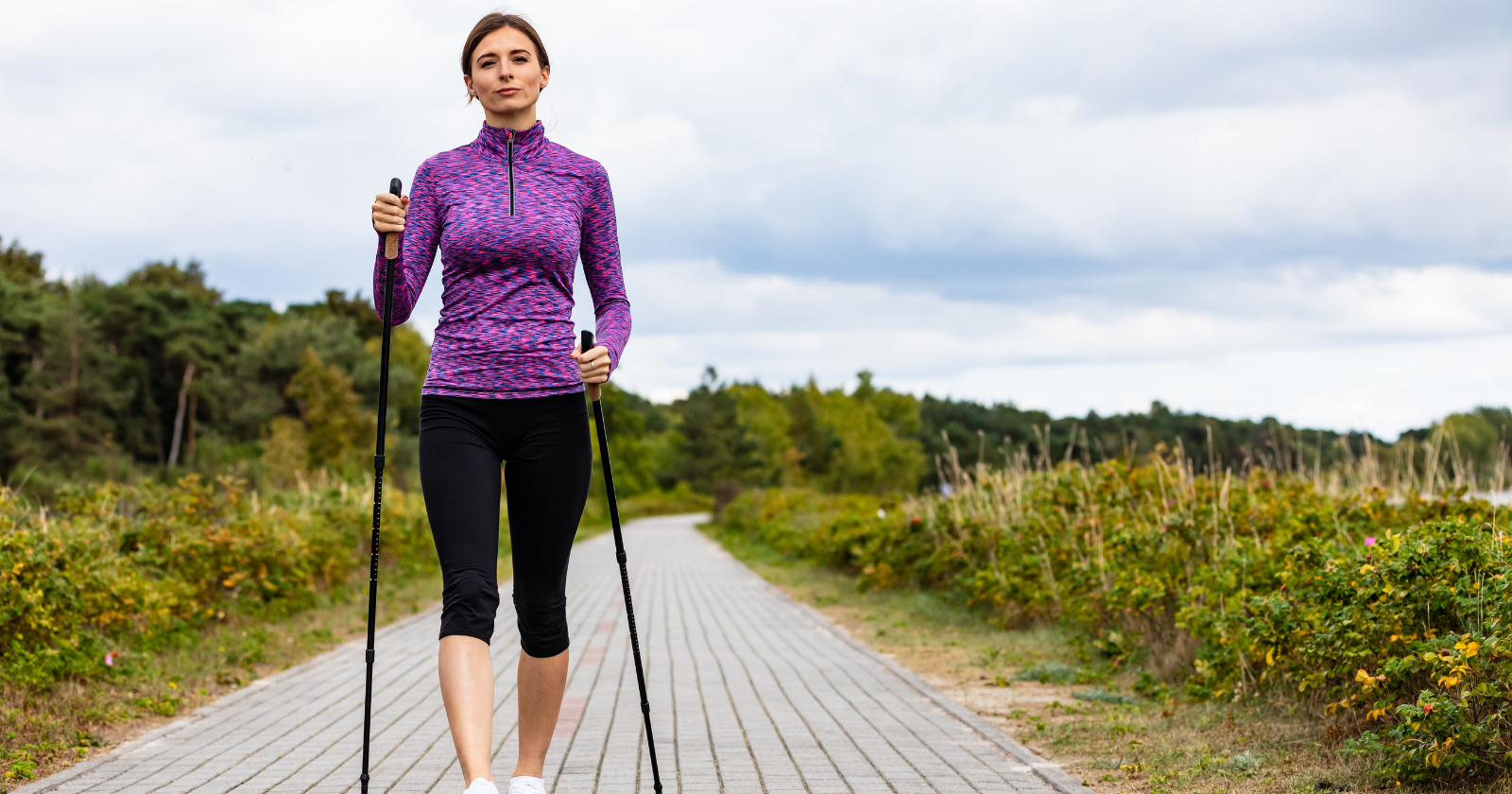
You know the image: someone on a paved path or a city sidewalk, a pair of poles clicking against the concrete, no snow anywhere, and usually a walker past sixty setting a steady pace. That image is real, and it has shaped how most people file Nordic walking in their heads. It looks like a gentle, low-stakes activity, the sort of thing recommended to people who need something easier on the knees.
Where it actually started is different. An elite cross-country skier in Finland, staying fit through the months when the snow was gone, walking on dry ground with the same poling motion they used on skis. Same gear, roughly the same movement, completely different person. That gap changes how you read the modern version once you know it.
We are not doctors, physiologists, or trainers, and none of what follows is exercise advice. This is our reading of the research and the history. The studies here are mostly small, so any figures describe averages across groups rather than what a given walk will do for a given person.
Where the poles actually came from
Nordic walking traces back to Finnish cross-country skiers who wanted a way to keep their fitness up through the snow-free part of the year. As Vanderbilt orthopedic surgeon Dr. Caitlyn Mooney puts it, “Cross-country skiers used poles during the snow-free months to maintain their conditioning.” One detailed account traces the habit to Finnish skiers as early as the 1930s.
For decades this stayed a training drill, not a pastime. It lived inside sports institutes and elite training circles, a way for serious athletes to keep the upper body and the poling rhythm sharp without snow underfoot. Nobody was selling it. There were no branded poles, no name, no classes. It was the ski-team version of a runner doing hill repeats in the off-season.
How a drill became a named sport
The shift to something more formal came in stages. A Finnish coach, Mauri Repo, included pole walking in a cross-country ski training manual in 1979, an early written trace of the idea. The bigger move came in the mid-1990s, when the Finnish outdoor-sports body Suomen Latu began collaborating with the Vierumäki Sports Institute and pole maker Exel in 1996 to turn the athletes’ habit into something the general public could take up.
In 1997, Exel launched the first purpose-designed poles and sold the whole thing as an exercise program. That is the moment an informal skiers’ warm-up became a distinct sport with a name and a product behind it. From Finland it spread quickly into Germany, Austria, and Switzerland. By the mid-2000s the International Nordic Walking Association estimated more than 3.5 million people did it worldwide, mostly in Europe.
From the ski team to everyone
The reason it caught on so widely is that the thing that made it useful for skiers made it useful for almost anyone. The poles are not there for balance or as a nod to fragility. They pull the upper body into a movement that would otherwise be all legs, which is exactly what a skier wanted from the off-season drill, and what a health researcher sees when they measure it.
Massachusetts General Hospital cardiologist Dr. Aaron Baggish describes it plainly: “The basic concept is you add upper body activity in the context of using Nordic poles, or walking poles, to assist with moving forward when you’re walking.” He puts the muscle side simply, telling Harvard Health: “When you walk without poles, you activate muscles below the waist. When you add Nordic poles, you activate all of the muscles of the upper body as well.” He estimates you are “engaging 80% to 90% of your muscles, as opposed to 50%, providing a substantial calorie-burning benefit.” Those percentages are his own characterization rather than a settled measurement, but they capture why the poles matter.
The extra work shows up when measured. Harvard Health’s summary of the evidence puts the extra calories burned at 18% to 67% more than regular walking, a wide range that reflects how much technique and pace vary. The often-cited 2002 Cooper Institute testing came out more modest, around a 20% average increase, closer to 17% for women and 21% for men. One trial found Nordic walking raised oxygen use and upper-arm muscle activity over ordinary walking, along with a higher heart rate.
What the origin story changes
Knowing where it comes from reframes the person on the sidewalk. The poles are not a concession to age. They are a leftover from elite ski conditioning, and that lineage is why the workout is more serious than it looks.
Personal trainer Stephanie Mansour, writing for TODAY, sums up the effect: “Walking with poles turns it into a total-body workout.” At a brisk pace the intensity climbs well beyond a stroll, which is part of why researchers keep studying it as something more than a leisurely walk.
There is a reason so many older walkers took it up, and it is not that it is easy. It delivers a real cardiovascular workout with less pounding than running, which is also why it has found a place in cardiac rehabilitation.
The poles-and-no-snow image reads as quaint until you know what those poles are actually doing. They are the same tool a Finnish ski racer reached for in the summers of the 1930s, doing the same job: turning a walk into a whole-body effort. The equipment never got easier. The audience just got wider.