


I did not see most of Málaga’s landmarks.
I had a list, the way most travelers do: the cathedral, the Alcazaba, the Picasso museum. But I kept not quite getting to it, because I kept finding a reason to sit down at whatever café was in front of me instead.
A cortado here. Somewhere else for the tostada. A third stop for no better reason than the light coming through the window looked like a good place to sit for twenty minutes and watch the street. By the end of the trip I had a mental map of the city built almost entirely out of where I had ordered coffee, and almost nothing built out of where I was supposed to have taken a photograph.
I used to feel a little guilty about trips that went this way, as if I had failed some basic requirement of tourism by not seeing the things everyone tells you to see. I have to admit — that was one of the reasons why I decided to think of the Málaga trip as a working-vacation kind of thing.
The plan was simple: work from the apartment in the mornings while it was still cool, and go sightseeing once the evening rolled around.
Nobody warned me that a large share of Spain treats air conditioning as optional. My apartment had a ceiling fan, which is a wonderful thing to own at twenty-two degrees and functionally decorative at closer to forty. By mid-morning the room had turned into something closer to a proofing oven for bread than a home office.
Simply put, I was frying, and there is only so much serious work you can produce while frying gently at your own kitchen table.
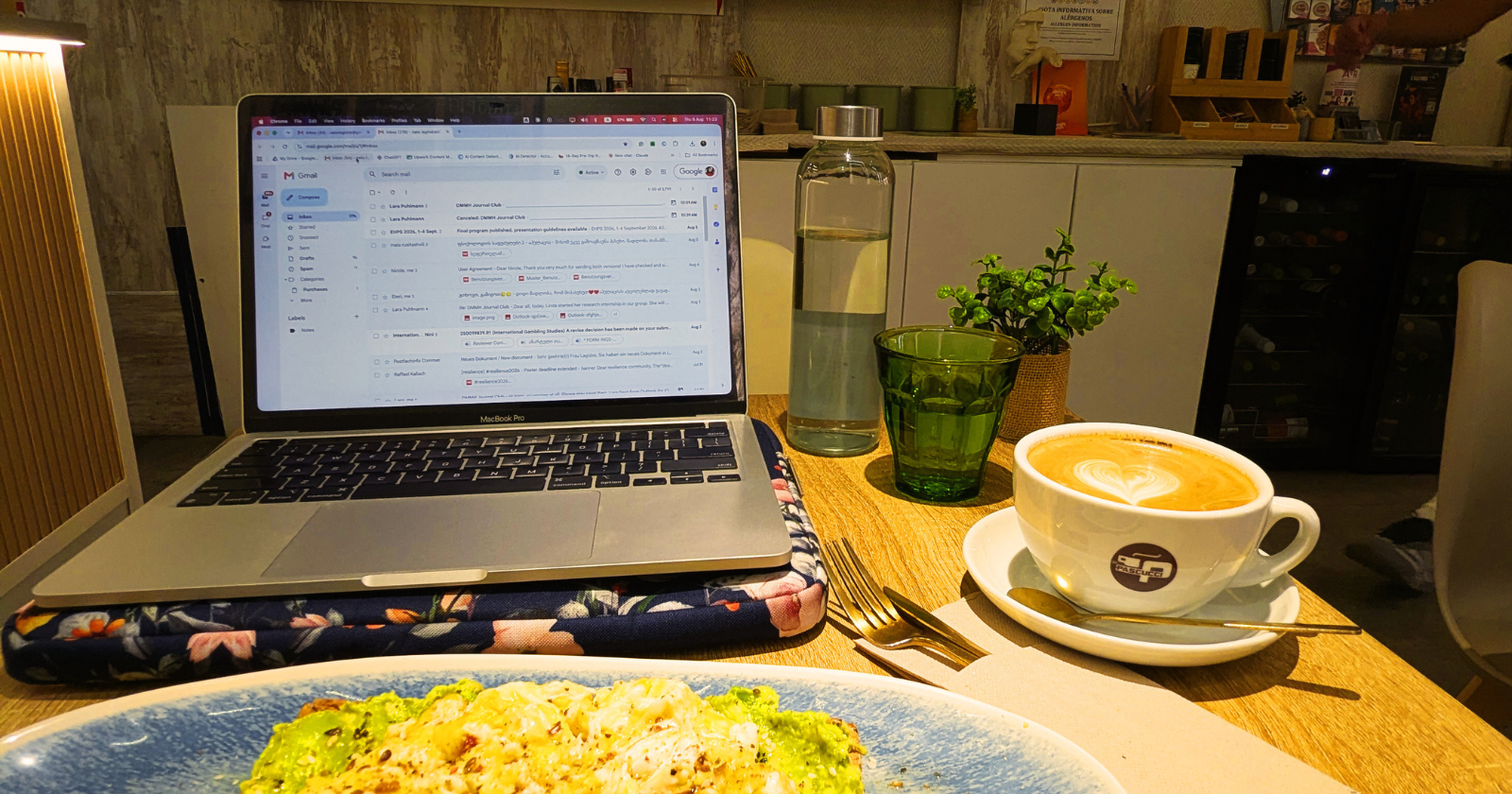
Plot twist: the plan didn’t really work.
But I did find out that a laptop travels quite well to an air-conditioned café and that the deadline I had told myself the trip would finally let me handle is oddly easy to abandon once nobody is checking and the room is a comfortable temperature. I opened it in three or four different cafés and, if I am honest, closed it again within twenty minutes each time, not because the writing wasn’t happening but because something else in the room usually seemed more worth paying attention to than the work I was ostensibly there to do.
It turns out I was not doing anything unusual. I was doing, slightly ahead of schedule, a version of what survey data suggests a growing number of travelers are now choosing on purpose, even if the numbers on record so far measure the shift against nightlife specifically, not against landmarks the way my own trip did.
The numbers behind a habit I thought was just mine
A survey of travelers across France, Germany, the UK and the US, conducted for GetYourGuide’s 2026 travel report, found that one in three travelers now rank a destination’s coffee scene above its nightlife when deciding where to go, and a quarter of millennials specifically said they would choose a destination for its coffee culture alone.
Coffee tour bookings on the platform rose 54 percent over the previous year. None of that reads, on its own, like much more than a niche enthusiasm for espresso. What it actually points to, I think, is a much bigger shift in what people expect a vacation to give them back.
Landmarks are designed to be looked at. A cathedral, a museum, a viewpoint, they exist in the same form for every visitor who arrives, on a schedule that has nothing to do with your actual day.
A café is different by construction. It exists on the rhythm of the people who use it daily, whether or not you happen to be there, and sitting inside it for twenty minutes puts you, briefly, inside a rhythm that belongs to somebody else’s ordinary life rather than a rhythm built for tourists.
The place that is neither home nor a checklist
Sociologists have a term for exactly this kind of space, developed decades before café tourism was a travel-industry trend line.
The sociologist Ray Oldenburg called it a third place, somewhere that is neither home nor work, where people gather without an agenda and status matters less than simply showing up. What Oldenburg was describing in local neighborhood life turns out to translate almost perfectly to what a traveler is looking for when they choose a café over a monument. You cannot rent a third place for an afternoon the way you can buy a museum ticket. But you can sit inside one that already belongs to somebody else’s town, order what the regulars order, and get a few minutes of proximity to a life you are not actually living.
That is a strange thing to want from a vacation, if you think about what vacations were traditionally sold as. The whole premise of a landmark-driven itinerary is that you are there to consume the place, efficiently, in the time available. Sitting in a café for no particular reason is closer to the opposite instinct: you are not there to consume anything specific. You are there to watch, and occasionally to be quietly included in something you did not build.
Efficiency is what a landmark asks of you. A café asks for the opposite: no plan, no photograph, just twenty minutes that already belong to whoever actually lives there.
What I actually wanted from Málaga
Part of my own research, outside of writing, looks at how people form attachment to places, why some cities start to feel like they belong to you faster than others, and why that almost never has anything to do with how many of the official sights you managed to check off.
What I noticed in Málaga was that hopping between cafés gave me something closer to that feeling than a single landmark ever had. I was not looking at the city from the outside, the way you look at a painting in a museum. I was, for the length of a coffee, sitting inside its actual daily traffic: people arguing gently about football, a waiter who clearly knew everyone’s order before they said it, an old man reading the same three pages of a newspaper for forty-five minutes because he was not actually there for the newspaper.
None of that would have shown up on a list of things to see. It also made me feel considerably less like a tourist, which is a strange thing to say about someone who very obviously was one, holding a phone, not fluent in the local rhythm of the room, occasionally getting an order slightly wrong. But there is a real difference between watching a place from behind a landmark’s velvet rope and sitting inside its actual, unremarkable daily life for twenty minutes at a time. The second one does not photograph as well. It is also, I have come to think, the entire reason to go anywhere at all.
There is a version of tourism that is really just walking, slowly, with no destination beyond the next place that looks like it might let you sit for a while, and I think that version of a trip teaches you more about a city’s actual shape than an efficient day of ticking off sights ever does. You learn which street gets shade in the afternoon. You learn what time the regulars show up and what time they leave.
None of it is information you could have looked up beforehand, and none of it fits neatly into a guidebook, which might be exactly why it feels like the part of the trip that was actually mine, rather than borrowed from someone else’s list of what Málaga is supposed to be about.
The vacation nobody had to justify to anyone
I do not think this is really a story about coffee, and I do not think the travelers in that survey are choosing espresso over the Colosseum because the espresso is better.
What they are choosing, whether or not they would put it this way, is proximity over performance, the chance to sit inside somebody else’s ordinary morning rather than stand outside their history with a camera.
A landmark tells you what a place used to be. A café, on a slow morning with nowhere else to be, tells you what it actually is, right now, while you happen to be sitting in it.