
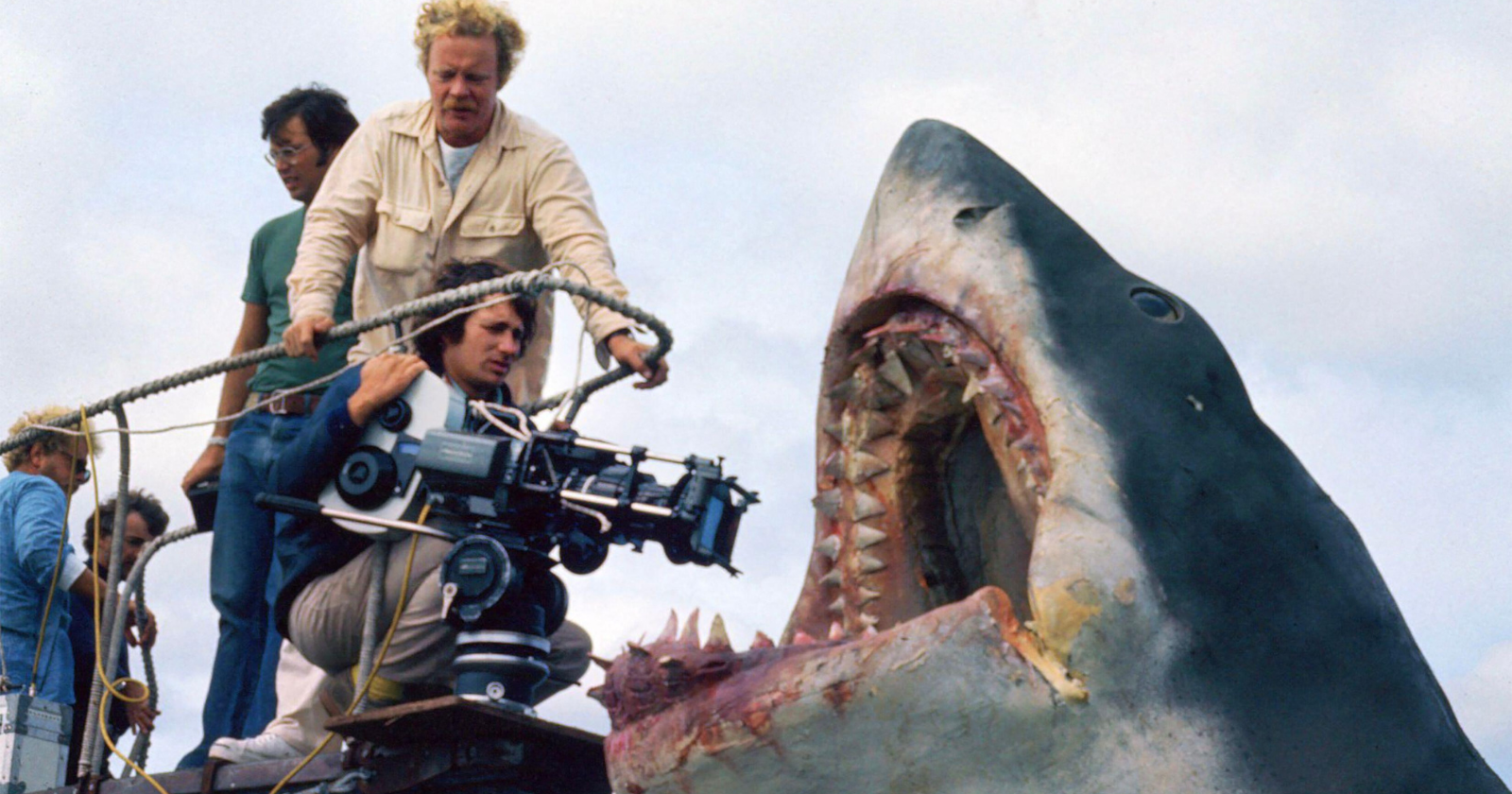
Three separate mechanical sharks were built for Jaws, and between them they spent nearly as much time in repair as they did in front of the camera. The crew called all three sharks Bruce, collectively, a private joke named after Steven Spielberg’s own lawyer, and Bruce’s first professional act, on his very first day of operation in the waters off Martha’s Vineyard, was to sink to the bottom of Nantucket Sound. It did not get much easier from there.
What followed was one of the more famously miserable shoots in Hollywood history, and also, almost by accident, a masterclass in how a production disaster can end up teaching a director something he couldn’t have learned any other way.
A shark that couldn’t survive its own ocean
Bruce and his two backup models were built for a controlled environment, then sent into one of the least controlled environments imaginable, because Spielberg wanted the film shot on the open sea, not in a studio tank. Saltwater, it turned out, was the one variable nobody had fully engineered around. According to accounts of the production, the corrosive water ate through the shark’s electric motor within about a week of shooting, and from that point on the crew was left with a nightly ritual of draining, scrubbing, and repainting the mechanism just to get it functional again for the next day. Even when it worked, it rarely worked convincingly — its eyes crossed at the wrong moments, its teeth read as too bright and too clean on film, and its jaws had a habit of simply refusing to close all the way.
The production, originally budgeted for 55 days and roughly $4 million, stretched to 159 days and very nearly $8 million, largely because a mechanical prop kept failing in the one setting where failure was hardest to fix quickly. Spielberg, still in his twenties and directing what was expected to be a fairly straightforward monster movie, was left running a shoot that had, in practical terms, lost its monster.
The pivot nobody planned for
Faced with a shark that couldn’t be trusted to work on any given day, Spielberg did the only thing left available to him: he stopped trying to show it. He has since described reaching for a very different reference point than the creature-feature tradition Jaws was ostensibly part of.
“I had no choice but to figure out how to tell the story without the shark. So I just went back to Alfred Hitchcock: ‘What would Hitchcock do in a situation like this?’ … It’s what we don’t see which is truly frightening.” — Steven Spielberg
That reframing is the reason Jaws plays the way it does. Instead of full, well-lit reveals of a rubber monster, the film leans on point-of-view shots gliding along the ocean floor, a fin cutting the surface at a distance, the low pulse of John Williams’s two-note theme standing in for a creature the camera almost never lingers on directly. What reads today as a masterclass in suggestion and restraint was, in the moment, a workaround born entirely out of necessity — a director hiding a prop that wasn’t working, not making a statement about what horror should look like.
What the workaround actually did to an audience
The suggestion-over-spectacle approach wasn’t just a critical talking point later on. It worked on the audiences sitting in the theater at the time, in ways the production could measure almost immediately. Producer Richard Zanuck later described the reaction at early screenings in blunt terms: “People were ripping out the seats. The place went crazy.” That reaction didn’t stay contained to movie theaters. Within weeks of the film’s release, a Los Angeles Times report, later recounted alongside other firsthand accounts of the film’s release, documented what it called “shark mania” spreading along real beaches that summer — swimmers reluctant to go past the shoreline, long-distance ocean swimming declining, and lifeguards fielding a spike in shark-sighting reports for fish that, in calmer years, nobody would have looked at twice.
A film built around withholding its monster had somehow made people more afraid of an ocean they couldn’t see into at all.
A release date pushed by the same problem
The delays had a second cost beyond money: they pushed Jaws out of its original Christmas 1974 release window and into the summer of 1975, a season that at the time was considered a dumping ground for weaker films, not a showcase slot. Universal treated the new date as an opportunity, not a retreat, and built an aggressive promotional campaign around it — heavy television advertising in the weeks before release and an unprecedented simultaneous opening on 464 screens at once, a scale of release nobody had attempted before. The film earned more than $100 million in its first five weeks, becoming the first movie to cross that mark in the United States, and in doing so it quietly rewrote the calendar that every studio blockbuster has followed since. The idea of summer as the season for the biggest movie of the year exists, in no small part, because a broken shark forced a release date nobody wanted.
What survived the shark that didn’t work
The lesson about the power of suggestion over spectacle came out of a young director improvising his way through a mechanical failure that, at various points during a chaotic shoot, threatened to sink the entire production.
What’s left, five decades later, is a film routinely cited as one of the most effective thrillers ever made specifically because of what it withholds — a lesson about restraint that arrived by accident, dragged up out of the water alongside a shark that, on its best days, still couldn’t quite close its own jaw.
Every generation of filmmakers that has since been told to trust the audience’s imagination over a special effects budget is, whether they know it or not, quoting a lesson a malfunctioning prop taught a twenty-seven-year-old director who had no other option available to him.