
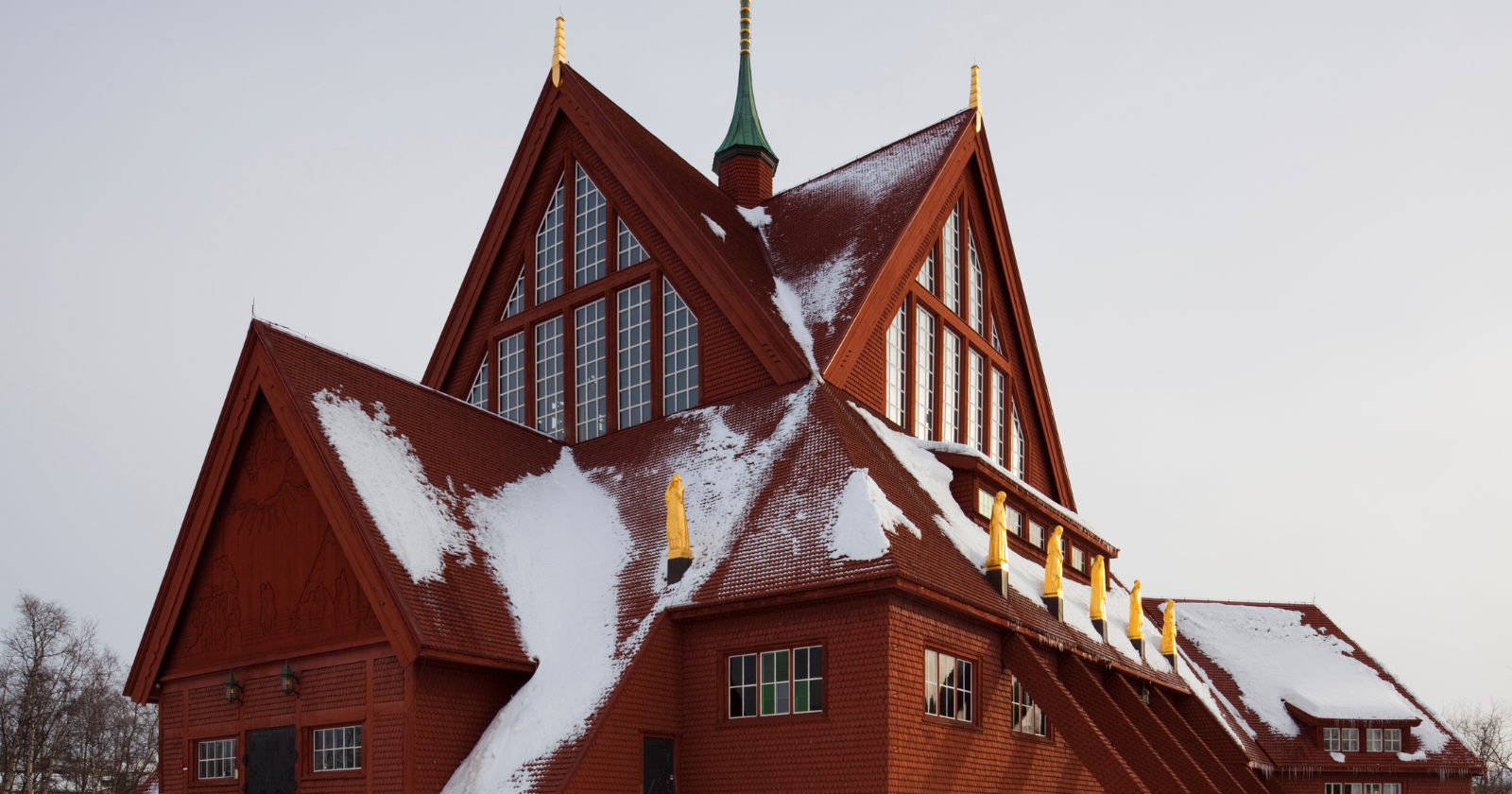
A 672-tonne wooden church moved five kilometres across a Swedish Arctic town at the speed of a slow walk, and it took two full days to get there.
That is not a metaphor.
In August 2025, Kiruna Church, one of Sweden’s largest wooden buildings and a fixture of the country’s far north since 1912, was lifted onto trailers, rotated, and rolled through the streets of Kiruna to a new address, because the mine underneath its old one is no longer safe to build on.
A year on, with the church still closed for reassembly, its parish is aiming to hold services again by Christmas 2026. The move remains one of the more striking pieces of infrastructure engineering Scandinavia has produced this decade, and a preview of what is coming for the rest of the town.
A church built for a mining town, now displaced by the mine
Kiruna Church was designed by the architect Gustaf Wickman and built between 1909 and 1912, consecrated on 8 December that year by Bishop Olof Bergqvist. Its exterior draws on Gothic Revival forms, its altar is Art Nouveau, and its interior nods to Sámi timber huts and Norwegian stave churches, a National Romantic mix that made it one of the more distinctive religious buildings in the country.
The church was built, like the rest of Kiruna, on money from the iron ore beneath the town. The state-owned mining company LKAB founded Kiruna in 1900 to house workers for what became one of the world’s largest underground iron ore mines, and more than a century later, that same mine is why the church had to leave. According to LKAB, ongoing expansion of the mine, including a new main working level roughly 1,365 metres below ground, has caused ground deformation that makes Kiruna’s original town centre unstable and unsafe to build on. The company first told municipal leaders in 2004 that a large part of the town, not just the church, would eventually need to move. Kiruna sits within Sápmi, the traditional land of the Sámi people, and its far northern setting, well above the Arctic Circle, is part of why the relocation has drawn so much international attention: this is a town rebuilding itself in place rather than being abandoned. Kiruna’s new town centre was formally inaugurated in September 2022, and according to LKAB, relocating the remaining affected buildings is expected to continue for roughly another decade.
Two days, half a kilometre an hour
The move happened on 19 and 20 August 2025, along a route roughly five kilometres long that had been specially widened and reinforced beforehand, according to LKAB’s press release. LKAB funded and organised the relocation at a cost of around 500 million Swedish kronor, roughly USD 52 million. It used two 28-axle self-propelled modular transporters, the same class of remote-controlled heavy-haul platform used to shift oil rig modules or bridge sections, each axle line in the class used by Mammoet, the firm that engineered the move. The 40-metre-wide building was set on a beam system across rows of these units and driven at roughly 0.5 kilometres an hour, walking pace, navigating narrow streets and at least one 90-degree turn along the way.
The church arrived at its new site at around 2:30pm on 20 August. During transit it was rotated 180 degrees, so the altar now faces west toward the town rather than east as before, a change LKAB has described as deliberate, meant to open the building toward the community around it rather than away from it.
A town centre turned into a live broadcast
Sweden treated the move as a genuine public event. More than 10,000 people are reported to have lined the route in a town of around 18,000 residents, and King Carl XVI Gustaf attended in person, according to reporting via The Hill. Swedish public broadcaster SVT covered the full two days as a piece of slow television, using around 30 cameras to track the church’s progress at not much faster than a stroll, and outlets including NPR and the Smithsonian picked up the coverage internationally.
Kiruna’s vicar, Lena Tjärnberg, spoke about the church in terms that made clear this was not simply a logistics story for the congregation. “Our beloved, beloved church began its journey yesterday from its unbelievably beloved location,” she told AFP as the move got under way, a line that captured how much weight a single building can carry in a small community’s sense of itself. Demolishing the church and building a replacement was never seriously considered, Tjärnberg has said, given what the original structure means to a congregation that has worshipped, married and been christened there for more than a century.
What happens now
The church is not yet open.
Reassembly and restoration work is under way at the new site, and Tjärnberg has said she hopes to hold services there again by Christmas 2026. LKAB says the new location was chosen to preserve the building’s character and its relationship to nearby structures, several of which have already been moved or rebuilt as part of the same programme.
The church’s move is the most visible chapter of a longer project. Kiruna’s shift away from its original town centre began in earnest after LKAB’s 2004 warning and gathered pace through the 2010s and early 2020s, with the new centre opening in 2022. Other historic buildings, including the old town hall, have already been relocated or reconstructed nearby. LKAB expects the wider process of moving the rest of the affected town to take until roughly the mid-2030s.
For Kiruna, the arrangement is unusual in that the industry causing the disruption is also the one paying for it. LKAB is Sweden’s largest iron ore producer and the town’s largest employer, and its continued operation is tied directly to the region’s economy, from municipal budgets to the jobs that keep young families in a town this far north. The church move, expensive and slow as it was, is one part of an ongoing exchange that keeps the mine running while trying to preserve what residents consider worth keeping from the town it built in the first place.