

A Greenland shark alive in the North Atlantic today may have been swimming through the same dark, near-freezing water when Isaac Newton was writing the Principia. Radiocarbon dating of eye-lens tissue by an international team of researchers put the maximum age of Somniosus microcephalus at somewhere around 392 years, plus or minus about 120, meaning the outer edge of the confidence interval reaches back to roughly the 1500s. The shark grows about one centimetre a year. It does not reach sexual maturity until it is roughly 150 years old. And for most of that unfathomable lifespan, a small parasitic crustacean is quietly eating its eyes.
The species holds the record as the world’s longest-living vertebrate. There could be individuals swimming under the Arctic ice today that were alive during the 1665 Great Plague of London, or during George Washington’s inauguration in 1789.
A body built to almost not move
Everything about the animal is calibrated for slowness. The heart beats about once every twelve seconds. It swims at roughly one foot per second, a pace a human could stroll past. Its scientific name translates to something like “sleepy small-head.” The Arctic water it lives in sits between minus two and seven degrees Celsius, and the shark’s tissues carry high concentrations of trimethylamine oxide and urea — chemical antifreeze that keeps ice from forming inside its cells.
That flesh, as a side effect, is toxic to eat. Consuming fresh Greenland shark meat causes vomiting, stumbling, and convulsions — a state Icelandic fishermen call being “shark drunk.” To make it edible, the meat has to be buried and fermented for months, then dried, producing the pungent delicacy kæstur hákarl.
A shark tagged in 1936 was recaptured sixteen years later. In that decade and a half, it had grown 2.3 inches.
How anyone figured out the age at all
Most sharks can be aged by counting growth bands on their vertebrae, the way a forester ages a tree. Greenland sharks have soft vertebrae without those bands. For decades, no one had any reliable way to date them.
The breakthrough came from the eye. The lens of a Greenland shark’s eye keeps growing throughout its life, layering new tissue around a core that formed when the animal was an embryo. That core is essentially chemically frozen — a time capsule of the ocean water the shark’s mother was swimming in when she gave birth.
Researchers used radiocarbon dating on the innermost lens tissue, taking advantage of the atmospheric bomb-pulse signal from nuclear weapons testing in the 1950s and 60s as a chronological anchor. As IFLScience details, the fallout gave scientists a datable spike they could work backwards from. The 2016 analysis, led by Julius Nielsen of the University of Copenhagen, produced a life expectancy estimate of at least 272 years, with a maximum near 400. The largest specimen in that study, a female just over five metres long, came out at around 392 years old.
The parasite on the cornea
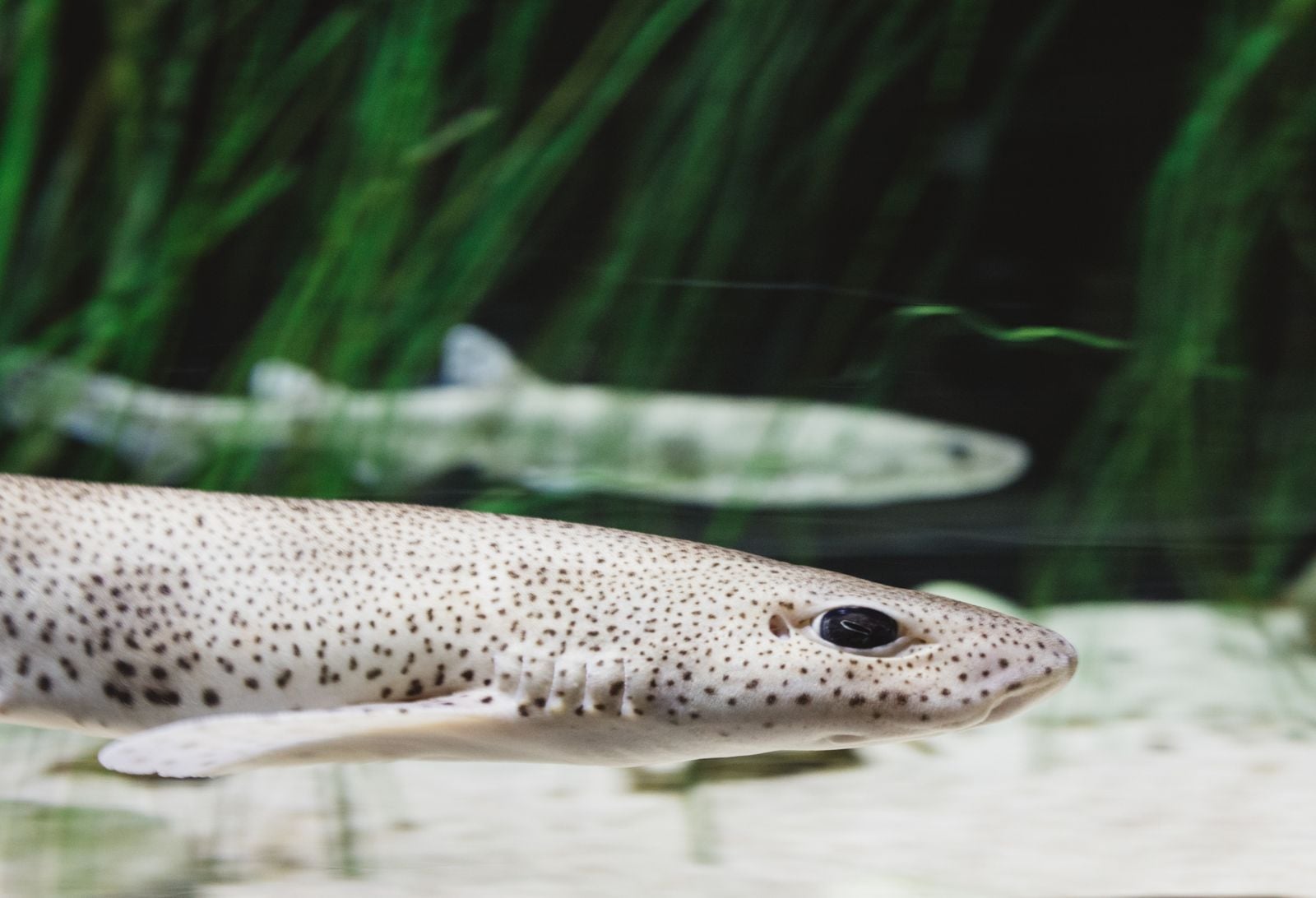
Look at a photograph of a Greenland shark’s face and you will often see something dangling from each eye — a pale, thread-like appendage a few centimetres long, waving in the current. That is Ommatokoita elongata, a parasitic copepod that anchors itself directly to the cornea and feeds on the corneal tissue.
According to the BBC’s species profile, the copepod latches on and feeds off the eye itself. Most adult Greenland sharks carry the parasite on one or both eyes. Each infection scars the cornea. Over decades — and remember, decades are early adolescence for this species — the scarring accumulates until the shark’s optical vision is essentially gone.
The animal does not seem to mind. It lives in water so deep and dark that vision would be marginal anyway. National Geographic notes that Greenland sharks range down to 7,200 feet, where sunlight has been absent for the entire distance above them. Smell does the work vision cannot. The shark’s olfactory system is highly developed, and it can detect carrion — a drowned polar bear, a whale carcass sinking through the water column — from remarkable distances.
What they eat, and what has been found inside them
Greenland sharks are described in the scientific literature as opportunistic. That word is doing heavy lifting. Stomach contents recovered from specimens have included fish, squid, seals, smaller sharks, porpoises, and — improbably — polar bears, horses, and reindeer. The horses and reindeer presumably drowned or fell through ice; the shark, cruising below, simply took the meal.
They are also capable hunters, not merely scavengers. Sleeping seals in the water column, trying to avoid polar bears on the ice above, may be exactly the kind of prey a slow, silent, sensory-driven predator can catch by drifting up from below.
Powerful suction lets the shark pull food into its mouth from over a metre away. The upper teeth are narrow spikes; the lower teeth form a broad, blade-like row. To dismember large prey, the shark bites down, then rolls its whole body in a slow circle, using the lower jaw as a rotary cutter.
A heart that ages, and yet keeps beating
For a long time, the working assumption was that Greenland sharks must have some extraordinary anti-aging machinery — pristine cells, tumor-proof genes, tissues immune to the wear that eventually stops every other vertebrate. Parts of that story are true. The genome is rich in sequences linked to DNA repair, cancer suppression, and resistance to cellular damage.
But recent research found something more interesting. When researchers examined heart tissue from Greenland sharks estimated to be between 100 and 155 years old, the hearts were, in fact, aging — and aging visibly. The team found severe fibrosis, huge deposits of lipofuscin (the pigment that accumulates when damaged cellular machinery fails to break down), damaged mitochondria, and swollen lysosomes inside the cardiomyocytes.
The research team found that the analyzed Greenland shark samples showed recognizable signs of classic aging at the molecular and tissue level. The findings demonstrate that aging processes occur in the heart tissue of this species.
The hearts are old. They look old. And yet they keep beating, once every twelve seconds, for another century. The team suspects the shark’s unusually low blood pressure and the distinct structure of its ventral aorta may keep the muscle elastic enough to keep pumping despite the visible damage.
Eyes that see better than assumed
The story of the blind shark, it turns out, is not the whole story either. Greenland sharks retain functional low-light vision well into old age, even with the copepods attached. The retinas keep working. What the parasite destroys is the cornea’s clarity, not the neural apparatus behind it. So the shark, at 300 years old, is not seeing images in any meaningful sense — but it may still register the vague gradient of a whale carcass silhouetted against faintly brighter water above.
For most of its centuries, that is enough. In water below the mesopelagic zone, a functioning optic nerve responding to a shadow is more useful than any high-resolution image. The parasite and the shark have arrived at something like a truce: the copepod gets a lifetime of corneal tissue, and the shark loses a sense it barely needed.
Where they are, and what threatens them
Despite the name, Greenland sharks are not restricted to Greenland. They inhabit the North Atlantic, the Russian high Arctic, and have been recorded as far south as the western Caribbean, in deep cold layers. A stranding reported in Ireland and ongoing genetic work continue to expand what is known about the species’ range and population structure.
The IUCN lists them as vulnerable. The traits that make Greenland sharks extraordinary — one-centimetre annual growth, sexual maturity at 150, generations that overlap with centuries of human history — are exactly the traits that make them fragile. A population that takes a century and a half to produce its next breeding cohort cannot absorb sustained bycatch. Until the 1960s, they were hunted commercially for the oil in their livers, which was burned in lamps and used as industrial lubricant. They are no longer targeted, but they still turn up entangled in longlines and trawls meant for other species.
The Nordic waters where they live have been studied intensively in recent decades, and Greenland shark research is now among the more active corners of Arctic marine biology, drawing teams from Copenhagen, Reykjavík, and beyond.
A creature outside our time signature
The strangest thing about the Greenland shark is not any single fact. It is the accumulation. An animal that grows a centimetre a year. A heart that beats five times a minute. A cornea colonised by a copepod for centuries. A brain running on olfactory data from a kilometre away in absolute darkness. Puberty at 150. A stomach that has, at various times, contained a horse.
Somewhere under the ice off Baffin Island right now, a shark is drifting through water at the pace of a slow walk. Its eyes are cloudy. Its heart is fibrotic. A pale copepod trails from each cornea like a strand of wool. It was already a decade old when Newton died in 1727, and if the population’s oldest members are as old as radiocarbon dating suggests they might be, it may still be swimming when the twenty-second century arrives.