
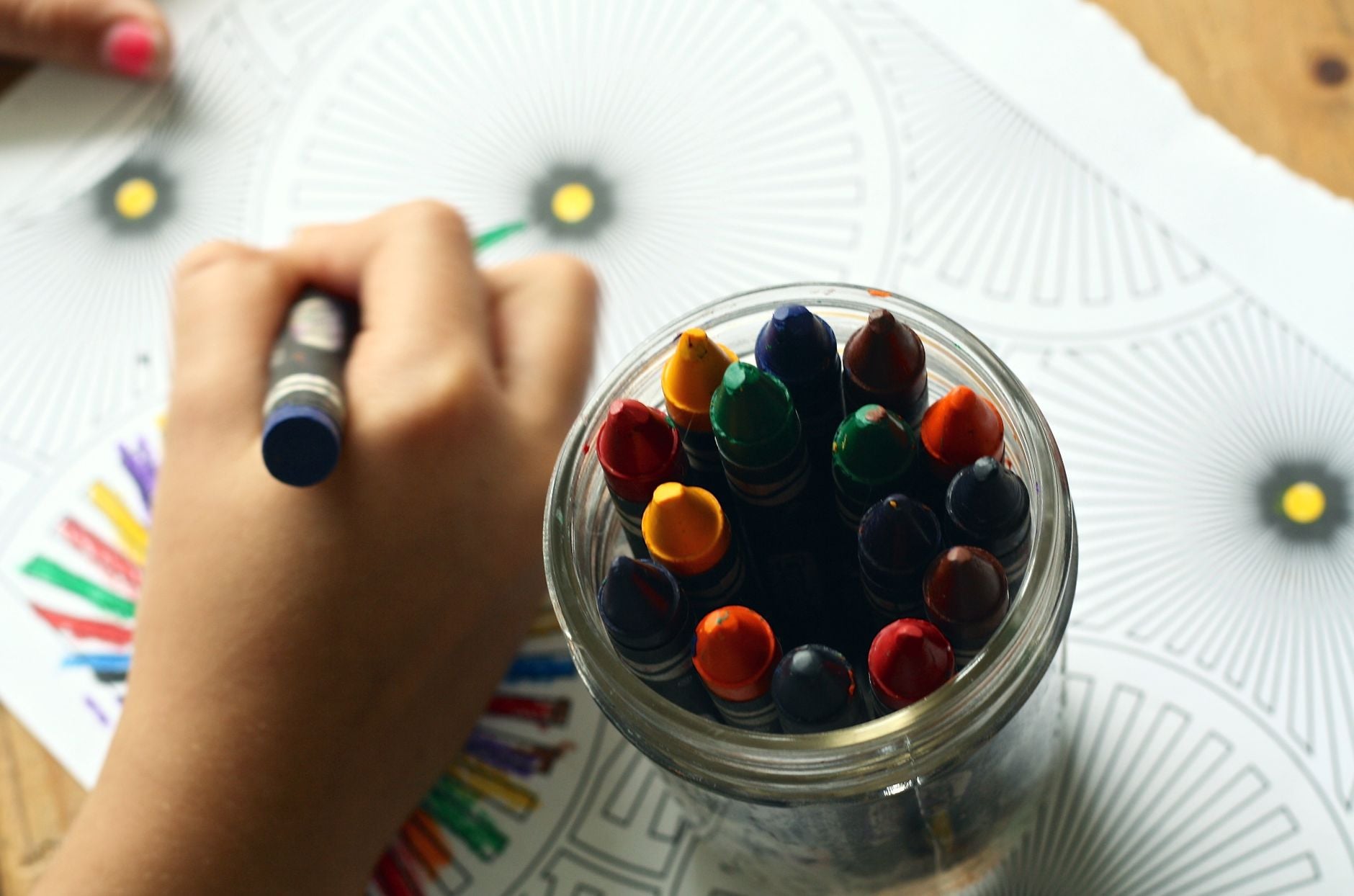

Walk into a Swedish förskola or a Norwegian barnehage and one thing is hard to miss: the walls. They are usually covered, low down at child height, with drawings. Not the tidy, framed sort a parent keeps, but the everyday output of small hands, taped up in quantity and treated as though it belongs there.
The love of drawing on display is not itself Scandinavian. Children more or less everywhere start making marks as soon as they can hold something that leaves a line, and the urge appears long before anyone teaches it. What is worth a closer look is not the impulse but what the surrounding culture decides to do with it, and here the Nordic countries have made some deliberate choices.
An Italian idea that found a home in Sweden
The most influential thinking about children’s creative expression in Swedish preschools did not originate in Sweden at all. It came from Reggio Emilia, a city in northern Italy, where the educator Loris Malaguzzi and the municipal preschools developed a philosophy built around the idea that a child has, in his phrase, a hundred languages: drawing, painting, clay, movement, music, and many more ways of thinking and expressing that adults tend to narrow down to just speaking and writing.
Sweden embraced this with unusual seriousness. The Reggio Emilia Institutet has operated in Stockholm since 1993, running courses for teachers, and the approach has shaped a large number of Swedish preschools. One of its most visible features is the atelier, a studio space for making, staffed in the Reggio model by an atelierista, a person with an artistic background whose job is to take children’s creative work seriously rather than to decorate the corridor.
It is worth being precise about this. The philosophy is Italian, not Nordic, and Sweden imported and adapted it. The interesting fact is not that Scandinavians invented a way of honouring children’s drawing, but that Swedish institutions chose to build so much of their practice around one.
Written into the rules, not just the mood
What makes the Nordic case distinctive is that this is not only atmosphere. It is policy.
Sweden’s national curriculum for the preschool, known as Lpfö 18, states that children should be given the chance to experience and communicate through a range of aesthetic forms of expression, image among them, and that they should have time, space and a degree of peace for their own creative activity. Drawing is not framed as a reward for finishing something more important. It is treated as one of the ways a child is meant to think.
Norway sets it out separately in its own Framework Plan for Kindergartens, which names art, culture and creativity as one of the core areas every child should encounter, and says the content of the kindergarten should inspire imagination, creative zest and self-expression. Observers of Norwegian kindergartens tend to note that drawing is among the most ordinary daily activities there, woven through the day rather than saved for an art lesson.
Denmark, Sweden and Norway differ in the detail, and the wider Nordic region including Finland and Iceland differs again, so it is a mistake to treat them as one system. But the shared inheritance is a play-based early childhood in which formal academic instruction starts comparatively late, around six or seven, leaving the earlier years with a great deal of room for the kind of open, self-directed making that drawing exemplifies.
What this does and does not prove
It would be easy, and wrong, to turn this into a story about Scandinavians having solved childhood.
None of the above shows that Nordic children draw better, or end up more creative as adults, than children anywhere else. Those are much harder claims to establish, and the evidence for national creative superiority is thin. What the curricula and the Reggio influence show is a set of priorities: an early childhood that protects time for self-directed expression, and a willingness to treat a four-year-old’s drawing as worth attention rather than as a way to keep them occupied.
There are trade-offs, and they are genuinely debated. A later start on formal literacy and numeracy worries some parents and policymakers, and the play-based model depends heavily on well-funded preschools and trained staff, which are easier to sustain in wealthy, high-tax societies than to copy wholesale elsewhere. The pleasant wall of drawings rests on public spending, not on a national temperament.
Still, the underlying observation travels. Children arrive already wanting to draw. The Nordic contribution is not that desire but a decision about how much of the early day to hand over to it, and a refusal to treat the results as clutter. That decision is available to anyone, which is perhaps the more useful thing to take from the walls of a förskola than admiration.