
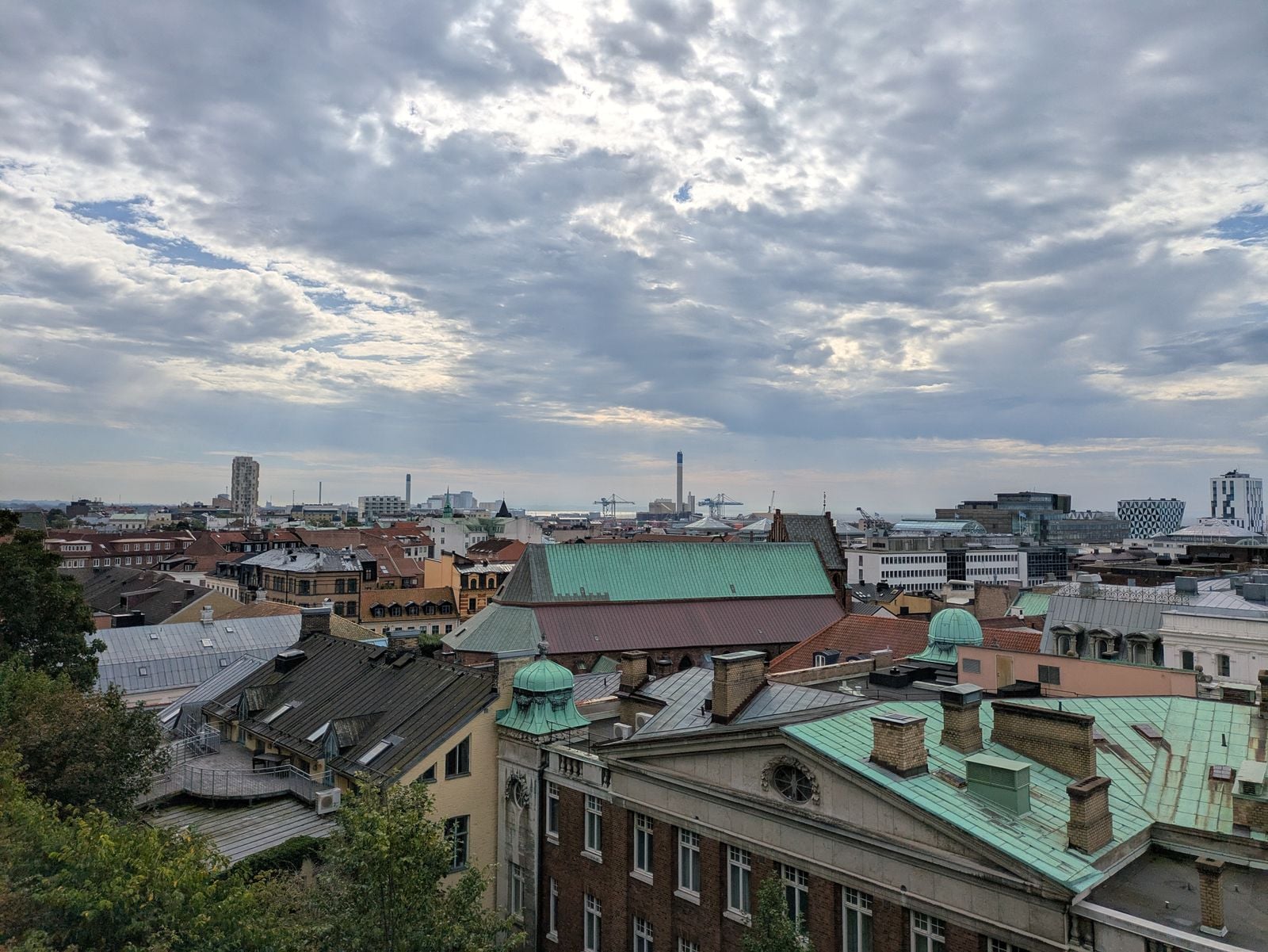

Step off the train in Malmö with a bit of textbook Swedish and you may still find yourself lost within a sentence. Someone points out a påg kicking a ball, mentions a pugga by the pond, and rolls an r so far back in the throat that it sounds closer to French or Danish than to anything you practised. This is skånska, the dialect of Skåne in the far south of Sweden, and it is one of several reasons that the southern edge of Scandinavia has a reputation, even at home, for phrases that stop outsiders in their tracks.
When we talk about “the south” here, we mean the southern reach of Scandinavia itself: Skåne, the province at Sweden’s bottom tip, and Denmark, the southernmost of the three Scandinavian countries. The confusion they generate is not random. Much of it comes from a border that moved.
A border that moved in 1658
For centuries, Skåne was Danish. It passed to Sweden in 1658, under the Treaty of Roskilde, after one of the many wars between the two crowns. The land changed hands, but speech does not redraw itself along a treaty line. The Scanian dialect kept a set of features that still lean south, toward Danish, rather than toward Stockholm.
The most audible of these is the r. Standard Swedish uses a rolled or tapped r near the front of the mouth. Scanian uses a guttural, uvular r produced at the back of the throat, the same broad family of sound found in Danish and in French. To a Swedish speaker from further north, the whole rhythm of the dialect, its vowels and its intonation, can feel tilted toward the neighbour across the water.
None of this makes skånska incorrect or lazy, a charge dialects everywhere tend to attract. It is simply older loyalties surviving in the mouth.
Words that stayed behind
The vocabulary carries the same history. A boy in Skåne is often a påg, not the standard Swedish pojke, a word with roots in Low German and old Danish. A girl can be a tös rather than a flicka. A frog is a pugga where the rest of Sweden says groda. The Scanian Academy’s 1995 Scanian-Swedish-Danish dictionary catalogued 2,711 such words and expressions, which gives some sense of how much diverges from the standard.
These words are not museum pieces. The regional commuter trains that run across Skåne are called Pågatåg, literally “boy trains,” in a nod to the local word, and newer sets given women’s names were promptly dubbed Tösatåg. The dialect that puzzles a visitor is, to the people who speak it, ordinary and affectionate. The Local has published a short field guide to the dialect words worth knowing in Skåne for anyone heading that way.
Denmark counts in twenties
Cross the Øresund to Denmark and a different kind of head-scratcher appears, this time in the numbers. Danish counting is partly vigesimal, built on units of twenty rather than ten, and it defeats plenty of learners well before they reach a hundred.
Seventy, for instance, is halvfjerds. That is a worn-down form of an older word, halvfjerdsindstyve, which unpacks roughly as “half-fourth times twenty.” The idea is three and a half twenties, which is indeed seventy, but almost no Danish speaker thinks it through that way in conversation. They simply say halvfjerds and move on, while a Swede or a Norwegian, whose own words for seventy are transparent compounds of seven and ten, is left doing arithmetic. The Local has a readable account of how Denmark ended up with these numbers.
It is a genuine outlier within the region. Swedish and Norwegian both count in plain tens, so the base-twenty logic is one of the clearest cases where Danish looks unlike its neighbours on the page as well as to the ear.
Why spoken Danish is hard even for the neighbours
The numbers are only the visible part. Spoken Danish is famously demanding for other Scandinavians, largely because Danish speech compresses and softens sounds, dropping and blurring consonants and endings that Swedish and Norwegian keep crisper. Written down, the three languages look close. Said aloud at speed, Danish can slip past a listener who reads it comfortably.
This is not just folklore. In 2005, the linguists Lars-Olof Delsing and Katarina Lundin Åkesson at Lund University published a Nordic Council report, Håller språket ihop Norden?, testing how well young people across the region understood their neighbours’ languages. It was one large study of youth comprehension rather than the final word on the matter, but its findings were telling. Young Norwegians came out best at understanding both Danish and Swedish, sitting as they do between the two, while comprehension in the other directions was patchier. Mutual understanding across Scandinavia is real, but it is not automatic, and it is not symmetrical.
Idioms add their own layer. A Dane who senses you are worrying without cause may tell you der er ingen ko på isen, “there is no cow on the ice.” The full version, der er ingen ko på isen, så længe rumpen er i land, adds “as long as its backside is on land,” which is when a wandering cow is safely not about to fall through. Translated flat, it is baffling. In use, it simply means relax, there is no problem.
What the confusion is not
It would be easy, and wrong, to file all this under charming Nordic eccentricity. Skånska is not broken Swedish, Danish numbers are not a mistake, and an idiom about a cow is no stranger than an English speaker telling someone to break a leg. Every one of these features has a traceable history, whether a border war, an old counting habit, or a farming image that outlived the farm.
It is also worth resisting the urge to treat any of this as a single Scandinavian personality. Denmark, Norway and Sweden are distinct countries with distinct histories, and within Sweden alone Skåne sounds nothing like Gothenburg or the far north. The phrases that leave people scratching their heads are usually the places where those separate histories are still audible.
The most reliable way through, for a visitor, is not to memorise a list but to ask. People in Skåne are generally happy to explain what a påg is, and a Dane will usually tell you, with some enjoyment, exactly how the twenties add up.