
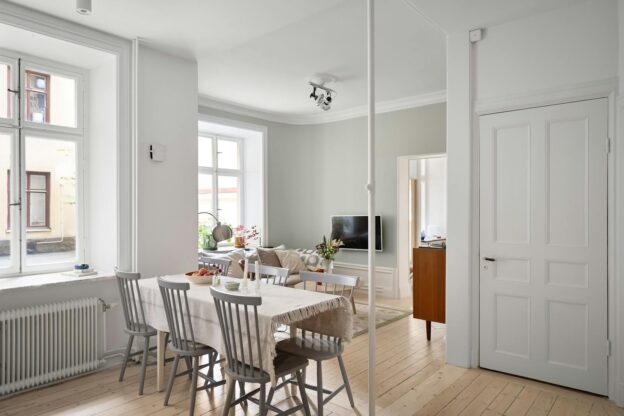
Sometime around 2017, a year after I’d moved to Copenhagen, I had dinner at a Danish friend’s apartment in Frederiksberg. Two rooms, a galley kitchen, a bathroom you could barely turn around in. But when I walked in, my shoulders dropped. My breathing slowed. The space felt like it had been cleared not just of objects but of noise. Two candles. A wooden table. A shelf of books arranged not for display but because someone had actually read them and decided which ones to keep. I remember thinking: this isn’t interior design. This is a person who knows what they want their mind to feel like.
That dinner has stayed with me for almost a decade, and the reason is simple. The calm I felt had nothing to do with Scandinavian design as a category. It wasn’t about the Aalto chair or the pendant light or any product you could order online. It was about something much harder to export: a set of beliefs about physical space, taught early and reinforced constantly, that treats clutter not as a cleaning problem but as a cognitive one.
What clutter actually does to your brain
The science on this is clearer than most people realise. Research has consistently found that when people perceive their homes as cluttered, their cortisol levels rise throughout the day, while those who don’t experience a clutter problem see their cortisol drop over the same period. Cortisol is not a metaphor. It’s a stress hormone with measurable effects on sleep, mood, and immune function. And the mechanism matters: clutter creates what psychologists call cognitive overload. The brain begins processing not only what it sees but what needs to happen next. Where does this go? Who will deal with it? When? That processing runs in the background like an app draining your battery. You don’t always notice it. But your body does.
Recent research has deepened this picture. People who reported more clutter also reported worse mental wellbeing, lower life satisfaction, and more negative emotions. But researchers identified something particularly interesting: a middle step. Clutter changed how people perceived the beauty of their homes, and that loss of perceived beauty was what partly explained the drop in wellbeing. The mess didn’t just take up space. It altered the feeling of being home. Meanwhile, researchers at Yale found that visual clutter alters information flow in the brain itself, disrupting how efficiently we process what’s in front of us. This isn’t about aesthetics. It’s about the brain working harder than it needs to.
And the problem compounds. During the pandemic, National Geographic reported on how stress breeds clutter, which breeds more stress, creating a feedback loop that many people found almost impossible to break. Anxiety produces mess; mess produces anxiety. The cycle is self-reinforcing, and willpower alone rarely breaks it.
So here’s the question most design magazines never ask: if we know all this, why do some cultures produce homes that feel calm and others don’t? And is it really about the furniture?
The childhood lesson that changes everything
Danish children are commonly taught to tidy their own spaces from a remarkably young age. Not as punishment, not as a chore chart with gold stars, but as a basic expectation woven into daily life. In many Danish børnehaver (kindergartens), young children are expected to return toys to their places before moving on to the next activity. The lesson isn’t to clean up because someone said so. The lesson is: you are responsible for the space around you, and the space around you affects how you feel.
This is a different framing than what most Anglophone cultures use. In the homes I knew growing up in Melbourne, tidying was a weekend event, something you did because company was coming or because the mess had finally crossed some invisible threshold. The mess itself was neutral. Dealing with it was labour. Nobody ever said to me: the state of your room is a choice you’re making about your own mental clarity.
Scandinavian parenting operates on a principle of early independence that extends well beyond tidying. Children are trusted to dress themselves, to play unsupervised, to make small decisions. But the spatial piece is foundational. When a child learns that their environment is something they shape rather than something that happens to them, they carry that into adulthood as an unconscious skill.
By the time a Dane is twenty-five and furnishing their first apartment, they aren’t making a design choice when they keep the surfaces clear. They’re doing what feels like breathing. The calm in Scandinavian homes isn’t achieved. It’s maintained, habitually, by people who were taught to maintain it before they could articulate why.

The gap between the photo and the life
I should be honest about something. The global version of Scandinavian interior design has almost nothing to do with how Danes actually live. The version that gets photographed for international shelter magazines is a product. A mood board. A carefully emptied room where someone removed 80% of the objects a real person would own and replaced the remaining 20% with items that cost more than most people’s rent.
I once worked on a spread for a Stockholm apartment that was meant to capture a kind of lived-in minimalism. The reality was months of styling. Every blanket was chosen, every book spine considered, every piece of fruit in the bowl evaluated for colour balance. The beautiful minimalism needed an enormous amount of effort to exist, and the effort was invisible by design.
The actual homes of my Danish friends are messier than the magazines suggest. There are children’s drawings on the fridge. There’s a stack of Politiken on the side table. Someone’s running shoes are by the door. The difference is that the baseline is lower. The mess accumulates on a surface that started clear, and it gets returned to clear regularly, not because anyone’s performing minimalism but because that’s just what you do.
This distinction is everything. The exported version of Scandinavian calm is about buying the right lamp. The real version is about a relationship with your possessions that most people in consumer-heavy cultures never develop, because they were never taught it.
Clutter as unfinished decision
Every object sitting on your counter or your floor is a decision you haven’t made. Keep it or discard it. File it or throw it away. Fix it or accept it’s broken. Clutter is the physical residue of postponed choices, and the reason it weighs on the mind is that your brain keeps those open loops running.
The Swedes have a concept for addressing this that goes further than anyone else in the world. Döstädning, or death cleaning, is the practice of systematically going through your possessions later in life so that your loved ones don’t have to after you die. It sounds morbid in English. In Swedish, it’s considered one of the most generous things you can do for the people you love. It takes the logic that clutter represents unfinished business and extends it to the very end of life.
But you don’t need to be facing mortality to apply the principle. The Danish version is smaller and more daily. It’s the practice of finishing things. Putting them away. Making the decision now instead of leaving it for later. When you grow up watching your parents close these loops in real time, you don’t develop the habit of leaving them open.
Research on decluttering has documented mental benefits including reduced anxiety, improved focus, and a greater sense of control. But framing decluttering as a periodic purge misses the point. The Scandinavian approach isn’t about decluttering. It’s about not accumulating in the first place. It’s about the decision happening at the point of entry, not the point of overflow.
Why this can’t be bought
The global wellness industry has spent the better part of a decade trying to sell Scandinavian calm. You can buy the candles, the linen bedding, the minimalist shelving. You can purchase a Marie Kondo book (which, for the record, draws on Japanese rather than Scandinavian traditions). You can even order a “hygge kit” online, which is a sentence that would make every Dane I know wince.
Hygge is real. I want to be clear about that. It’s the warmth of sitting with friends in low light during a Danish winter, drinking something warm, talking about nothing in particular. I’ve written before about how Scandinavian quietness is often misread as coldness, and hygge is part of the same cultural logic: presence matters more than performance. But hygge is something you experience, not something you buy. The candles are tools for creating darkness with warmth; they’re psychological survival during months when the sun barely appears, not Instagram props.
The calm in Scandinavian homes operates on the same principle. It can’t be purchased because it isn’t a product. It’s a set of habits learned so early they feel like personality rather than practice.
When someone who grew up in a culture of abundance and accumulation tries to recreate it by buying a Scandinavian-designed shelf, they’re solving the wrong problem. The shelf isn’t what creates the calm. The calm creates the conditions in which a single, well-made shelf is enough.
The economics of less
There’s a class dimension here that deserves acknowledgement. Scandinavian minimalism is easier to practice when you have a functional welfare state, affordable healthcare, and a cultural consensus that excessive wealth display is in bad taste. When your survival isn’t precarious, you don’t stockpile. When status isn’t signalled through objects, you don’t accumulate them to prove your worth.
The Scandinavian relationship to daily habits and wellbeing is inseparable from the social infrastructure that supports it. You tidy your home more easily when you’re not working three jobs. You let go of possessions more easily when you trust that you can replace what you need. The calm in these homes isn’t just psychological; it’s underwritten by systems that reduce baseline anxiety about material security.
This doesn’t invalidate the lesson. It complicates it. The childhood teaching, that your space reflects your mind and you’re responsible for both, works best in a context where people have the time and security to act on it. Exporting the aesthetic without the infrastructure produces something hollow: beautiful objects in stressful lives. And yet the inverse is also true. Even within societies that lack that infrastructure, the core insight holds. A person who begins to treat their space as a reflection of their mental state, who starts closing the small loops and making the small decisions, will feel the difference. The systems make it easier. But the habit itself still works.

What the mind learns from empty space
I’ve been in Copenhagen for a decade now. My apartment is not minimalist by Scandinavian standards. I have too many books. I have a drawer that I’m not going to describe. But something has shifted in how I relate to the space I’m in, and it happened gradually, through proximity to people who treat their environments like an extension of their thinking.
When you live with less, your attention lands differently. You notice the light on a wall. You hear the sounds outside. You sit with your own thoughts instead of being distracted from them by visual noise. This isn’t poetic exaggeration. It’s the daily experience of millions of Scandinavians who simply grew up this way.
The real lesson of Scandinavian homes is not about design. It’s about a culture that decided, collectively and early, that physical space is mental space. That every object you keep without intention is a small tax on your attention. That teaching children to manage their environments is teaching them to manage themselves.
You can’t buy that in a flat-pack. You can only learn it. And the earlier you start, the less it feels like effort.
The homes that feel calm feel that way because someone, probably a long time ago, made a choice. And then kept making it, every day, so automatically they forgot it was a choice at all. That forgetting is the whole point. The highest form of discipline is the one that stops feeling like discipline. It just becomes the way you live, the way your space breathes around you, the quiet at the centre of a room that has exactly enough and nothing more.
Photo by Lisa Anna on Pexels