
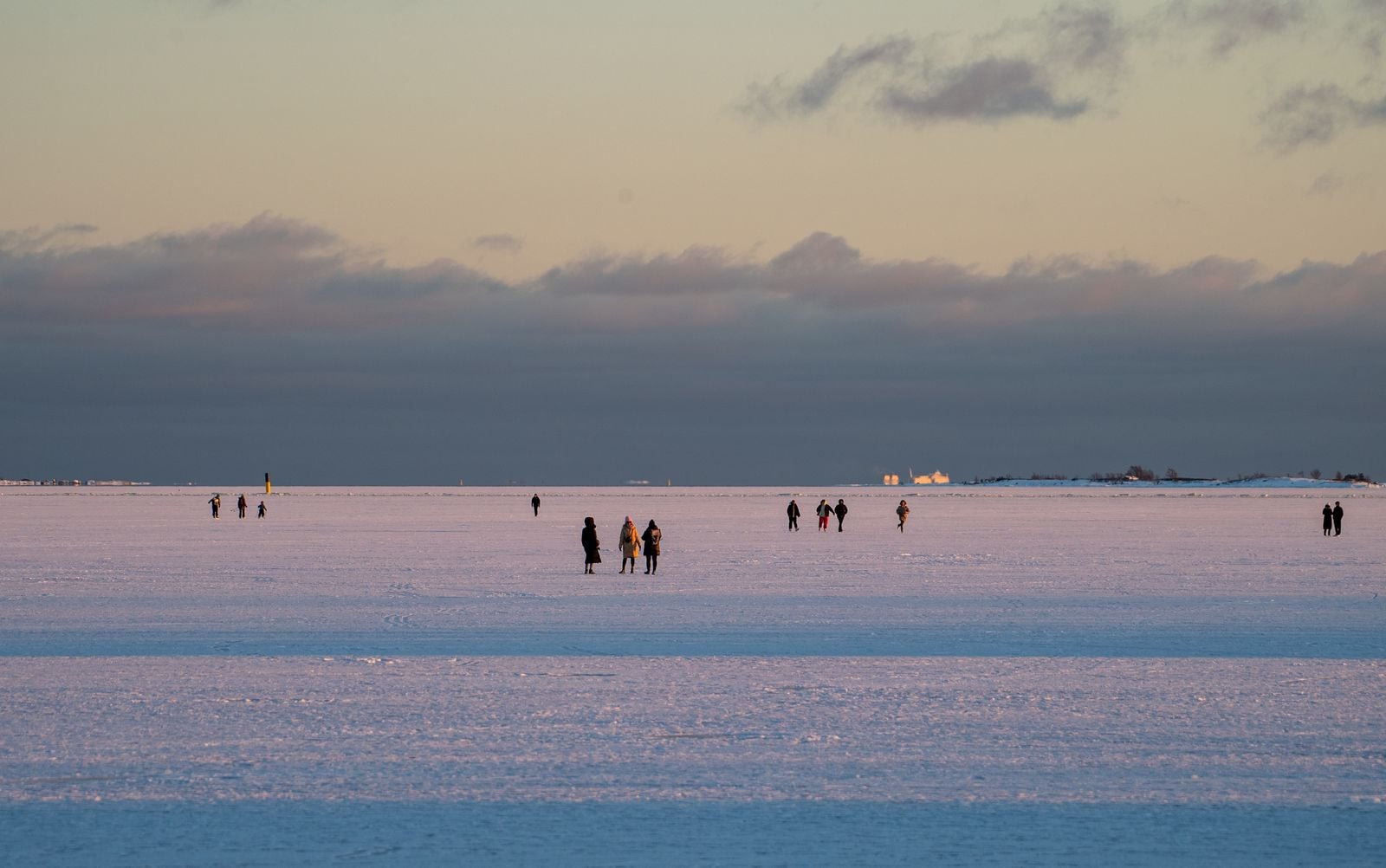

Finland’s relationship with the word happiness has always contained a quiet joke. The country keeps winning the world’s most famous happiness ranking, while many Finns respond with some version of: are you sure you mean us?
The 2026 report placed Finland first again, with an average life-evaluation score of 7.764 out of 10, extending a run that began in 2018. The length of that run does not answer the more interesting question: what kind of happiness is the ranking actually capturing?
The ranking does not count smiles
The World Happiness Report does not ask respondents how cheerful they feel or how often they laugh. Its headline ranking comes from a single life-evaluation question known as the Cantril Ladder. People imagine a ladder on which zero represents the worst possible life for them and ten the best, then say where they currently stand.
Gallup surveys nationally representative samples, usually contacting about 1,000 people in each country each year. The ranking uses three-year averages, which smooth some of the noise in any single survey. Finland’s 2026 result therefore reflects how residents evaluated their lives across 2023 to 2025, rather than a national mood observed on one unusually bright afternoon.
This distinction explains why a reserved population living through a long, dark winter can rank above places associated with more outward warmth. Life evaluation asks whether life is going well as a whole. It is related to emotion, but it is not the same as feeling delighted.
The report’s researchers use factors including income, healthy life expectancy, social support, freedom to make life choices, generosity and perceptions of corruption to help explain differences among countries. Those factors do not mechanically determine the rankings. The ranking itself comes from residents’ answers. As Gallup explains in its methodology, the score is a self-assessment, not an index assembled from government statistics.
What the Finnish CEO actually said
That interpretation draws on Miika Mäkitalo, the CEO of HappyOrNot, the Finnish company behind the smiley-button feedback terminals found in shops and airports. Writing in The Standard after Finland’s eighth win in 2025, Mäkitalo argued that Finnish happiness is frequently misunderstood.
He wrote that the Finnish idea was rooted in realism and in fostering “trust, security and resilience” within communities. Later, he described happiness as contentment, stability, fairness and trust, and ended with the quieter formulation of knowing that life is “secure, fair and balanced”.
Security, trust and balance is a fair compression of that argument, though the phrasing is our summary rather than a direct quotation from him. The distinction matters because Mäkitalo’s point was not that all Finns possess a special emotional temperament. He was describing conditions that can make ordinary life feel dependable.
That form of wellbeing may be barely noticeable on a good day. A bus arrives. A school works. A medical bill does not become a financial catastrophe. A stranger is assumed to be basically honest. There is enough time after work to cook, walk, collect a child or sit in silence. None of these necessarily produces joy. Together, they reduce the number of reasons to feel that life might suddenly fall apart.
Trust is practical infrastructure
Trust can sound like a soft cultural quality until it is expressed through ordinary transactions. It affects whether people expect public institutions to function, whether they believe taxes will return as recognisable services, and whether asking for help feels likely to produce help.
The numbers support part of that picture without justifying a national myth. The OECD’s 2025 country note for Finland reported that 47 per cent of people had high or moderately high trust in the national government in 2023, above the OECD average of 39 per cent. It also found that 83 per cent were satisfied with the administrative services they had used, compared with an OECD average of 66 per cent.
Those results are strong, but 47 per cent is not unanimity. Trust is neither a permanent Finnish personality trait nor evenly distributed. It can fall when services weaken, finances tighten or institutions fail particular groups. A serious account of Finnish wellbeing has to treat trust as an outcome that public systems earn and can lose.
The same applies to security. Finland’s public provision does not remove illness, unemployment or loneliness. It changes some of the consequences. Health care, education, income support and municipal services create a floor beneath many households, though access and quality are debated and experienced unevenly.
Balance is partly designed
Work-life balance is often presented as a personal skill: set boundaries, close the laptop, take a walk. In practice, the room available for balance depends on working-time rules, paid leave, childcare, commuting, wages and whether an employee can refuse an unreasonable demand without risking rent.
Finland’s social protections and labour arrangements do not make every workplace humane. They do make it more plausible for time outside paid work to be treated as a normal part of life rather than an indulgence. The point is structural before it is cultural.
This is where broad celebrations of a “Finnish secret” tend to go wrong. They extract a pleasant habit, such as sauna, forest walks or coffee with friends, from the public conditions that make time and access possible. Nature matters in Finland, but a lake cannot replace secure housing. A sauna cannot fix an unpredictable income. Personal rituals work inside a larger arrangement of resources and expectations.
Nordic success without a Nordic fantasy
Finland is a Nordic country, but it is not part of Scandinavia in the strict geographic and linguistic sense, which refers to Denmark, Norway and Sweden. Its presence in a publication called Scandinavia Standard reflects the broader cultural use of “Scandinavian” outside the region, not a reason to erase the distinction.
The other Nordic countries also appear near the top of the happiness rankings. Researchers examining this pattern have pointed to a cluster of explanations rather than one regional essence: reliable institutions, comparatively low corruption, social support, personal freedom, prosperity and welfare protections. The World Happiness Report’s analysis of Nordic countries’ repeated high placement also notes that they are not necessarily the places reporting the world’s most frequent positive emotions.
National averages hide variation in income, health, migration status, age and geography. Finland’s result describes the centre of a distribution, not every resident’s experience. It also does not prove that one policy caused the score. Countries are complicated systems, and many of the explanatory factors reinforce each other over decades.
The happiness of nothing going wrong
Mäkitalo’s account is useful because it makes room for happiness that does not announce itself. Security is often felt as the absence of panic. Trust appears as a decision not to check twice. Balance can be an evening with no urgent claim on it.
That does not make Finland secretly joyful, nor does it reduce the country to quiet competence. It clarifies what the World Happiness Report asks people to judge: the quality of the life available to them, including the social ground beneath their private emotions.
Finland’s ninth first-place finish is less a medal for cheerfulness than a repeated answer to a practical question. When residents look at the whole ladder, many believe they are standing on a reasonably secure rung.