
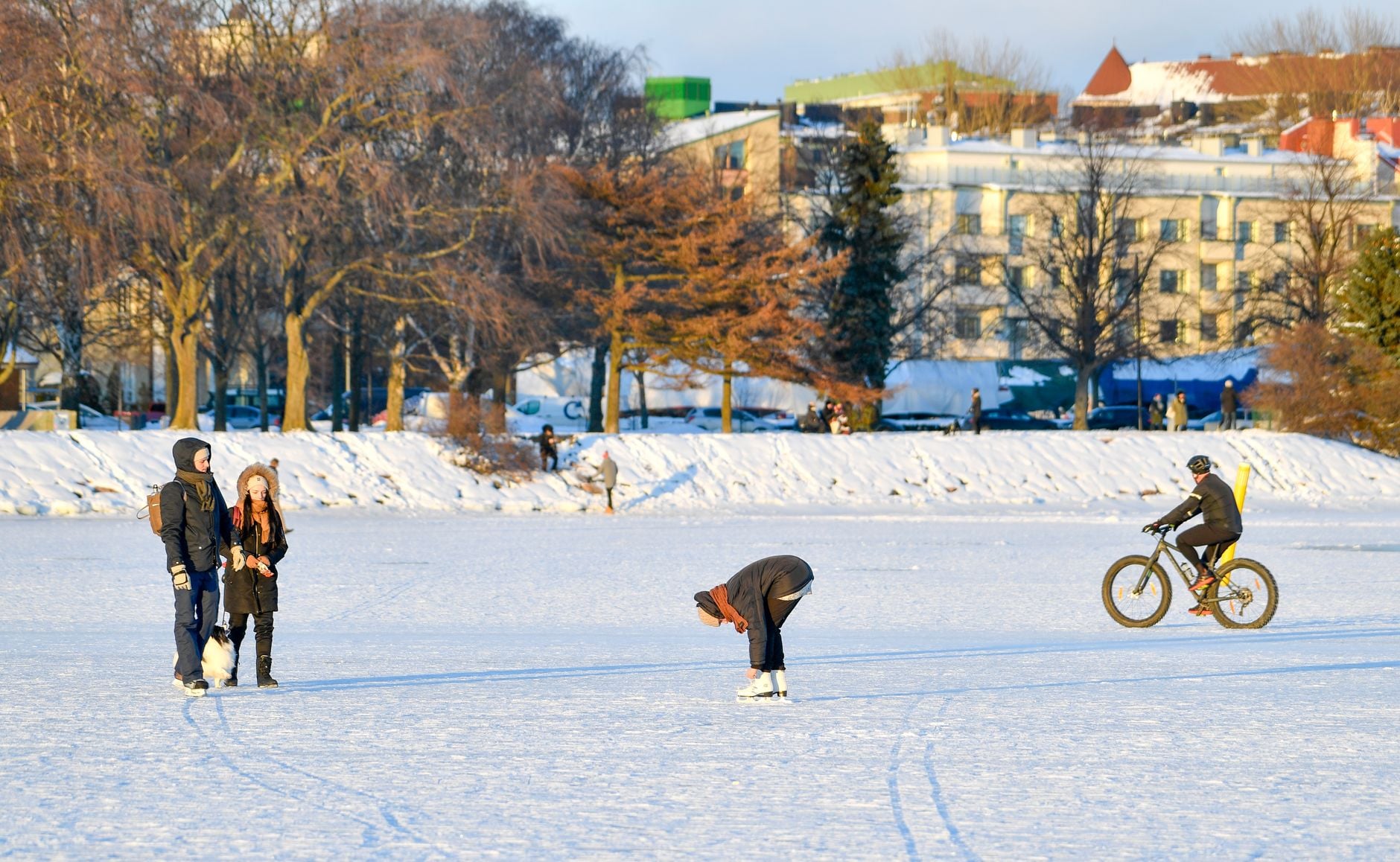

Finland’s ninth consecutive first-place finish in the World Happiness Report was announced in March 2026, after another season of snow, darkness and below-zero days. The contrast made an irresistible headline: the country with some of Europe’s hardest winters had again been named the world’s happiest.
The 2026 World Happiness Report gave Finland an average life-evaluation score of 7.764 out of 10, extending a first-place run that began in 2018.
The deeper point sits underneath the headline. “Happiness” in this ranking does not mean constant good mood. It means an average evaluation of life as a whole. Weather can change how a day feels without determining the answer someone gives when asked whether their life, in the broadest sense, is going well.
The result is a life-evaluation score
The 2025 report had placed Finland first with an average score of 7.736, and the 2026 report repeated the result at 7.764. Rankings were based on a three-year average of responses, which smooths away any single day’s weather and much of the short-term noise in public mood.
Respondents answer a question known as the Cantril Ladder. They are asked to imagine a ladder running from zero, representing the worst possible life, to ten, representing the best possible life, then say where their life currently stands.
That is a measure of evaluative wellbeing. It asks people to step back and judge their circumstances. It is different from affective wellbeing, which concerns recent emotions such as enjoyment, sadness, stress or anger. It also differs from eudaimonic wellbeing, which concerns meaning and purpose.
The word “happiest” compresses these distinctions into something catchy. Finland did not win a global contest for smiling most often in February. It recorded the highest average answer to a broad life-evaluation question.
The Finnish winter is genuinely severe
None of this requires pretending the climate is gentle. The Finnish Meteorological Institute’s description of the seasons defines winter as the period when the daily mean temperature remains below 0 degrees Celsius. By that measure, winter lasts roughly 100 days in southwestern Finland and as many as 200 days in Lapland.
In southern Finland, the shortest day is about six hours long. North of the Arctic Circle, the sun does not rise for part of winter. In the country’s northernmost corner, that polar night lasts 51 days. Typical annual lows can reach minus 45 to minus 50 degrees Celsius in Lapland and eastern Finland.
The most recent completed winter was especially stark. Official statistics show that December 2025 through February 2026 was colder than usual. Average winter temperatures ranged from around minus 1 degree Celsius in Åland to around minus 16 in northern Lapland. The season’s lowest reading was minus 42.8 degrees at Tulppio in Savukoski on 9 January.
The daylight constraint behind that description is real. A national wellbeing result should not be used to romanticise it or imply that Finns are biologically untouched by cold and darkness.
Weather, mood and life satisfaction are different signals
Daily weather can affect experience. Heat, cold, wind, precipitation and sunlight alter comfort, plans, travel and opportunities for outdoor activity. Some studies find links with positive or negative affect, although effects vary across people, seasons and places.
The evidence for a strong effect on life satisfaction is much weaker. One large study linked more than 1.9 million US survey responses to local weather. After researchers separated day-to-day weather from regional and seasonal differences, daily temperature was not associated with life satisfaction. Sunlight and wind showed some associations with negative affect, but the overall findings did not support the idea that a nice day reliably makes people judge their entire lives more favourably.
Other large studies have found weather effects on wellbeing to be small and sensitive to modelling choices. That does not mean an individual cannot feel brighter in sunshine or miserable during a cold rain. It means those immediate effects do not translate cleanly into national averages of life evaluation.
There is also an important clinical boundary. The US National Institute of Mental Health explains that shorter days can coincide with recurrent seasonal depression for some people. Winter-pattern seasonal affective disorder is more than a temporary dislike of bad weather. Finland’s high average score neither disproves that condition nor tells us what any individual is feeling.
Stable conditions can outweigh an unpleasant Tuesday
A person can have a bad mood and a favourable view of life at the same time. Imagine a delayed train on a dark morning. Irritation belongs to the immediate experience. A judgement about life satisfaction may draw on housing, income, health, relationships, safety, autonomy and confidence about the future.
The World Happiness Report uses six variables to help explain differences among countries: GDP per person, healthy life expectancy, social support, freedom to make life choices, generosity and perceptions of corruption. These are analytical predictors, not a checklist used to calculate each respondent’s answer, and the residual differences remain substantial.
Finland’s winter preparedness may also change what the same weather means in practice. Insulated buildings, district heating, maintained transport, snow clearing, suitable clothing and cultural familiarity reduce the disruption caused by cold. The weather is still cold; daily life is designed with that fact in mind.
Social expectations matter too. If winter arrives on schedule and institutions continue to function, darkness can be unpleasant without feeling like evidence that life is collapsing. Adaptation changes the practical and psychological meaning of a condition. It does not erase the condition.
The ranking is not a portrait of every Finn
National averages conceal variation. Finland contains people who are thriving and people who are lonely, depressed, financially strained or dissatisfied. “World’s happiest country” does not mean that every Finnish resident scores above every resident of another country.
Survey answers can also be shaped by culture, expectations and the way people use rating scales. Three-year averages reduce short-term volatility but do not transform a subjective judgement into an objective national essence.
Nor does the ranking prove that cold weather is irrelevant to long-term wellbeing. Climate can influence housing costs, mobility, work, health and social activity over time. The narrower finding is that daily weather and immediate mood are not the same thing as an overall life evaluation.
Our earlier look at meals, trust and the World Happiness Report reaches a related conclusion: the ranking is most useful when its broad label is unpacked into the specific questions and relationships underneath it.
Finland’s ninth year makes the distinction clearer
The winter immediately preceding the 2026 announcement was colder than the 1991–2020 average across the country. The coexistence is no longer a one-year curiosity.
It is not evidence that Finns enjoy every frozen commute. It is evidence that a country’s average judgement about life can remain high through repeated winters. The weather supplies one layer of experience; institutions, relationships, health, autonomy and expectations supply others.
That is the useful reminder inside the headline. A dark day can be genuinely difficult. It can lower energy, narrow plans or worsen mood, and for some people the seasonal effect becomes a serious mental-health condition. Yet the feeling of a day and the evaluation of a life are not interchangeable.
Finland’s ranking does not defeat winter. It shows why “How happy do I feel right now?” and “How satisfied am I with my life?” can produce different answers under the same short northern sky.