
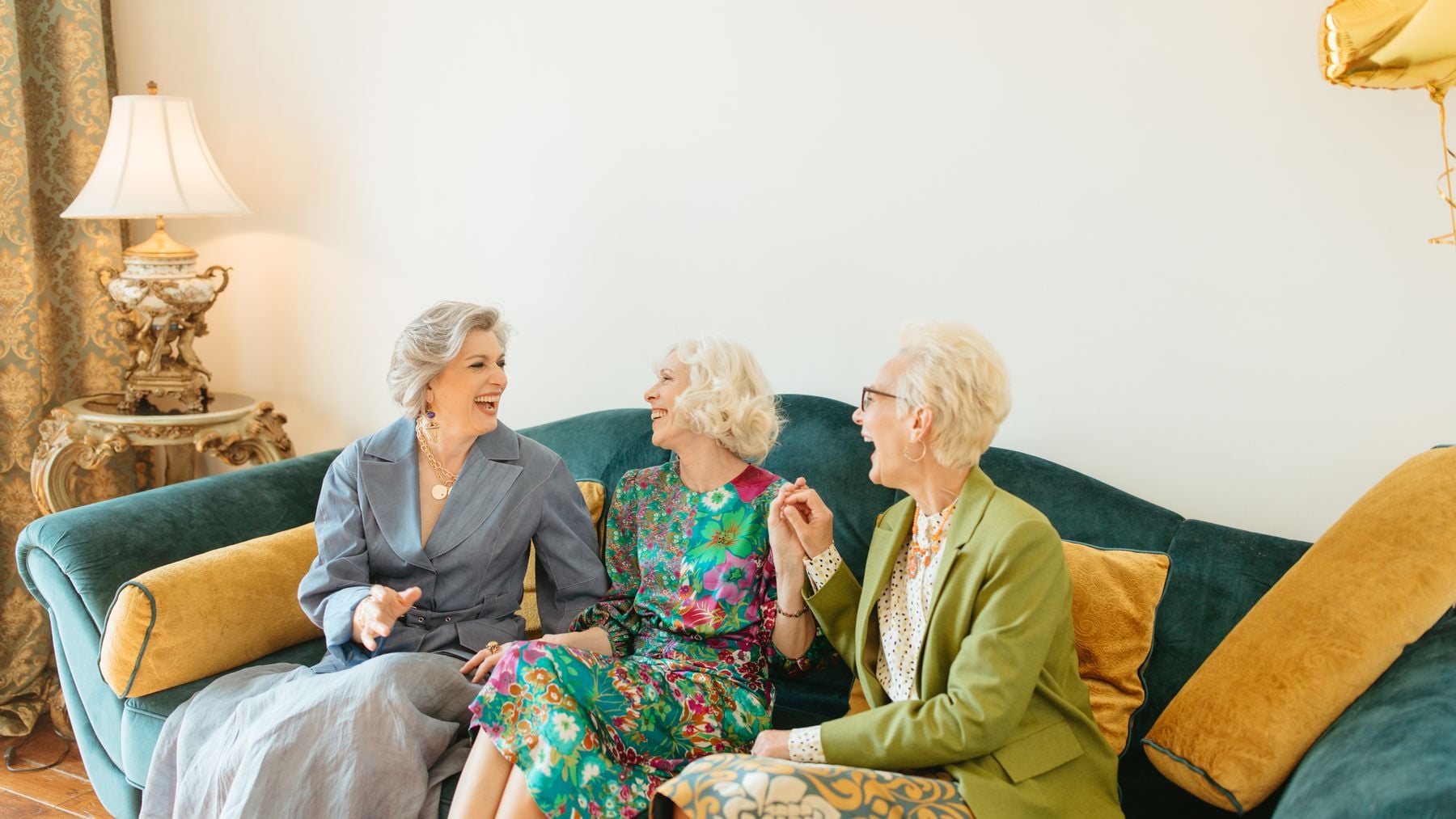

There is an appealing neatness to the idea that a rich social life after 60 comes down to two or three people and a weekly date in the diary. It turns friendship from something vague into something you could almost count.
The evidence does point towards the value of a small, dependable core and regular contact. But the headline combines findings from different studies, and no research establishes two or three friends seen every week as a universal formula.
That distinction matters. A reassuring rule can become another standard against which people judge themselves. The research is more useful when read as a description of several overlapping patterns.
Where the two-or-three figure comes from
The clearest source is a study led by Alexandra Thompson and published online by Ageing & Society in 2022. The researchers surveyed 335 UK residents aged 65 and over and asked how many close friends they had.
The relationship was not simply linear. The estimated point at which adding friends brought diminishing benefits differed by outcome: four close friends for loneliness, three for anxiety, and two for depression and stress.
Those numbers are interesting, but they are not a prescription. This was an exploratory, online, cross-sectional survey. It captured one moment and could not establish whether friendships improved wellbeing or whether people who felt better found it easier to sustain friendships. Participants also decided for themselves what counted as a close friend.
Even on its own terms, the study does not identify two or three as the single ideal number. Its narrower suggestion is that the biggest difference may occur between having very few close friends and having a small core, while gains appear to flatten as the number rises.
It did not test weekly meetings
The same study did not measure whether participants saw those friends every week. In its limitations, the research team explicitly listed frequency, mode of contact, length of friendship and the content of interactions as questions for later work.
The weekly part of the headline comes from separate evidence. A 2025 conference abstract based on the US National Poll on Healthy Aging analysed 3,181 adults aged 50 and over. Among the 2,877 respondents who had friends, fewer friends, less than weekly contact, and feeling dissatisfied with the number of friends or amount of contact were each associated with feeling isolated or short of companionship. The abstract was published in Innovation in Aging.
This supports the importance of regularity. It does not show that people need exactly two or three weekly friends, and it covers everyone over 50 rather than only people over 60. It is also a conference abstract rather than a full paper, so there is less methodological detail available to inspect.
A larger network can still matter
A different study makes the strongest wording in the headline harder to defend. Snorri Bjorn Rafnsson, Aparna Shankar and Andrew Steptoe followed 4,116 participants in the English Longitudinal Study of Ageing for six years. Their 2015 analysis found that network size and contact frequency were both positively and independently associated with later life satisfaction and quality of life after adjustment for demographic, socioeconomic and health factors.
In other words, frequency was not all that mattered. Size retained its own association. This does not mean that everyone should maximise their social circle, either. It means the evidence does not support replacing one simple rule, more friends is always better, with its opposite, only two or three really count.
There is another measurement issue here. A rich social life can include a partner, relatives, neighbours, former colleagues, club members and familiar faces in a local café. A study counting close friends is not necessarily measuring that whole social world.
The Norwegian evidence adds a useful correction
A large Norwegian study offers perhaps the most helpful way to interpret the numbers. Magnhild Nicolaisen and Kirsten Thorsen analysed 14,725 people aged 18 to 79 in the Norwegian Life Course, Gender and Generations study. They found that younger people saw friends most often, while older groups reported greater satisfaction with the contact they had.
Across the age groups, wanting more contact and feeling dissatisfied with current contact were more strongly related to loneliness than actual contact frequency. The study does not make frequency irrelevant. It shows why the same calendar can feel abundant to one person and sparse to another.
That is a better fit for ordinary life. One person may want a long conversation with two old friends each week. Another may value a larger, looser circle and be entirely content with less frequent meetings. Someone else may have many social contacts but miss a confidant.
What a small core can provide
The case for two or three close friends is not that this number has magical properties. It is that a small number of relationships can be maintained with enough repetition to become part of the structure of a week.
Regular contact reduces the need to stage a major reunion every time. Friends hear the continuation of last week’s story. They notice small changes. Shared routines also protect friendship from the logistical erosion of adult life. I have written before about how adult life dismantles the conditions that once made friendship easy. A recurring walk, meal or call quietly rebuilds one of those conditions: repetition.
Yet not every valuable friendship is weekly. Distance, work, caring responsibilities, health and money shape how often people can meet. A monthly friendship can be close. A weekly gathering can remain superficial. The studies above measure associations across groups, not the worth of any particular bond.
The useful finding is not a quota
So does study after study point to the same conclusion? Only in a broader sense. Several strands of evidence suggest that close friendship, regular contact and satisfaction with that contact all matter in later life. One small study found diminishing returns after roughly two to four close friends, depending on the outcome measured. Another found an association between at least weekly contact and companionship. Larger longitudinal evidence suggests network size still contributes too.
The grounded reading is not that the richest social lives belong to people who have exactly two or three friends on a weekly rota. It is that richness need not require a crowded address book. For many people, a small core they can rely on and see regularly may be enough. The part no headcount can settle is whether the contact feels close, wanted and sufficient to the person living it.