
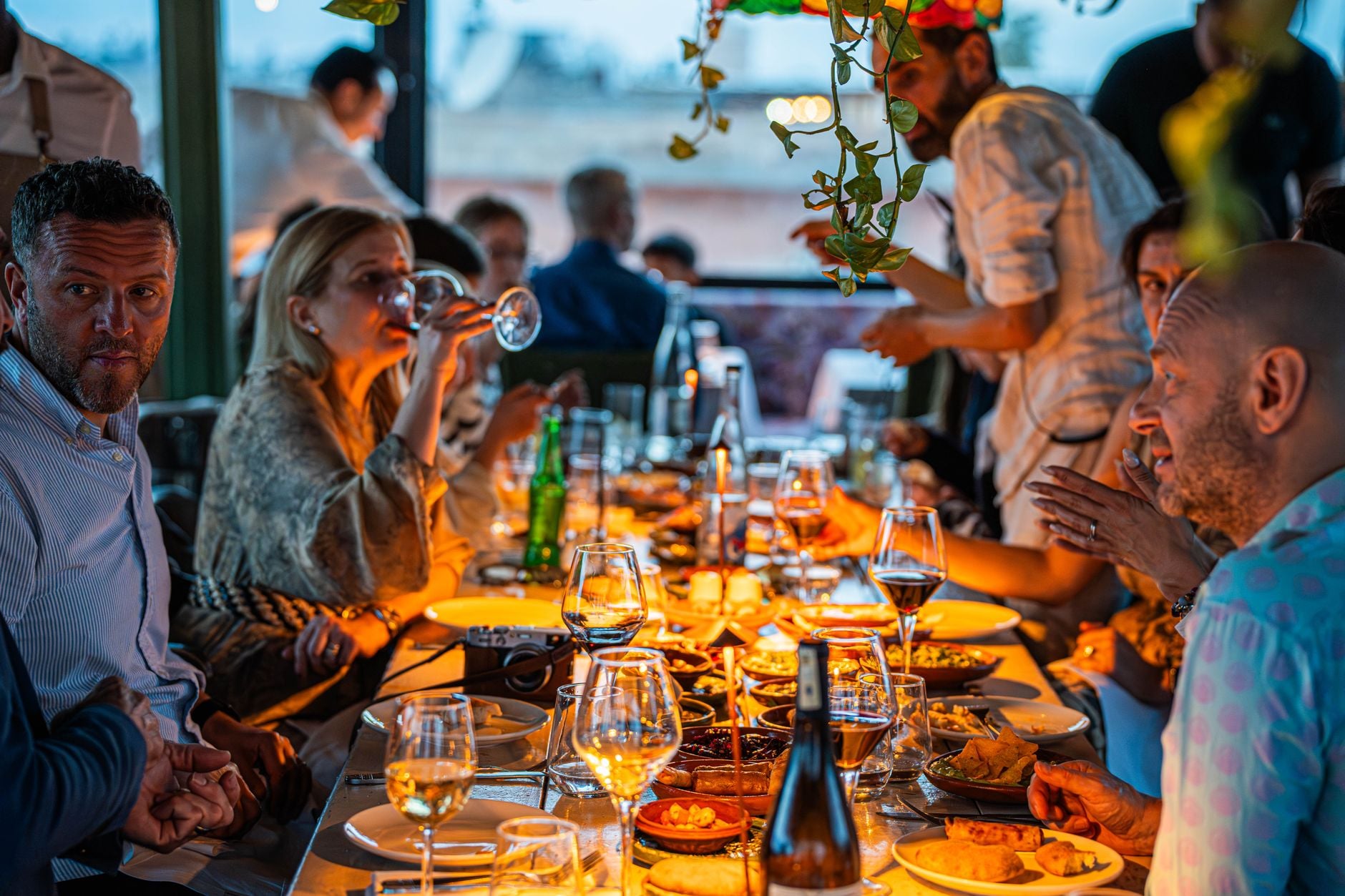

Some people are quiet at a party until you discover that the party is theirs.
Then they seem to change. They greet everyone at the door, remember who needs introducing, refill glasses, settle awkward pauses and move between conversations without looking remotely stranded. It is tempting to conclude that the introversion was an illusion.
I think there is a more interesting possibility. Hosting gives a person a role, and a role supplies the next line. The gathering may still be tiring. The host may still prefer depth to breadth and solitude to prolonged stimulation. What has disappeared is not introversion, but uncertainty.
This is a psychological interpretation, not the finding of one experiment on introverted dinner-party hosts. The research supports its pieces: traits do not dictate behaviour in every situation, situations change how traits are expressed, and some people handle social life through learned scripts. The private meaning of any particular gathering still belongs to the person hosting it.
Introversion is a tendency, not a ban on social skill
Personality psychology generally treats extraversion as a continuum. People differ in their average tendency to be talkative, assertive, energetic and drawn towards social reward. An introverted person can still be warm, funny, decisive and socially observant.
William Fleeson’s experience-sampling research on personality states found large variation within individuals. Over ordinary days, the typical person displayed a wide range of trait-relevant behaviour even while maintaining a stable average.
A later study comparing personality expression across work, family, friendship, romantic and hobby situations likewise found substantial person-by-situation variation. The person who appears reserved as somebody else’s guest may behave differently when responsible for the room.
The host role turns a crowd into a sequence
A guest enters an open social field. Where should I stand? Whom should I approach? When do I leave one conversation? A host enters a sequence of tasks.
Take the coat. Offer a drink. Introduce the person who knows nobody. Check the food. Notice the guest left outside the circle. Move the evening to the table. Bring out coffee. These acts may look spontaneous from across the room, but many are predictable.
Research on self-monitoring is useful here. A review by William Ickes and colleagues argued that socially adaptable high self-monitors often prefer clearly defined situations, use scripts for familiar settings, plan before encounters and read other people’s behaviour for cues.
Self-monitoring and introversion are not the same trait. We should not casually assign one from the other. The relevant point is narrower: apparent social ease can be constructed from preparation and structure. It need not arrive as an effortless appetite for crowds.
A script is not necessarily a false self
Calling hosting a performance can sound accusatory, as though the welcome is counterfeit. Most social life contains roles. A teacher, nurse, parent, waiter and old friend all bring out different parts of the same person.
I have written before about small talk as social coordination rather than failed conversation. Hosting uses many of those modest exchanges. “Can I take that?” and “Have you two met?” do not expose a soul. They tell people that the room is safe and that somebody is paying attention.
The host may be sincere in every gesture. A script does not determine whether a feeling is real. It simply reduces the number of decisions required to express it.
Hosting also changes who is allowed to ask the questions
The role gives legitimate reasons to move, interrupt and redirect attention. The host can ask where someone travelled from, whether they have enough food and how they know another guest. Then the conversation can be handed across the table.
That asymmetry matters. A person can be highly present while revealing relatively little. Asking, noticing and facilitating are forms of participation, but they place other people at the centre.
My earlier piece on why follow-up questions make people feel heard explored one benefit of attentive questioning. The same ability can make a host excellent company. Yet listening skill and self-disclosure are different capacities.
This is where hosting can become protective. If the conversation approaches something personal, there is always ice to fetch, music to adjust or another guest to welcome. The exit is socially useful, so it rarely looks like an exit.
The cost may appear after the door closes
A person can perform a social role well and still pay for it later. In one randomised trial of acting more extraverted for a week, participants who were more introverted in disposition reported weaker positive effects and more tiredness, negative affect and reduced authenticity.
Other findings do not map perfectly onto that result. An experience-sampling study of sociable behaviour and fatigue found that acting sociably predicted tiredness two to three hours later, but it did not find that this link was stronger specifically for introverts.
So I would resist the familiar claim that every social encounter simply “drains an introvert’s battery”. The evidence is more complicated. Ease during the event tells us little about the recovery required afterwards.
The confident host washing glasses alone at midnight may not have been pretending. They may simply have spent the energy exactly where they intended to spend it.
The role can be a bridge or a hiding place
Hosting gives control over the guest list, setting, timing, food, music and physical territory. Those are not trivial comforts. For someone who dislikes unstructured social exposure, they can make a large gathering more manageable than a smaller event organised by somebody else.
But control can carry a quiet trade-off. In a previous article, I looked at how being useful to a room can coexist with remaining hard to know. The host may become indispensable as the person who creates connection while nobody thinks to ask what connection feels like for them.
There is no need to turn that possibility into a pathology. Some people host because generosity is one of their most genuine languages. Some enjoy designing the conditions for other people to relax. Some prefer purposeful sociability to socialising without a role. Some are simply very good at throwing parties.
The question is not whether their ease is fake. It is whether the role expands what they can do or becomes the only version of closeness they can tolerate. Can they accept help? Can they remain seated when the meal is finished? Can they let a conversation stay on them for a moment without reaching for the empty plates?
An introvert at the head of a crowded table is not a contradiction. Personality is an average, while a gathering is a situation. The host has a map of that situation: welcome, connect, feed, notice, close.
From the guest’s side, it looks like fearlessness. From the host’s side, it may feel like the relief of knowing what comes next.