
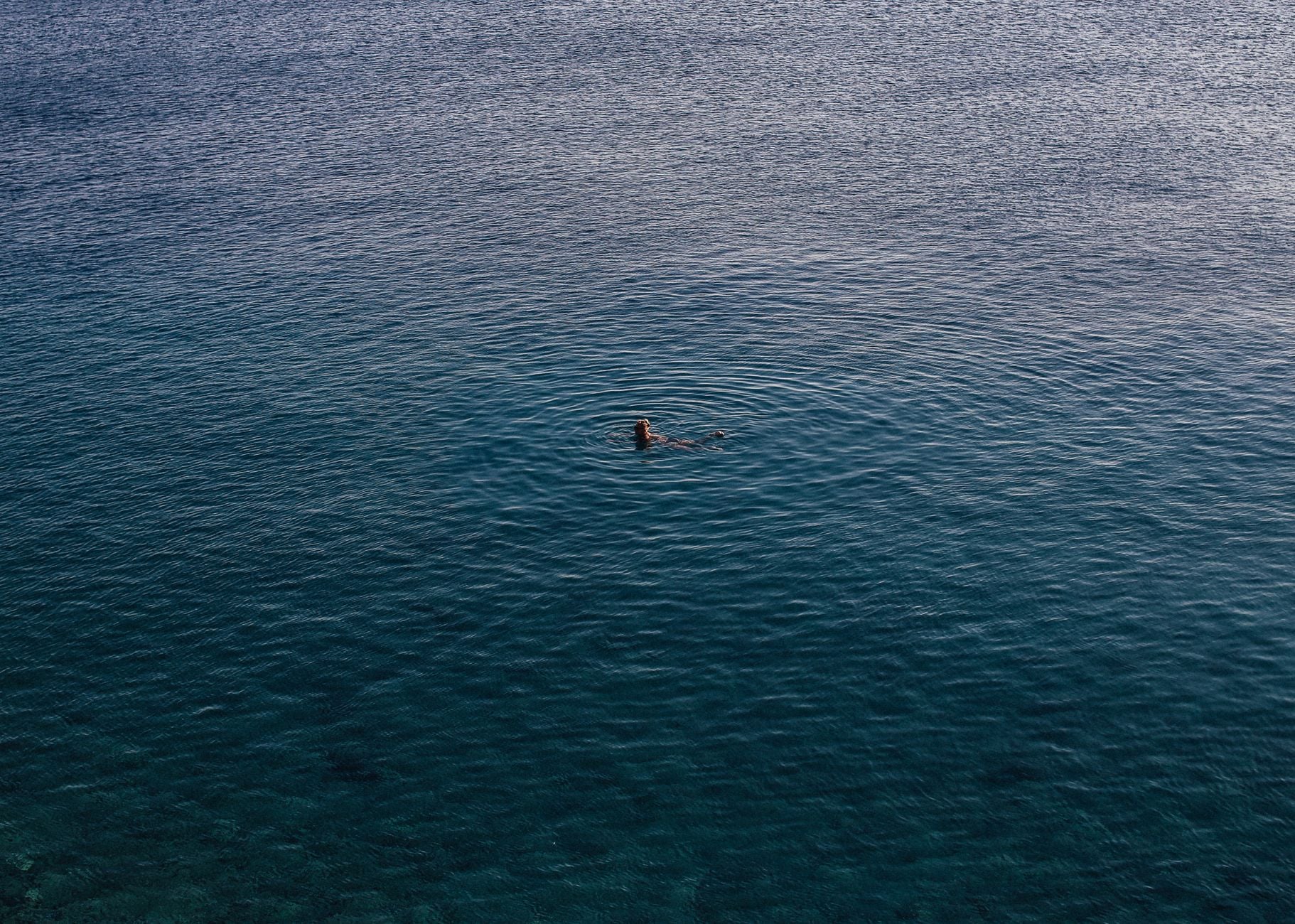

A pool and an ocean can contain the same swimmer performing the same stroke, yet they rarely feel like the same activity. One is a measured container. The other is a moving environment that happens to permit swimming.
The salt does make a physical difference, though a smaller one than people sometimes imagine. Typical seawater is about 2.5 per cent denser than freshwater. The larger change is everything surrounding that extra buoyancy: waves alter the surface, currents move the swimmer, temperature varies, visibility changes and there is no wall arriving every few seconds to confirm distance and direction.
This is an explanation of why the experiences differ, not water-safety guidance. Conditions, exposure and swimming ability vary too much for a general article to make individual decisions.
Salt changes buoyancy, not the whole story
The US Geological Survey gives representative densities of about 1.000 grams per cubic centimetre for freshwater at 20 degrees Celsius and about 1.025 for seawater. Density varies with temperature and salinity, but that comparison supplies the familiar effect: the same submerged body displaces slightly more mass in salt water and receives slightly more upward buoyant force.
A difference of 2.5 per cent is real. It can change how high a swimmer sits in the water and how floating feels. It does not explain the scale of the subjective difference on its own.
A pool removes most uncertainty. Water depth is known. The bottom is visible. Lane lines damp some surface movement, black markings organise direction, and the wall divides effort into standard lengths. Even when the body is working hard, the environment repeats itself.
The sea offers no such agreement. Buoyancy may increase a little while almost every other cue becomes less stable.
The water has its own destination
In a pool, still water pushes back against a stroke in a fairly predictable way. Ocean water is moving before the swimmer enters it. Wind generates surface waves, tides change water levels and currents carry water horizontally. A person can keep pointing towards the same landmark while moving sideways relative to the seabed.
This is why distance in open water is not experienced as a simple count of strokes. The swimmer is producing motion inside a second motion. Progress depends on the relationship between the two.
Waves also keep changing the surface through which the swimmer breathes. A stroke timed comfortably in flat water may meet a crest or trough instead. The ocean does not need to be dramatic for this to matter. Small, repeated irregularities are enough to make the whole task feel less automatic.
The appeal for some people is precisely that negotiation. The water is not a blank medium. It has texture and direction, and the swimmer has to remain aware of it.
The horizon replaces the lane line
A pool supplies close visual references above and below the surface. In the sea, the bottom may disappear into colour or darkness after a few metres. The nearest useful landmark may be a headland, building, buoy or boat far beyond the swimmer.
Open-water swimmers therefore describe “sighting”, periodically checking an external reference to understand direction. The need is simple to state but changes the sensory rhythm. Looking forward interrupts the alignment used for breathing to the side, while waves can briefly hide the target.
The absence of walls changes time as well as space. A pool length has an ending built into it. The ocean offers no automatic pause and no universal unit. Five hundred metres may be a marked course in one setting and only an estimate between two points in another.
I think this loss of measurement is part of why ocean swimming can feel expansive even when the actual distance is modest. Attention shifts from accumulating lengths to maintaining a relationship with a shoreline, a swell and a changing field of view.
Temperature makes the first moments disproportionately vivid
Ocean temperature can differ sharply by season, location and even depth. Cold water is not merely a stronger version of cool water. It can produce an immediate physiological response, which is why the Royal National Lifeboat Institution treats cold and changing conditions as safety matters, not as tests of toughness.
I previously wrote about an experiment in which the ending changed how people remembered a cold-water experience. That study involved hands in laboratory containers, not sea swimming, but it highlights how unevenly an experience is remembered. The first contact and the final return to shore can dominate the story a swimmer tells about the whole time between them.
This is also where romantic language becomes unhelpful. Describing cold water as purifying, brave or character-building can turn a physical condition into a moral performance. Temperature is an environmental fact. Nobody earns more from the ocean by ignoring it.
Why swimmers keep describing connection
A 2025 qualitative study in Psychology of Sport and Exercise interviewed ten frequent outdoor swimmers in the United Kingdom. Participants described motives including leisure, exercise, time alone, companionship and connection with nature.
Ten self-selected swimmers cannot tell us what ocean swimming does to everyone. Their accounts describe perceived experience, not a controlled health effect. Still, the range is revealing. People did not reduce the activity to fitness. They spoke about solitude and company, exertion and reflection, body and place.
That fits with something I noticed when writing about the association between coastal proximity and reported wellbeing. The difficult question is always causation. People may benefit from an environment, choose it because they already value it, or experience both at once.
Ocean swimming intensifies that relationship with place. Weather is no longer scenery seen through a window. It changes the water touching the body. The coast is no longer a view. It becomes the boundary by which direction, distance and return are understood.
Neither pool nor ocean is the purer form
It would be easy to make the ocean the authentic version and the pool a sterile substitute. I do not think the distinction holds. A pool makes precision, repetition and access possible. The ocean introduces variation, uncertainty and a stronger awareness of surroundings.
They ask different things of attention. In a pool, the swimmer can disappear into rhythm because the setting remains constant. In the ocean, rhythm has to coexist with observation.
Seawater’s extra density helps a body float a little higher. What makes ocean swimming feel larger is that the swimmer is no longer moving through water alone. They are moving through weather, geography and a body of water that is already on its way somewhere else.