
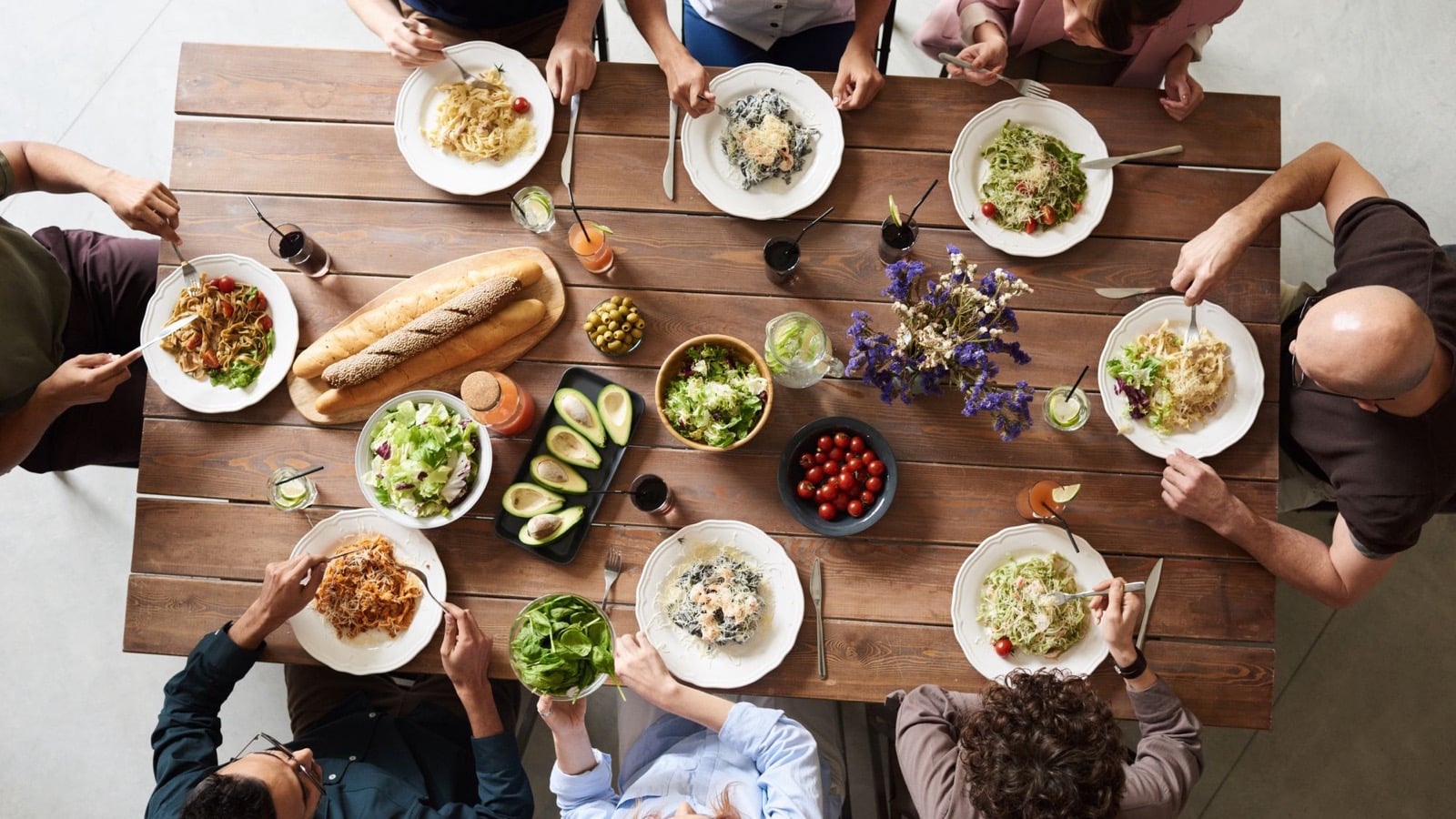

A table can hold two different kinds of abundance. There is the food itself, counted in plates and glasses, and there is the company around it, harder to measure but often more revealing. The 2025 World Happiness Report put numbers around that second part.
Across more than 150,000 people in 142 countries and territories, those who shared lunches and dinners more often generally reported higher life satisfaction and more positive emotions. In statistical models, the simple meal-sharing measure was about as informative as income or employment status.
In the United States, meanwhile, 26 per cent of adults recorded eating every meal alone on the day covered by a 2023 time-use diary. That was 53 per cent higher than the corresponding figure in 2003.
The finding is worth examining, but it is not the final word. These are observational data from two different surveys. They show that shared meals are an unusually revealing marker of how life is going, not that adding another chair automatically makes a person happier.
The one-in-four figure describes one diary day
The American trend comes from the US Bureau of Labor Statistics’ American Time Use Survey. Respondents reconstruct the previous day’s activities and identify who was present. Researchers analysed approximately 235,000 adults interviewed between 2003 and 2023.
A respondent counted as dining alone when every eating occasion in that day’s diary took place without another person present. In 2023, 26 per cent fell into that category, compared with about 17 per cent in 2003. The increase from 17 to 26 percentage points is nine points in absolute terms and 53 per cent in relative terms.
This distinction prevents an easy misreading. The result does not show that one quarter of Americans habitually eats every meal alone, every day. It shows that one quarter did so on the particular day captured by the survey. Because thousands of diary days are sampled to represent the population, the data can reveal a national trend without turning a one-day record into a permanent description of an individual’s life.
Living alone explains only part of the increase
More single-person households might seem like a complete explanation. The report’s analysis suggests otherwise. Changes in household size accounted for an estimated 15 to 20 per cent of the rise in solitary eating.
Among Americans who lived with other people, the share eating every meal alone on the diary day increased from 12 per cent in 2003 to 18 per cent in 2023. Among those living alone, it rose from 55 per cent to 69 per cent. Solitary eating became more common inside shared homes as well as outside them.
The increase was especially steep among younger adults. For those aged 25 to 34, the rate rose by more than 180 per cent across the two decades. The time diaries cannot isolate why. Work schedules, commuting, study, food delivery, household routines and phone use are plausible parts of the background, but the dataset does not assign each a share of the change.
The pandemic is not a sufficient explanation either. The trend was already rising before 2020, and the highest overall level in the series was recorded in 2023.
What the World Happiness Report measured
The international analysis appears in the meal-sharing chapter of the World Happiness Report 2025, written by Jan-Emmanuel De Neve, Andrew Dugan, Micah Kaats and Alberto Prati. Gallup World Poll respondents were asked on how many of the previous seven days they had eaten lunch with someone they knew and on how many they had eaten dinner with someone they knew.
Their answers were compared with three measures of subjective wellbeing: an overall evaluation of life, positive emotions and negative emotions. People who reported one shared meal in the previous week rated their lives at an average of 5.2 on a ten-point scale, compared with 4.9 among those reporting none. Life evaluations generally rose with the number of shared meals, although the pattern was not perfectly smooth.
The relationship remained after the researchers adjusted for age, gender, education, employment, income, household size, country and whether respondents could afford enough food. The chapter and its underlying paper are also available through the University of Oxford’s research archive.
The meal-sharing survey module was funded by the Ajinomoto Group, a food company, which the authors disclose. Funding does not invalidate a result, but it belongs in a clear account of where the questions came from.
“As strong as income” is a statistical comparison
The researchers ran separate models to ask how much variation in people’s life evaluations could be explained by meal sharing, income and unemployment. By that measure, the number of shared meals performed about as well as the established economic indicators. Meal sharing also explained more variation in positive emotions than income and unemployment combined.
This does not mean one dinner has the same causal effect as a pay rise. Nor does it establish that arranging another lunch will lift life satisfaction by a fixed amount. A predictor can be strong because it captures several circumstances at once. Someone who regularly eats with others may have workable hours, nearby friends, a stable household, enough money for food and a reliable social network.
The direction of the relationship remains open. Shared meals may support wellbeing. People who are already happier may be more inclined to arrange them. Both may be produced by a third factor, such as supportive relationships or predictable working hours.
An earlier peer-reviewed study of social eating, led by Oxford psychologist Robin Dunbar, found that people who ate socially more often reported greater happiness, life satisfaction, trust and social support. It was observational too, so it adds context without settling causation. An OECD review of food and social connectedness reaches a similarly measured conclusion.
The Nordic figures resist a tidy cultural lesson
The global data give this subject an obvious place in a publication based in Scandinavia, but the rankings do not support a regional happiness formula. Iceland was the only European or North American country in the global top ten, averaging about 10 shared lunches and dinners each week. People in Sweden averaged 9.5, according to a summary from Oxford’s Wellbeing Research Centre. The corresponding American average was 7.9.
Iceland is Nordic rather than Scandinavian in the strict geographic sense, and Sweden’s result cannot stand in for Denmark or Norway. National averages also conceal differences between households, regions, age groups and work patterns. Latin America and the Caribbean recorded the highest regional frequency of meal sharing, yet the association with wellbeing was not equally strong in every part of the world.
The long table may still function as social infrastructure. Scandinavia Standard previously covered a Copenhagen project organised around communal dinners with people who had not yet met. That was one local project, not evidence of a national personality. Its practical premise was simpler: connection often needs a time, a place and a reason to begin.
A shared meal is a marker, not a prescription
Eating alone is not a personal failure. Solitude can be chosen, restorative and practical. Some shared tables are warm; others are tense. The global survey counted company, not the quality of conversation, the fairness of the cooking and cleaning, or whether anyone at the table felt welcome.
There are also structural differences hidden inside the phrase “share a meal”. For one person it means a relaxed dinner with friends. For another it means expense, care work or an obligation performed after a long shift. Some people lack company; others deliberately protect time alone.
The useful question for institutions is whether daily life leaves room for company when it is wanted. Predictable breaks, affordable food, accessible communal spaces, school meals and work cultures that do not reward eating at a desk can change whether a shared meal is possible without treating private choices as a problem.
A meal is an ordinary unit of time that already exists in the day. The evidence suggests that who is present during it tells us a surprising amount about wellbeing, while leaving open how much the table itself can change.