
On 26 March 2018, a young female Arctic fox stepped from Spitsbergen onto sea ice and began moving west. Seventy-six days later, her satellite track reached Ellesmere Island in Nunavut, Canada. The route reported in the paper’s abstract totalled 3,506 kilometres, completed at a mean movement rate of 46.3 kilometres a day.
Those numbers became a global headline when Eva Fuglei of the Norwegian Polar Institute and Arnaud Tarroux of the Norwegian Institute for Nature Research published the track in Polar Research in June 2019. Their actual claim was narrower and more interesting than some retellings: this was the first satellite tracking of natal dispersal by an Arctic fox between continents and High-Arctic ecosystems. It was not the first fox ever to cross Arctic sea ice, and it was not a return migration.
This is one animal’s documented movement, not evidence that a typical Arctic fox travels from Europe to North America. The value of the case lies in what its daily locations reveal about distance, sea ice and biological connection across an Arctic map that humans tend to divide into countries.
The 76-day clock began after the journey had already started
The original study describes a longer movement than the title’s number. The fox left her natal area around 1 March 2018 and first travelled across Spitsbergen. She reached an ice-free shore on 11 March, turned west, met open water again on 16 March, then changed direction and crossed the north of the island. Only on 26 March did she find ice-covered sea and leave Spitsbergen.
She covered 1,512 kilometres in the next 21 days, reaching northern Greenland on 16 April. After crossing sea ice, coast and the Greenland ice sheet, she left Greenland on 6 June and arrived on Ellesmere Island on 10 June. The 76 days and 3,506 kilometres therefore refer specifically to the section from Spitsbergen to Ellesmere.
Across the researchers’ full four-month analysis, from 1 March to 1 July, the fox covered a cumulative 4,415 kilometres in 122 days. By 1 July she had settled into a much smaller area in Canada. The endpoint was about 1,789 kilometres from her natal area as the crow flies, showing how different the travelled route was from a direct line.
The satellite track is a minimum, not a pedometer reading
The fox wore a 115-gram KiwiSat Argos transmitter that broadcast for a three-hour window each day. The researchers removed failed positions and used a Bayesian state-space model to estimate one location per day. They then drew straight lines between consecutive daily locations. In the paper’s own language, those lines represent minimum distances covered daily.
Any smaller turns between transmissions disappear from the calculation, so the animal may have travelled farther. There is also a minor rounding curiosity in the paper: the abstract and narrative report 3,506 kilometres, while the movement table gives 3,507. The one-kilometre difference does not alter the result, but it is a reminder that this was a modelled track rather than a wheel rolled over the ice.
Scandinavia Standard’s recent explainer on Norway’s 100,915-kilometre coastline dealt with the same underlying problem: measured length depends on scale and method. Here, 3,506 kilometres is a cumulative route built from daily points, while 1,789 kilometres is the straight-line displacement between origin and destination. Both are correct answers to different questions.
The 46.3-kilometre figure is likewise a mean movement rate, not a steady speed. Daily estimates ranged from 0.5 to 155.1 kilometres, with the maximum recorded on the north-western Greenland ice sheet. The standard deviation was 41.1 kilometres a day, almost as large as the mean. Imagining a fox maintaining two kilometres an hour without pause misses how uneven the journey was.
She weighed 1.9 kilograms when the collar was fitted
Researchers captured the fox near the front of Fjortende Julibreen in Krossfjorden on 29 July 2017, probably close to her natal den. Tooth wear identified her as a juvenile. She weighed 1,900 grams at capture, so the 115-gram transmitter was substantial equipment on a very small animal. The study did not report a second weighing before she departed the following March, which means her mass during the crossing is unknown.
The current Norwegian Polar Institute species profile gives a general adult weight range of 2.5 to 5 kilograms. It also describes the compact anatomy that reduces heat loss: short snout, small rounded ears and a body smaller than a red fox. None of this tells us what the tracked animal ate or how much energy she spent on the route, because there was no observer beside her.
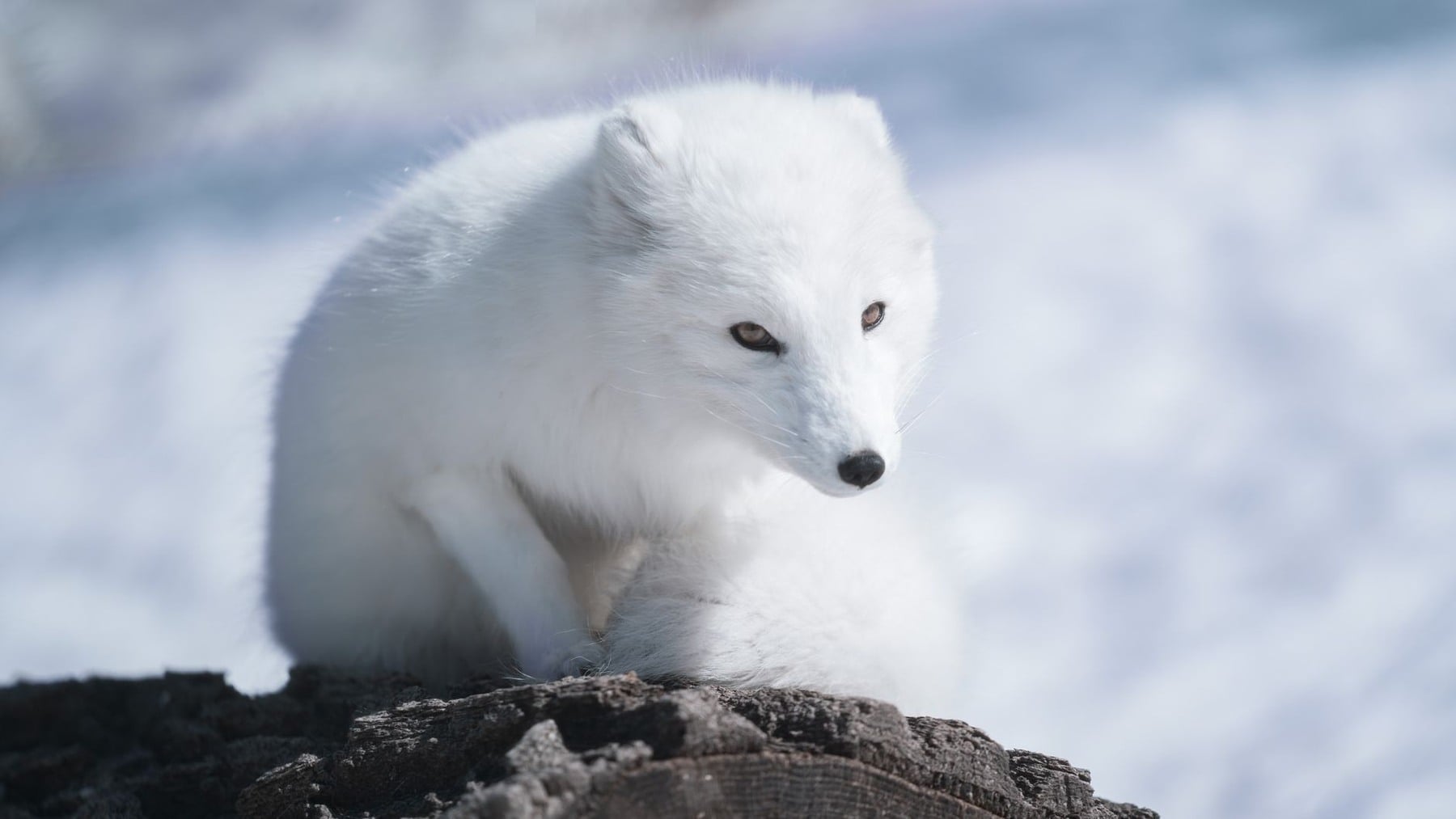
She was a blue-morph Arctic fox, meaning her coat remained dark rather than turning white for winter. That morph is associated with the coastal ecotype found on islands without lemmings, where food from marine ecosystems is especially important. The distinction became relevant at the end of the route.
The fox crossed into a different food web
Svalbard has no native lemming cycle, whereas Ellesmere Island supports lemmings. The animal therefore moved from what the authors called a coastal fox ecosystem to a lemming fox ecosystem. After reaching Ellesmere, she stayed within a limited area around the Fosheim Peninsula, behaviour consistent with establishing a new terrestrial home range.
That is why the paper calls the movement natal dispersal. In ecology, dispersal means movement away from a birth area towards a potential breeding area. Migration usually implies a regular directional movement, often with a return. The satellite record showed departure and settlement, not a seasonal round trip.
The collar kept transmitting from Ellesmere until 6 February 2019. Its silence after that date does not reveal whether the equipment failed, detached or the fox died. The study also cannot show that she reproduced. Her track demonstrates that one individual connected the regions physically; it does not by itself prove that she contributed genes to the Canadian population.
One exceptional fox fits a wider pattern of long-distance movement
The female was one of 54 foxes in a Svalbard tracking project. The Norwegian Polar Institute’s project summary says most remained within 90 kilometres of where they were captured. The average daily movement across that work was 6.6 kilometres, although individuals varied widely. The Canada-bound female was an outlier within her own project.
Later evidence shows that long dispersal itself is not a biological one-off. A 13-year satellite study in the Canadian High Arctic fitted collars to 170 Arctic foxes and analysed long-distance dispersal by 10 juveniles and 27 adults. Juveniles undertook it more often than adults and, among complete long-distance tracks, travelled farther and for longer.
That larger study makes a young fox leaving its natal range less mysterious, but it does not make this precise journey ordinary. Different foxes left at different times, followed different routes and often had tracking end before successful settlement could be established. One famous track can illustrate a capacity without defining a species-wide routine.
Sea ice acted as a bridge, with an uncertain future
The female’s average movement rate was higher on sea ice than on land. A published erratum clarified the comparison: she moved 34.0 kilometres per day faster on sea ice, rather than moving at a total of 34.0 kilometres per day there. The interpretation was unchanged. Fuglei and Tarroux argued that the ice functioned mainly as a dispersal platform rather than a foraging habitat.
Even that conclusion has limits. The track contains two 48-hour slowdowns below 10 kilometres a day. The authors offered several possibilities, including open leads in the ice, bad weather, rest or a food source. A daily satellite position can show where speed changed, not why the fox made a decision.
What the route makes visible is a form of Arctic connectivity that political maps hide. Seasonal ice can join Svalbard, Greenland and the Canadian Arctic for an animal capable of using it. Population genetics had already indicated movement and gene flow among many circumpolar Arctic fox populations; this female supplied a detailed physical example of how such contact can occur.
Declining sea ice may narrow future routes and change access to marine food, but this single 2018 track cannot measure that future by itself. Its cleanest lesson is simpler: for 76 days, a few kilograms of fox treated sea ice, glacier and tundra as one continuous landscape, while a small collar recorded the daily points that let humans see the connection.