
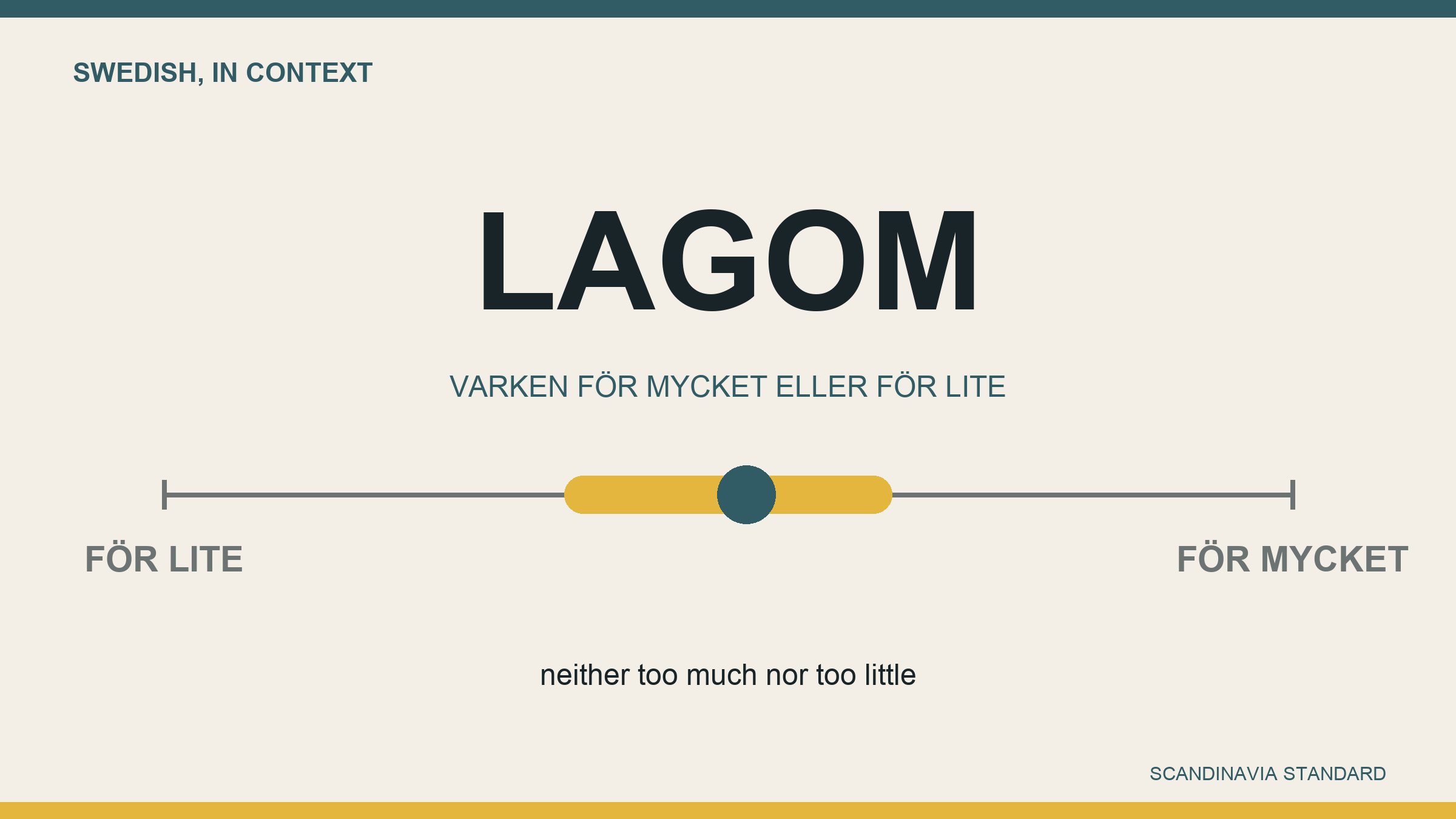

A cup of coffee can be lagom warm. A jumper can be lagom thick for the weather. A child can be given a lagom amount of Saturday sweets, and a guest can arrive i lagom tid, at an appropriate time.
In each case, the Swedish word does more than declare that some minimum has been reached. It judges the degree as fitting. There is no troublesome excess and no disappointing shortage. The coffee, jumper, quantity or timing suits the occasion.
This is why translations of lagom tend to expand into phrases: just right, the right amount, in moderation, suitably, enough but not too much. English can express the idea perfectly well. Swedish has simply packed it into a remarkably useful everyday word.
The dictionary definition is about suitability
The current Swedish Academy dictionaries give lagom two closely related jobs. As an adverb, it means doing or having something to a suitable extent, neither too much nor too little. As an adjective, it describes something with a suitable extent or amount.
The Swedish Institute’s current English-language glossary offers the familiar compact version: “just right; not too little, not too much”. That catches the core of the word, but the Academy’s use of “suitable” is especially helpful. Lagom is not a number. It is a judgement made in context.
The right amount of coffee for a late evening is not necessarily the right amount at breakfast. A comfortably warm room in January may feel stifling in June. What counts as lagom changes with the purpose, the person and the moment.
Why “enough” can sound grudging
English “enough” often marks a threshold. There is enough petrol to reach home, enough money to pay the bill, enough flour for the cake or enough time to catch the train. The word confirms that a requirement has been met. It does not necessarily say that the amount is comfortable, desirable or well chosen.
“Just enough” can narrow the margin further. A phone with just enough charge for the journey is not an ideal phone. A salary that is just enough to cover the rent is not generous. The phrase often suggests that the speaker would prefer a little more.
Lagom need not carry that undertone. A lagom portion is not merely a portion large enough to prevent hunger. In its usual approving sense, it is the portion that feels right for this appetite and this meal. A lagom walk is not one reluctantly cut short. It may be exactly as long as the walkers wanted.
That is the subtle difference behind the headline. English “enough” commonly asks whether a minimum has been satisfied. Lagom commonly asks whether the degree fits. The answers can coincide, but the emotional colouring is different.
Swedish can move the word around
Part of the word’s usefulness is grammatical. Lagom can behave as an adverb or as an indeclinable adjective, slipping into places where English would need to choose among several constructions.
The Academy’s examples include lagom stor, meaning suitably or rightly sized, and i lagom tid, at the appropriate time. Its historical dictionary contains examples of punch that is lagom söt, berries that are lagom mogna for picking and a coat that is exactly the right size for its wearer.
English handles each example without difficulty, but not with the same repeated word. The punch might be sweet enough, pleasantly sweet or not too sweet. The berries might be ripe enough or ready to pick. The coat might fit perfectly. A translator has to decide what sort of rightness matters.
Swedish speakers can keep lagom and let the noun, situation and tone do more of the work. That convenience, rather than any supposed impossibility of translation, is what makes the word distinctive.
Lagom is not the arithmetic middle
Descriptions of lagom sometimes reduce it to “the middle” or “average”. Both are misleading. The amount halfway between two extremes might be wrong for everyone. Lagom points to suitability, not to an automatic compromise.
A strong cup of coffee may be lagom for one drinker and far too much for another. The same winter coat may be lagom in Malmö and inadequate in Kiruna. A large table can be lagom for a big family, while a much smaller one is lagom for a studio flat.
The word can therefore approve an objectively large quantity or a very small one. It can endorse intensity when intensity is called for, and restraint when restraint makes sense. Its centre is contextual, not mathematical.
This also separates lagom from simple blandness. Food that is lagom spicy is not necessarily timid food. It is as spicy as the eater thinks it should be. The judgement concerns fit, not a national ban on chilli.
The communal drinking bowl is a folk story
One especially persistent origin story claims that lagom came from laget om, “around the team”. In the usual version, a bowl or horn was passed around a group and each person drank just enough to leave a fair share for everyone else.
It is a memorable explanation because it makes the modern stereotype of Swedish moderation feel ancient and communal. It is also not the etymology given by the Swedish Academy.
The Academy’s historical dictionary connects lagom to the Old Swedish form laghum and ultimately to a grammatical form of lag. The older sense was associated with what was according to rule or as it should be. From there, a meaning concerned with the appropriate manner or measure is not difficult to recognise.
The documented account lacks the satisfying image of a Viking-age drinking circle. It has the less glamorous advantage of linguistic evidence.
Usually approving does not mean always approving
No useful word keeps exactly the same tone in every sentence. Lagom has an approving core, but delivery and construction can bend it.
The historical dictionary records ironic uses of just lagom, where the apparent claim that something is suitable means almost the opposite. It also records så lagom in senses closer to “hardly”, “not much” or “certainly not”. A speaker can use the language of rightness to signal scepticism or refusal.
Even without an established ironic expression, combinations can sound less enthusiastic than the bare dictionary definition suggests. Depending on tone, something described as lagom bra may be heard as adequately good rather than wonderful. The same pragmatic uncertainty exists in English “fine”, which can express genuine satisfaction or icy displeasure.
So the distinction is a tendency, not a rule. In an ordinary positive description, lagom often approves the balance it names. Context can still turn that approval into faint praise, humour or criticism.
A common word became an exported philosophy
Outside Sweden, lagom has been presented as a lifestyle system: buy less, work sensibly, furnish quietly, eat moderately and seek balance. There is a real connection between the word and those ideas, but the packaging can make an ordinary piece of Swedish sound mystical.
Swedish speakers do not need to invoke a national philosophy every time soup has the right amount of salt or a box is the right size. They are using a convenient word. Sweden, meanwhile, contains ambition, excess, conflict, luxury and bad judgement like any other country. A vocabulary item is not a national personality test.
Scandinavia Standard previously distinguished lagom from the economic idea of taking the first good-enough option. That distinction matters here. Lagom does not necessarily mean settling for the first acceptable choice. It can mean that the choice is properly calibrated to the need.
Another earlier piece considered lagom in the home, where it is often mistaken for fashionable minimalism. A room can contain many things and still feel lagom if those things serve the people who live there. The principle is rightness for purpose, not emptiness for its own sake.
The nearest English translation depends on the sentence
There is no single English replacement that will work everywhere. “Just right” is the nearest general translation. “The right amount”, “suitable”, “moderate”, “enough”, “appropriately” and “neither excessive nor insufficient” may be better in particular sentences.
That does not make lagom untranslatable. It makes it compact. English usually has to identify the sort of fit being praised and build a phrase around it. Swedish can state that the quantity, timing, size or intensity suits the situation, then move on.
The word’s appeal lies in that everyday ease. At its most ordinary, lagom does not sound like reluctant acceptance of the minimum. It says that nothing important is missing and nothing unnecessary has tipped the balance. Not barely enough, and not mathematically average. Just right for here and now.