
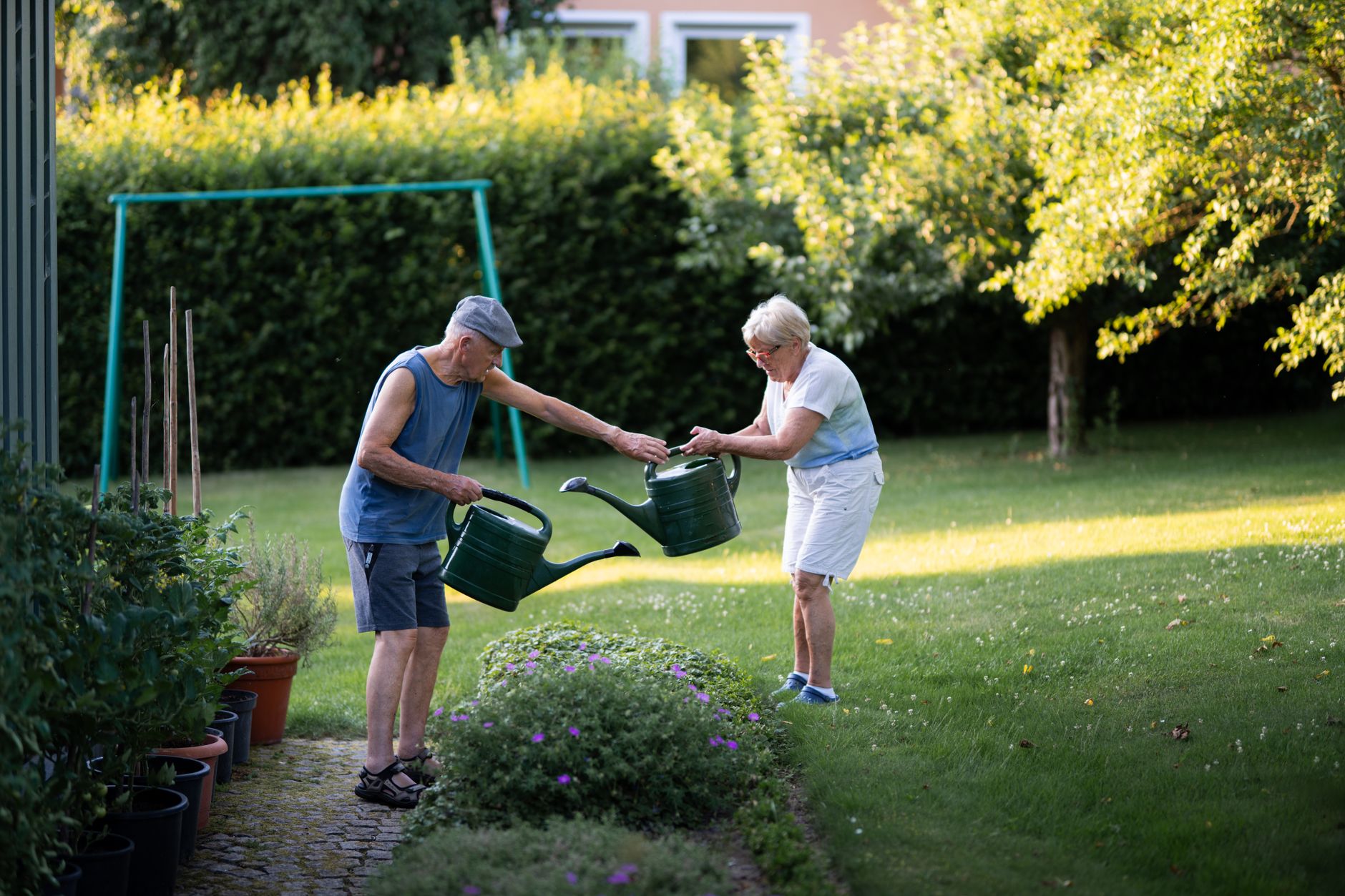

It can happen with almost comic speed.
Someone retires after forty years of meetings, deadlines and sensible shoes. Six months later, the same person is sending photographs of a tomato plant to the family group chat. The bird feeder must be filled before breakfast. The sourdough starter has a name, a feeding schedule and, apparently, moods.
From the outside, the intensity can look disproportionate. It is only a garden. They are only birds. It is only bread.
But “only” is doing a great deal of work there. These small commitments often carry something that is no longer being supplied by a workplace: a role, a rhythm, a test of competence and visible proof that a person’s attention still changes what happens next.
Calling them replacement identities is slightly too neat. Psychology has not established that every retired gardener or home baker is secretly rebuilding a lost professional self. Plenty of people simply enjoy growing things, watching birds or making excellent bread.
Yet the broader idea is sound. A serious hobby can become an identity scaffold after retirement, holding up parts of the self that paid work once supported almost invisibly.
Retirement does not only remove a job
Work gives people much more than money, including people who complained about it every Sunday night.
It divides time into meaningful units. It makes Monday different from Saturday. It offers a ready answer to the question, “What do you do?” It provides a place where somebody notices if you do not arrive, a vocabulary that other people understand and a stream of tiny verdicts on whether you are useful.
Then retirement can remove all of that in a single administrative event.
The result is not necessarily a crisis. Many people feel relief, freedom and a welcome expansion of choice. But even a happy retirement creates an identity problem: when a role occupied thousands of hours and dozens of relationships disappears, what now organises the day and confirms who you are?
This is why the most revealing sentence about a newly serious hobby is often not “I enjoy it.” It is “I have to.” The seedlings have to be watered. The feeder has to be cleaned. The dough has to be folded. Obligation has returned, but this time in a form the retiree chose.
Why little things can suddenly feel enormous
A large Dutch study followed 4,927 older workers and found that retirement was associated with greater increases in physical, social and self-development leisure than remaining in work. The researchers discussed two ways of understanding that shift. Activity theory emphasises replacing lost roles, while continuity theory emphasises preserving a coherent self through familiar patterns and values. In practice, retirement leisure can do both.
That distinction matters. The hobby may look new while the person inside it is recognisable.
A retired engineer who becomes exacting about a greenhouse may still be solving systems. A former teacher who learns every bird in the neighbourhood may still be gathering knowledge and passing it on. Someone who once ran a department may now coordinate a community garden, not because a vegetable bed is equivalent to a career, but because planning, responsibility and stewardship remain part of who they are.
The activity offers a small arena in which cause and effect are unusually clear. Water this and it grows. Refill this and living creatures arrive. Change the fermentation time and the loaf changes. After decades spent inside organisations where results could be delayed, political or impossible to see, that clarity can be deeply satisfying.
The garden is a place where agency becomes visible
A garden is never merely decorative to the person tending it. It is a negotiation with weather, soil, pests, patience and the limits of one’s own body. It asks for memory and judgement. It also gives immediate evidence that care has consequences.
In qualitative research with people of advanced age in Aotearoa New Zealand, gardens appeared in participants’ stories not simply as therapy but as resources for identity, connectedness, adaptation and agency. That last word may explain the emotional charge. Ageing can bring more appointments, more assistance and more occasions when somebody else decides what is safe or sensible. The garden returns a territory in which the older person remains the expert.
Even a balcony can provide that territory. Scandinavia Standard’s guide to gardening in a small space is ostensibly about soil, containers and choosing what to grow. Underneath those practical questions is a larger pleasure: turning a bounded patch into a world that responds to your knowledge.
This is also why unsolicited help can land badly. To an adult child, weeding the whole bed may look kind. To the parent, it may feel as if somebody has quietly taken over the place where their competence still has daily proof.
The bird feeder offers something rarer than entertainment
A bird feeder creates a relationship without demanding conversation. The birds arrive according to season, weather and appetite. Gradually, the person watching learns who appears first, which species bullies the others and what time the light brings them in.
There is evidence that ordinary encounters with birds can matter to wellbeing. A study using 26,856 real-time assessments from 1,292 people found that seeing or hearing birds was associated with lasting improvements in mental wellbeing. That was not a retirement study, and it does not prove that keeping a feeder rebuilds identity. It does, however, help explain why paying attention to nearby birdlife can feel more consequential than an outsider assumes.
The feeder adds something else: a modest form of being expected.
No bird knows the retiree’s job title. None offers gratitude. Yet the seed runs out if nobody fills it. A task that sounds trivial becomes a recurring piece of evidence that there is still something to notice, know and look after. It gives the morning a first appointment, with no commute and no performance review.
Sourdough turns time and knowledge into something tangible
Sourdough is almost perfectly designed to absorb a retired person’s attention. It is alive but manageable, repetitive but never identical. Temperature, flour, water and timing all leave marks on the result. The baker develops a private expertise that is difficult to fake and easy to share.
Research on cooking in later life describes food preparation as more than domestic labour. It can express identity, memory, culture, autonomy and connection. A recent scoping review found that cooking is closely tied to older adults’ identities and social worlds, even as health, household arrangements and physical ability change.
A loaf also solves a problem many abstract “purpose” projects do not: it finishes. There is a result on the table. It can be sliced, judged, improved and handed to another person. Scandinavia Standard’s own guide to baking Danish rye bread captures the practical specificity of the process. The measurements and stages are not clutter around the meaning. They are where much of the meaning lives.
For someone whose previous expertise vanished from view the day a work login was disabled, becoming the person who makes the bread can be a remarkably solid new sentence about the self.
“Replacement identity” gets one important thing wrong
The phrase suggests that a work identity is removed and a hobby identity is inserted into the empty space. Human beings are rarely that tidy.
Some retirees do seek genuinely new roles. Others recover parts of themselves that employment crowded out. Many carry the same qualities into a smaller, more personal setting: precision, generosity, curiosity, competitiveness, patience or the desire to make something better than it was yesterday.
There can also be freedom in becoming several modest things instead of one official thing. Gardener on Tuesday. Grandparent on Wednesday. Choir member on Thursday. Person who knows the blackbird’s routine every morning. A job title compresses identity into a single socially legible label. Retirement can let it spread out again.
This does not contradict the case for letting a day exist without proving its worth. As a recent Scandinavia Standard article argued, happiness can suffer when it becomes another achievement project. A hobby becomes oppressive if every tomato or loaf must justify a life. Its gentler value is that it offers participation without requiring a grand mission.
A smaller stage can still hold a whole person
Families sometimes tease older relatives about these devotions because they see only the object. They see a bird feeder, not the dawn routine around it. They see a loaf, not the accumulated judgement in the baker’s hands. They see a row of beans, not a season of decisions and proof that care still produces change.
Retirement can make a life look smaller on paper. There may be fewer meetings, fewer journeys and fewer people asking for an opinion. But smallness and emptiness are not the same thing. A bounded activity can become dense with attention, mastery, continuity and belonging.
So when a retired person begins talking about compost as if national policy depends on it, it may be worth resisting the smile. The compost is probably not “just” compost. It may be a place where experience still counts, tomorrow still requires preparation and the person tending it can still say, with complete accuracy: this is mine to care for.
That is not a retreat from identity. It is identity learning to live somewhere new.